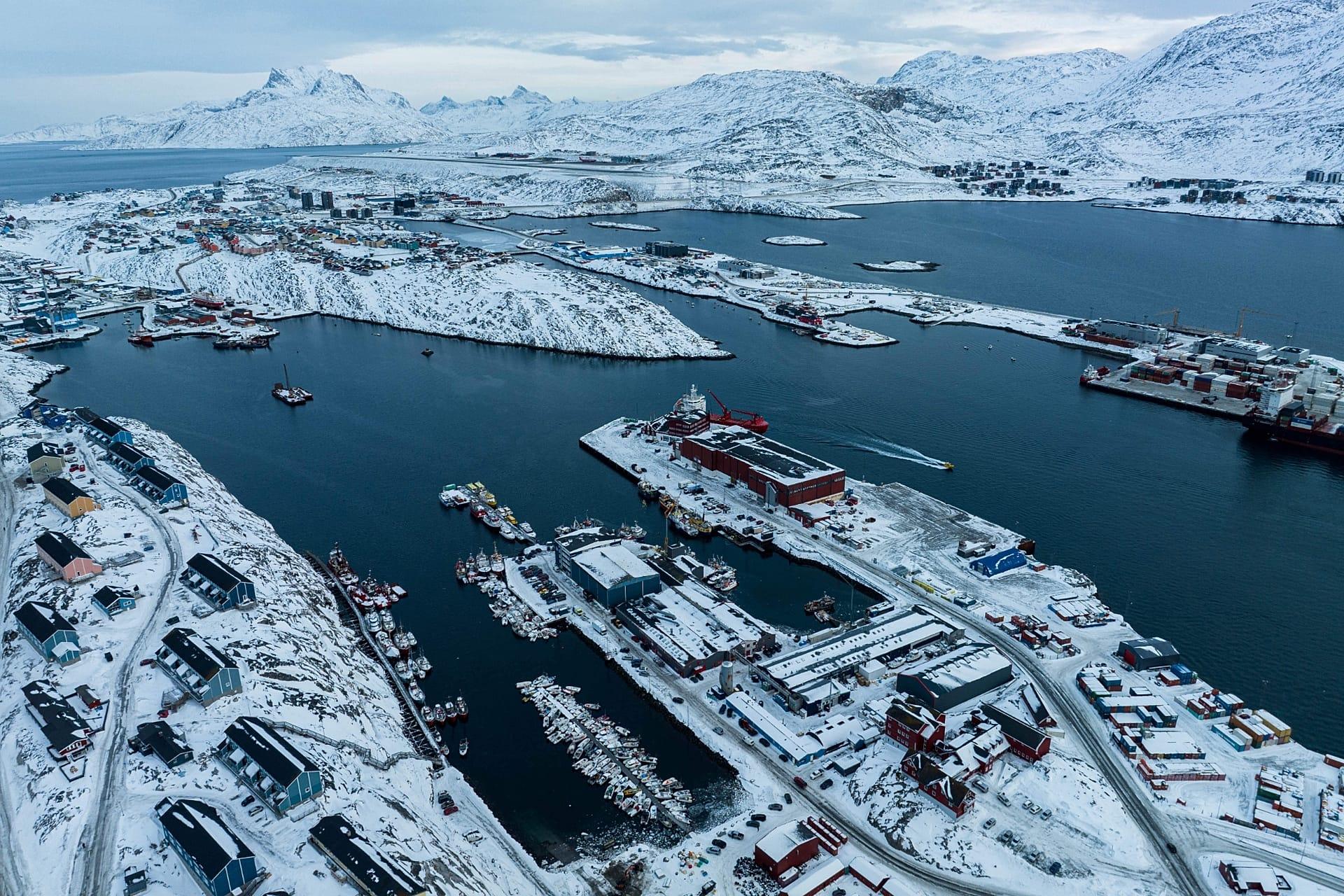
For years, the relationship between the European Union and Greenland largely reflected its institutional architecture: cooperation with an associated territory, focused primarily on education, fisheries and economic development. On September 7, 2026, in Nuuk, that relationship began to change in nature.
The European Union, the Greenlandic government and the Danish government signed a new joint declaration aimed at deepening their political and economic ties. At the same time, Brussels announced €200 million in new investment for 2026 and 2027. The amount remains modest compared with the needs of a vast, sparsely populated territory where almost everything is expensive to build. But the sectors targeted by the funding tell a much larger story than another European budget allocation.
Digital connectivity, sustainable mining, energy, tourism, education, fisheries and housing: the Union is beginning to finance the infrastructure that will determine Greenland’s ability to turn its geography and resources into greater economic autonomy. A strengthened satellite connectivity project involving Greenlandic operator Tusass and Eutelsat OneWeb adds a dimension that clearly extends beyond territorial development. In the Arctic, telecommunications have also become an infrastructure of sovereignty.
This evolution did not begin from scratch. Greenland is already receiving €225 million under the European Union’s 2021-2027 budget. Brussels and Nuuk also signed a partnership on raw materials in 2023, before the European Commission opened a permanent office in the Greenlandic capital in 2024. The political declaration adopted in 2015 had established the broader framework. The pieces, in other words, had gradually been put in place.
What changes now is how they fit together.
The Union is no longer treating education, natural resources, diplomatic presence and infrastructure as separate areas of cooperation. It is beginning to integrate them into a broader relationship in which economic development and European security are becoming increasingly difficult to separate. The Commission has also proposed raising the allocation for Greenland to €530 million for the 2028-2034 period. That amount remains subject to the adoption of the EU’s next financial framework, but its scale already reveals the shift underway.
In European policy, Greenland is gradually moving from the status of an associated territory receiving development cooperation to that of a partner increasingly relevant to economic security.
The first reason is raw materials.
For several years, the European Union has sought to reduce strategic dependencies across its supply chains, particularly those involving China. Greenland’s subsoil contains several resources that could contribute to that objective. But possessing minerals is not the same as possessing a mining industry. Between a resource identified on a geological map and a raw material actually available to a European factory lies an expensive chain of requirements: energy, roads, ports, equipment, financing, environmental permits, local acceptance and potentially processing capacity.
Greenland’s problem has therefore never been merely geological.
By combining investment in resources with investment in energy, housing and infrastructure, Brussels is beginning to address the economic conditions that will determine whether those resources can eventually enter European supply chains. The 2023 raw materials partnership expressed an intention. The policy announced in Nuuk now attempts to build some of the conditions required to make it real.
Connectivity follows a similar logic.
In a territory covering more than two million square kilometres but inhabited by fewer than 60,000 people, telecommunications are already an economic necessity. In the contemporary Arctic, they are also becoming strategic. Satellite networks affect the continuity of communications, maritime activity, the circulation of information and the resilience of infrastructure scattered across an immense territory.
The involvement of Tusass and Eutelsat OneWeb is therefore not simply a technical detail attached to a development programme. It shows that Europe is beginning to regard Greenlandic connectivity as part of its own strategic depth.
This transformation is taking place in a political environment that has become considerably less abstract.
Greenland sits at the intersection of American, European, Russian and Chinese interests. The United States has long maintained a military presence there that is essential to the defence of North America. Russia remains the Arctic’s dominant military power. China has shown sustained interest in the resources and infrastructure of the High North. Denmark, meanwhile, is strengthening its own Arctic capabilities as Greenland’s strategic value rises.
Recent American pressure surrounding the territory’s status has made this reality impossible to ignore. The European Union has reaffirmed its support for Greenlanders’ right to determine their own future. But sovereignty has a fairly persistent characteristic: it becomes more convincing when backed by infrastructure, capital and economic alternatives.
That is probably where the most important dimension of Europe’s new policy lies.
Brussels cannot replace Denmark within the constitutional architecture of the Kingdom. Nor can it rival American military power in the Arctic, and it does not appear to be trying. It can, however, influence a quieter variable: the number of options available to Nuuk.
An economy dependent on a very limited number of partners necessarily has less room to negotiate. A Greenland capable of drawing on Greenlandic, Danish, European, American and private capital can develop without having to organise every major economic decision around a single dominant relationship.
European investment could therefore produce a paradoxical result. By increasing its own presence in Greenland, the Union may also increase Greenland’s room for independent decision-making rather than simply replacing one dependency with another.
None of this means that €200 million will be enough to transform Greenland’s economy.
The precise composition of the new financing still needs to be established. Grants, loans, guarantees and the private investment Brussels hopes to mobilise must be distinguished from one another. Some projects may move quickly; others will probably remain programmes for years. The proposed €530 million allocation for 2028-2034, meanwhile, remains subject to European budget negotiations.
Mining will provide the clearest test of reality. Distance, climate, logistics, environmental procedures and local acceptance will continue to determine what can actually be developed. Greenland’s critical resources have already generated far more maps, strategies and declarations than producing mines.
That is precisely why the coming years will reveal how deep the change announced in Nuuk really is. An Arctic strategy is not ultimately measured by the number of memoranda it produces, but by the infrastructure it manages to build.
For the European Union, the issue also extends beyond Greenland. For several years, Brussels has been trying to convert its regulatory and financial power into geopolitical capacity. It rarely possesses the military instruments available to traditional great powers. It does, however, possess a market, capital, regulations, financial institutions and a distinctive ability to build interdependence gradually.
Greenland offers something close to a full-scale experiment in that method.
Europe is not trying to conquer the Arctic. It is trying to become sufficiently present there that decisions concerning the region can no longer be made entirely without it. Mines, energy, satellites and infrastructure then become different expressions of the same policy.
For a long time, Greenland stood at the periphery of the European project: institutionally close, geographically distant, important but rarely central.
The geography has not changed.
What Europe sees in that geography has.
Main Sources
European Commission, joint declaration between the European Union, Greenland and Denmark, September 7, 2026.
European Commission, announcements on the EU-Greenland partnership and new investments for 2026-2027, September 7, 2026.
European Commission, cooperation framework with Greenland for 2021-2027 and proposed financial allocation for 2028-2034.
European Commission, EU-Greenland strategic partnership on sustainable raw materials value chains, 2023.
Reuters, coverage of the European Union’s €200 million announcement and strengthened partnership with Greenland, September 7, 2026.
Associated Press, coverage of the new EU-Greenland cooperation, including infrastructure and connectivity initiatives, September 7, 2026.
Atlas Limits Research Desk
Atlas Limits’ editorial and analytical desk.