For a long time, sanctioning a commodity essentially meant shutting it out of the major markets where it could be sold, financed and converted into liquidity. Russian gold is now exposing the limits of that logic. Four years after being excluded from the main Western marketplaces, the metal has not disappeared from global trade. It has changed routes.
And that route increasingly leads to Hong Kong.
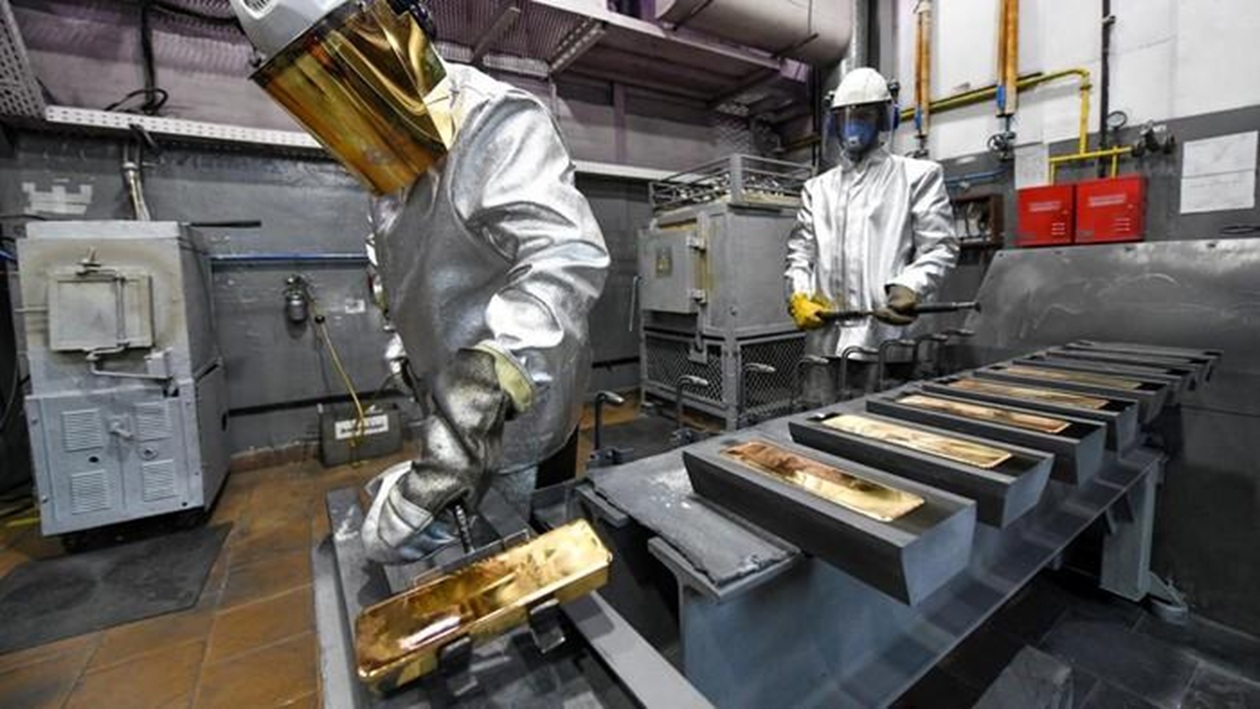
During the first seven months of 2026, Hong Kong imported nearly 100 tonnes of gold from Russia, according to Hong Kong customs data reported by the Financial Times. The volume was almost three times higher than during the same period in 2025 and already represented a record. Since 2022, Hong Kong entities are estimated to have purchased roughly $35 billion worth of Russian gold.
Taken in isolation, these figures could be interpreted as another stage in the commercial reorientation Moscow began after the invasion of Ukraine. But something deeper is happening at the same time. Hong Kong is not merely importing more gold. It is building the infrastructure required to become one of Asia's principal locations for storing, clearing, financing, delivering and, perhaps increasingly, pricing the metal.
On July 7, 2026, Hong Kong launched pilot operations for its new centralized gold clearing and settlement system. The coincidence between these two developments does not prove that the infrastructure was built for Russian flows. It does, however, reveal a much larger transformation in the global gold market: trade routes created under the pressure of sanctions are beginning to intersect with Asian financial infrastructure designed to last.
The gold that could no longer go to London
When G7 countries decided in 2022 to prohibit imports of newly mined Russian gold, they were targeting an important source of external revenue for Moscow. The United States banned imports of Russian gold in June 2022. The United Kingdom adopted a particularly broad regime: its restrictions cover gold originating in Russia and exported after July 21, 2022, as well as certain products processed in third countries when they incorporate Russian gold.
The decision was symbolic, but above all financial. London remains the historic center of the international bullion market, concentrating a substantial share of global trading, refining, storage and financing activities. Cutting Russian gold off from this ecosystem therefore meant removing access to one of the world's most efficient mechanisms for transforming a physical asset into international liquidity.
But a Western prohibition is not a global prohibition.
Russian producers gradually turned toward the United Arab Emirates, Turkey, China and Hong Kong. Gold could therefore continue to be exported, purchased and potentially redirected toward other markets, provided the actors involved were not subject to jurisdictions prohibiting those transactions.
Hong Kong has a decisive characteristic in this respect. The special administrative region has not adopted Western sanctions against Russian gold. At the same time, it remains one of the world's leading financial centers and an exceptional interface between mainland China and international markets.
For Russia, that combination is difficult to replace.
From trade diversion to a corridor
During the first years after 2022, the new routes taken by Russian gold could still be understood primarily as a geography of substitution. London disappeared; Dubai, Istanbul, Hong Kong and various Asian intermediaries took its place.
The 2026 data now suggest something different.
Nearly 100 tonnes in seven months is no longer a marginal flow searching opportunistically for an accommodating jurisdiction. Hong Kong is absorbing in a matter of months volumes that would previously have represented roughly a full year of trade. Reporting based on Hong Kong customs data also indicates that a significant portion of the gold entering the territory ultimately moves into mainland China.
The geography created by sanctions is beginning to acquire its own infrastructure.
The development is all the more significant because Beijing is simultaneously pursuing a policy aimed at strengthening Hong Kong's role in the international gold trade.
On July 7, the Hong Kong government began pilot operations of its new central clearing and settlement system. Administered by the Hong Kong Precious Metals Central Clearing Company, a wholly government-owned entity, the system is designed to record and settle bilateral and over-the-counter gold transactions.
A central registry tracks settlements, transfers and balances among participating banks. Bank of China (Hong Kong) was designated as a settlement institution and approved vault operator. The governing structure brings together Hong Kong authorities and regulators, the Shanghai Gold Exchange and eleven major Chinese and international banks.
The composition deserves attention. Institutions involved include HSBC, JPMorgan, Citi, UBS, Standard Chartered, Bank of China, ICBC and China Construction Bank. This is therefore not the birth of a parallel marketplace severed from the international financial system. On the contrary, Hong Kong is seeking to combine its privileged relationship with mainland China with its deep integration into global finance.
It is precisely this ambiguity that makes its position so powerful.
Hong Kong and Shanghai move closer
The new architecture also extends far beyond clearing.
Alongside the launch, Hong Kong opened the first phase of “Delivery Connect” with the Shanghai Gold Exchange. The mechanism allows participating institutions to transfer physical gold between Hong Kong infrastructure and facilities linked to the Shanghai market. HSBC, Bank of China (Hong Kong) and ICBC Asia participated in the initial transfer operations.
In other words, two pools of physical liquidity that had remained largely distinct are beginning to connect.
Hong Kong also intends to expand its storage capacity considerably. The Hong Kong Precious Metals Central Clearing Company has outlined an objective of more than 2,000 tonnes within three years. Authorities are simultaneously developing new gold-related financial products, seeking to strengthen local refining capacity and have introduced, with Bloomberg, a Hong Kong-specific gold price indicator known as HAU.
Each measure appears technical when viewed separately.
Together, they reveal a much broader ambition: to construct the entire value chain of a major international gold center.
Gold must be able to arrive in Hong Kong, be stored there, transferred, used to settle transactions, incorporated into financial products and moved between Hong Kong and Shanghai without systematically passing through the traditional Western infrastructure.
Russia is not the official reason for this architecture. But it could become one of its earliest major commercial beneficiaries.
Gold as geopolitical liquidity
For Moscow, gold matters for reasons extending beyond its simple export value.
A barrel of oil depends on a complex chain: ships, insurers, terminals, pipelines, refineries and payment systems. Each intermediary can become a pressure point for sanctions.
Gold has a different geometry.
Its value is extraordinarily concentrated. Hundreds of millions of dollars can be transported in a comparatively small physical volume. Once delivered to a jurisdiction willing to receive it, the metal can be sold, held as a reserve asset, pledged as collateral or converted into liquidity.
It is therefore particularly well suited to a world in which access to financial infrastructure has itself become an instrument of geopolitical power.
That also explains why Washington has focused on networks facilitating the commercialization of Russian gold.
In June 2024, the U.S. Treasury sanctioned a network it accused of laundering proceeds for an already designated Russian gold producer. According to Washington, several Hong Kong companies were used to channel payments from gold sales into the Russian financial system. VPower Finance Security Hong Kong Limited was notably involved in transporting Russian-origin gold.
Other U.S. measures subsequently targeted networks using companies in Hong Kong and the United Arab Emirates to convert proceeds from Russian gold into fiat currencies or cryptoassets.
But two phenomena must be carefully distinguished.
Transactions involving sanctioned persons or deliberately structured to conceal the origin of funds belong to the conventional realm of sanctions evasion.
The importation of Russian gold by a Hong Kong company that is not subject to those prohibitions is not, by itself, a clandestine operation.
That legal distinction is essential. The rise of Russian gold flows toward Hong Kong does not mean that 100 tonnes of gold have been “laundered” or illegally introduced into the international financial system. It demonstrates something more structural: when one group of countries closes its market, other markets can continue to operate and eventually develop institutions of their own.
The geographical limits of sanctions
Western sanctions rest on formidable financial power, but that power has a frontier.
Washington can prohibit U.S. persons from purchasing Russian gold. London can prevent Russian gold from entering the United Kingdom, including under certain circumstances when it has been processed in a third country. Financial institutions exposed to the United States or the United Kingdom must also carefully scrutinize their counterparties and transactions.
But those rules do not automatically turn every Asian transaction involving Russian gold into a prohibited operation.
That is precisely where the strategic problem lies.
Sanctions can close a jurisdiction. They can increase transaction costs. They can exclude individual intermediaries. They can make financing and transportation more difficult.
What they find much harder to prevent is the emergence of alternative economic infrastructure once transaction volumes become large enough to justify its creation.
The paradox then begins to appear.
The more Western sanctions make certain trade routes unusable, the greater the incentive for excluded actors to construct other routes. And the more important those new routes become, the more economically rational it becomes to provide them with permanent infrastructure.
An instrument designed to isolate can therefore, over time, help organize part of the economic space lying beyond its reach.
This is not the end of London
It would nevertheless be premature to declare that the global gold market has split into separate Western and Asian systems.
London retains unparalleled market depth, institutional networks and influence over international price formation. The standards used in Hong Kong themselves demonstrate the persistence of this interdependence. The new Hong Kong system accepts bullion meeting international standards, while its governing structure includes several of the world's largest Western banks.
Hong Kong is therefore not constructing a Chinese financial fortress hermetically sealed from the rest of the world.
The strategy is subtler.
The city is attempting to preserve the advantages of global finance while simultaneously deepening its integration with China's financial system.
That is precisely what could allow it to become a pivot.
The Shanghai Gold Exchange provides access to the Chinese market. Hong Kong provides convertibility, financial infrastructure, logistics and an international banking community. Russia now provides a substantial volume of metal seeking markets outside the Western system.
These three elements were not designed to operate together.
Yet they are beginning to form a system.
Two markets, or two centers of gravity?
The real consequence of the economic confrontation that began in 2022 may therefore not be the sudden emergence of two hermetically separated global gold markets.
The change could be more gradual.
For several decades, financial globalization concentrated many essential functions around a relatively small number of centers: London for gold, New York for the dollar and capital markets, and a handful of major European and Asian hubs for much of the rest.
Sanctions against Russia demonstrated the power of that concentration.
They also demonstrated its potential cost to countries that fear they could one day find themselves excluded from it.
China does not need to replace London tomorrow to alter this balance. It merely needs to develop, gradually, an ecosystem in which a growing number of transactions can take place without systematically passing through London.
The launch of a central clearing system, the closer connection with Shanghai, the expansion of storage capacity and the dramatic increase in Russian gold imports belong to separate processes.
But they are converging.
And when trade flows large enough to matter encounter financial infrastructure capable of absorbing them, detours sometimes become routes.
Hong Kong may be building one now.
Main sources
Financial Times, Hong Kong customs data on Russian gold imports, September 2026.
Hong Kong Financial Services and the Treasury Bureau, launch of the Hong Kong Gold Central Clearing and Settlement System, July 7, 2026.
Hong Kong Precious Metals Central Clearing Company, institutional documentation on the clearing system, governance and storage capacity.
RTHK, launch of the gold clearing system and connection with the Shanghai Gold Exchange, July 7, 2026.
U.S. Department of the Treasury, sanctions concerning networks involved in the commercialization and monetization of Russian gold, June 2024.
UK Government, Russia Sanctions Statutory Guidance and Notice to Importers 2953.
Atlas Limits Research Desk
Atlas Limits’ editorial and analytical desk.