The Transformation of Threats, the Limits of Military Power and the New Architecture of Security
Military power has long been measured by the ability of states to mobilise armies, control territory, destroy opposing forces and impose political settlements through the use of force. This conception of warfare, deeply embedded in the history of international relations, rested on the existence of relatively identifiable adversaries, organised chains of command and territorial or strategic objectives that could be achieved through military operations.
The expansion of violent extremist networks has introduced a fundamental difficulty into this framework. How can a state defeat an adversary whose military destruction does not guarantee its disappearance? How can an organisation be neutralised when it can lose its territory, leadership and a substantial proportion of its fighters while retaining ideological influence, financial networks, recruitment capabilities and clandestine structures capable of reconstituting themselves elsewhere?
These questions extend far beyond counterterrorism operations. They concern the definition of power itself, the relationship between domestic security and foreign policy, the effectiveness of public institutions and the capacity of societies to withstand forms of violence that exploit their own vulnerabilities.
Since the attacks of September 11, 2001, the interventions in Afghanistan and Iraq, the expansion of the Islamic State organisation in Syria and Iraq, and the proliferation of insurgent movements across Africa and Asia, states have accumulated considerable experience in confronting such threats. They have developed more sophisticated surveillance capabilities, strengthened intelligence services, adapted special operations forces and established international mechanisms for financial and judicial cooperation.
Yet the persistence of several armed organisations, despite prolonged military campaigns, demonstrates that technological superiority and the destruction of operational capabilities do not necessarily produce lasting security.
The difficulty lies partly in the nature of the adversary, but also in the political, economic and institutional conditions that allow it to develop.
A violent extremist network never exists in a strategic vacuum. It operates within a social environment, exploits pre-existing conflicts, seeks resources and adapts its organisation to the responses of public authorities. In some circumstances, it functions primarily as a clandestine structure. In others, it becomes an insurgent force capable of controlling territory, extracting revenue, administering populations and directly challenging the state.
Warfare against these networks cannot therefore be understood simply as a confrontation between modern armies and dispersed organisations.
It is a prolonged competition between different forms of authority, mobilisation, organisation and legitimacy.
This transformation requires a reassessment of military doctrines, intelligence practices, prevention policies and the very conditions under which victory can be achieved.
A History Older Than Contemporary Terrorism
Confrontations between states and non-state armed organisations are not an invention of the twenty-first century.
Empires, monarchies and modern states have repeatedly confronted rebellions, insurgencies, guerrilla movements and clandestine organisations. Colonial wars, revolutionary movements and conflicts of decolonisation demonstrated long ago that a militarily inferior force could prolong a confrontation by exploiting its knowledge of the terrain, social networks, mobility and the political constraints of its adversary.
The Algerian War, the Vietnam War and several twentieth-century insurgencies revealed the limitations of interpreting military power exclusively through conventional balances of force.
An army can win tactical engagements without achieving a durable political settlement. It can control transportation routes, destroy opposing units and occupy strategic positions while failing to secure the support of local populations or neutralise the mechanisms sustaining an insurgency.
The distinction between military victory and political success is therefore not new.
What has changed is the environment in which certain contemporary organisations operate.
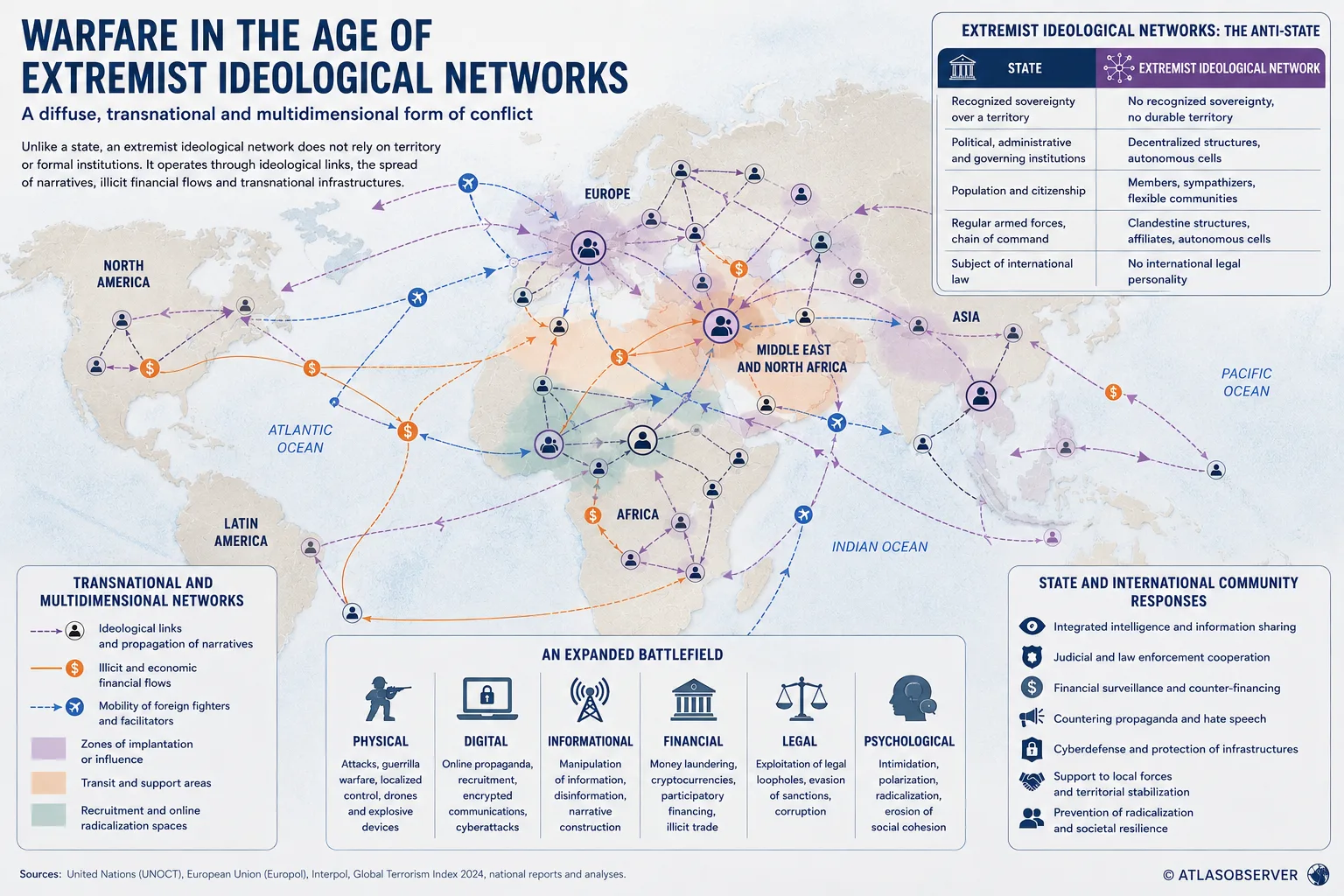
The globalisation of communications, international capital flows, migration, digital networks and the growing availability of commercial technologies have multiplied the possibilities for organising activities across borders.
An organisation can maintain ideological relationships with distant sympathisers, receive support from several territories and distribute messages on a scale once inaccessible to clandestine movements.
This transnational capacity does not mean that all extremist organisations operate under a unified global command.
Contemporary networks exhibit widely different organisational structures.
Some maintain relatively centralised hierarchies. Others operate through regional branches, local alliances, autonomous cells or individuals who identify with an ideology without maintaining direct operational relationships with its principal representatives.
The concept of a network therefore encompasses distinct organisational realities.
This diversity presents states with an initial strategic difficulty: there is no single model of adversary to which a universal doctrine of neutralisation can be applied.
From Clandestine Organisation to Territorial Authority
One of the most common analytical errors is to assume that violent extremist networks are, by definition, detached from territory.
This description applies to certain clandestine organisations, but it does not account for the full range of contemporary experiences.
Beginning in 2014, the Islamic State demonstrated that a terrorist organisation could attempt to transform itself into a territorial entity administering populations, exploiting resources and organising coercive institutions.
At its height, the organisation controlled extensive areas of Iraq and Syria. It exercised functions involving taxation, policing, imposed judicial authority and the management of certain economic activities.
This territorial expansion fundamentally altered the nature of the threat.
The organisation was no longer limited to preparing attacks or supporting clandestine cells. It sought to exercise political authority in competition with internationally recognised states.
Its territorial defeat, completed in March 2019 with the loss of Baghouz in Syria, represented a major military achievement.
It did not, however, eliminate every network, fighter, sympathiser or organisation affiliated with its ideology.
The experience revealed two complementary realities.
Territorial control can provide an armed organisation with substantial power, but it can also create vulnerabilities. Once an organisation administers cities, infrastructure and populations, it becomes more exposed to conventional military operations.
Conversely, territorial defeat may encourage a return to clandestine forms of organisation that are less visible and sometimes more difficult to identify.
An organisation's development does not necessarily follow a linear trajectory from clandestine activity to territorial conquest and eventual disappearance.
It may alternate between several forms of presence.
This capacity for transformation explains why the destruction of a territorial apparatus cannot be equated with the permanent elimination of a threat.
It also highlights the importance of distinguishing organisations according to their objectives and methods.
Some seek to exercise lasting territorial authority. Others prioritise attacks, political destabilisation or intimidation. Still others combine local insurgency, clandestine economic activity and transnational ideological affiliation.
Security strategies must be developed around these differences rather than a general category that obscures the mechanisms specific to each organisation.
The Paradox of Military Superiority
States generally possess considerable advantages over non-state armed organisations.
They can mobilise conventional forces, air power, satellite surveillance, intelligence systems and financial resources far beyond those available to most insurgent groups.
Yet this asymmetry does not guarantee political victory.
The reason lies partly in the difference between the objectives pursued.
A state generally seeks to restore security, control territory, protect populations and re-establish the normal functioning of its institutions.
An insurgent organisation may, under certain circumstances, regard its continued survival as a sufficient strategic achievement.
It does not necessarily need to defeat the state militarily. It may instead seek to demonstrate that the authorities remain incapable of providing lasting security.
The persistence of attacks, even on a limited scale, can sustain insecurity, disrupt economic activity and weaken public confidence in institutions.
This difference in objectives produces a fundamental asymmetry.
For the state, success often requires a visible and lasting improvement in conditions.
For the armed organisation, the failure of such improvement may be sufficient to preserve its influence.
Military campaigns can therefore substantially reduce an organisation's capabilities without eliminating the conditions that allow it to maintain clandestine activities.
The removal of leaders may disrupt an organisation. It may also result in the emergence of new commanders, organisational fragmentation or the redistribution of activities among different groups.
The destruction of a sanctuary may restrict training and coordination capabilities. It may also encourage displacement towards other territories.
These developments are neither automatic nor identical across conflicts.
They nevertheless demonstrate that tactical results must be evaluated according to their strategic consequences.
The question is not simply how many fighters have been neutralised or how many positions have been recaptured.
It is whether the organisation retains the capacity to recruit, finance its activities, intimidate populations and rebuild its networks.
This distinction requires a reassessment of how military effectiveness is measured.
A temporary decline in attacks can represent meaningful progress. It does not necessarily demonstrate that the causes of violence have disappeared.
Conversely, the continued existence of a residual threat does not mean that military operations have failed.
Strategic outcomes must be assessed over time, through changes in adversary capabilities, civilian security and institutional resilience.
Afghanistan and the Limits of Political Transformation Through Force
Afghanistan represents one of the most important experiences for understanding the relationship between military power, insurgency and institution-building.
The international intervention launched after the September 11 attacks initially pursued objectives associated with destroying Al-Qaeda's capabilities and overthrowing the Taliban government that had provided it with sanctuary.
It gradually evolved into a much broader effort involving stabilisation, the training of security forces and institutional reconstruction.
For two decades, the United States and its allies mobilised considerable military, financial and administrative resources.
Institutions were established, military and police forces were trained, and infrastructure was developed.
These achievements did not, however, produce a political and security system capable of enduring the withdrawal of international military support.
The Taliban's return to power in August 2021 exposed the limitations of institutional dependency and state-building under external protection.
The experience does not demonstrate that every military intervention is necessarily ineffective.
It shows that neutralising a threat, stabilising territory and transforming political institutions involve different mechanisms.
Military capabilities can be destroyed through force.
Institutional legitimacy, political cohesion and national ownership of security structures cannot be produced exclusively through military means.
Afghanistan also highlights the importance of sanctuaries, support networks, cross-border relationships and organisational continuity.
An insurgency can preserve its capacity for mobilisation over long periods when political and geographical conditions allow it to survive.
The duration of a campaign consequently becomes a strategic variable in its own right.
Intervening states must sustain prolonged financial and political commitments. Insurgent organisations may seek to exploit budgetary constraints, changes of government and shifts in public opinion.
Time does not systematically favour the weaker actor.
But when political objectives are poorly defined or local institutions remain dependent on external support, the prolongation of an intervention can itself become a source of strategic vulnerability.
The Sahel as a Laboratory of the Crisis of State Authority
The Sahel provides an essential setting for understanding the relationship between violent extremism, insurgency and failures of territorial governance.
In Mali, Burkina Faso and Niger, armed organisations affiliated with Al-Qaeda or the Islamic State have developed operational capabilities in territories where public authority remains contested or insufficiently established.
Their expansion cannot be explained exclusively by the spread of radical religious ideology.
It interacts with land disputes, tensions between communities, conflicts involving pastoral activities, predatory practices, weaknesses in judicial systems and inadequate public services.
In some areas, armed organisations exploit local grievances to recruit or establish influence.
They may impose levies, arbitrate certain disputes or compel populations to accept rules defined by the organisations themselves.
Such practices do not confer recognised political legitimacy.
They nevertheless demonstrate how insurgencies can develop by occupying functions that the state has abandoned, exercises inadequately or is unable to perform effectively.
The problem therefore extends beyond the neutralisation of armed groups.
It concerns the ability of public institutions to provide lasting security, justice and essential services.
The geographical characteristics of the Sahel further complicate this challenge.
Borders cross longstanding areas of circulation where commercial, agricultural and pastoral activities do not always correspond to contemporary administrative divisions.
Armed organisations can exploit this geographical continuity to relocate their activities and circumvent military pressure.
Political transformations in several Sahelian states have also altered relationships with international partners.
Changes of government, the reorganisation of security cooperation and the emergence of new regional frameworks have profoundly transformed the diplomatic environment.
These developments illustrate a fundamental reality: choices concerning military alliances can modify a state's operational capabilities, but they do not automatically resolve the institutional and social causes of insurgency.
The recapture of territory becomes a lasting success only when followed by the restoration of effective public authority.
A locality recovered militarily and subsequently left without administration, justice or permanent security may become vulnerable again.
Territorial security therefore requires continuity between military action and institutional governance.
The Sahel demonstrates that confronting violent extremism cannot be separated from the question of the state itself.
Global Networks, Fundamentally Local Conflicts
The transnational dimension of extremist organisations should not obscure the importance of local conditions.
Affiliation with an international organisation may provide a group with visibility, ideological identity and, in some cases, resources or support.
It does not necessarily mean that its operations are directly commanded from an external centre.
Relationships between central organisations and regional branches can take very different forms.
Some involve operational coordination. Others are primarily ideological or symbolic. Still others evolve according to political circumstances and local balances of power.
This diversity is particularly important in Africa.
Conflicts around the Lake Chad Basin, across the Sahel, in Somalia and in parts of Central Africa possess distinct histories, actors and economic structures.
Grouping them under a single category of international threat may facilitate certain comparisons.
But such an approach can also conceal the differences that determine the effectiveness of public responses.
An organisation exploiting land disputes and communal tensions cannot be confronted exclusively through the same methods as a clandestine cell preparing attacks in an urban environment.
An insurgency controlling commercial routes possesses different capabilities and vulnerabilities from a predominantly digital network.
Strategies must therefore operate at two levels.
At the international level, states need to understand financial, ideological and organisational connections.
At the local level, they must identify political conflicts, recruitment mechanisms and relationships between populations and authorities.
The difficulty lies precisely in connecting these dimensions.
An exclusively global approach may neglect territorial causes.
An exclusively local approach may underestimate transnational resources and support.
Effectiveness depends on the capacity to analyse both simultaneously.
Intelligence at the Centre of Contemporary Confrontation
Against dispersed, mobile and sometimes clandestine organisations, intelligence becomes an essential component of security.
The primary challenge is to identify actors, understand their relationships, distinguish intentions from actual capabilities and anticipate organisational developments.
States therefore mobilise different categories of intelligence.
Human sources can provide insight into social relationships, motivations and informal structures.
Technical capabilities may help identify certain communications and activities.
Satellite imagery provides information about movements and installations.
Financial intelligence can reveal suspicious flows and clarify economic mechanisms.
Open-source analysis contributes additional information concerning public narratives, claims of responsibility and observable developments.
None of these methods is sufficient in isolation.
Technical information may reveal a connection without explaining its significance.
A human source may provide valuable context while remaining vulnerable to error or manipulation.
A financial transaction may appear suspicious without constituting proof of criminal activity.
The quality of intelligence therefore depends on corroborating sources, establishing context and distinguishing verified facts from hypotheses.
Artificial intelligence is progressively transforming certain dimensions of this work.
Graph analysis, automated classification and large-scale data processing can help identify relationships or anomalies that would be difficult to detect manually.
These tools may accelerate processing and support the prioritisation of information.
They do not, however, eliminate uncertainty or the risk of error.
Available data may be incomplete, biased or ambiguous.
A statistical correlation does not necessarily establish an operational relationship.
An individual's indirect association with a network does not demonstrate participation in violent activities.
This distinction is essential in a field where errors can have considerable human, judicial and political consequences.
The use of artificial intelligence must therefore remain subject to requirements of reliability, proportionality and human oversight.
Technological sophistication does not replace analytical rigour.
Intelligence is not simply a question of how much information can be collected.
It is fundamentally a question of judgement.
Digital Networks and the Transformation of Ideological Mobilisation
Digital technologies have profoundly changed the conditions under which extremist ideologies circulate.
Communication platforms allow organisations and individuals to distribute narratives, reach audiences and maintain communities that do not depend on geographical proximity.
The circulation of content can accelerate the visibility of events, amplify emotions and contribute to the spread of narratives that justify violence.
This transformation does not mean that exposure to radical content automatically leads to violent engagement.
Radicalisation processes are complex.
They may involve personal trajectories, social relationships, experiences of marginalisation, identity conflicts, ideological influences and political circumstances.
It would therefore be misleading to reduce violent extremism to an exclusively digital phenomenon.
Online environments may facilitate certain interactions, but they do not provide a sufficient explanation for the decision to engage in violence.
Organisations may also exploit the rapid circulation of information to produce psychological effects disproportionate to their material capabilities.
An attack may directly target victims and infrastructure while seeking a much broader impact on collective perceptions.
Fear, uncertainty and polarisation can become strategic objectives.
Public communication consequently becomes a dimension of security.
Authorities must inform the public without inadvertently amplifying violent organisations' propaganda.
They must respond to manipulation campaigns without undermining freedom of expression.
They must also distinguish radical opinions, which are not necessarily unlawful, from incitement to violence and criminal activities.
This distinction protects both the effectiveness of public policy and the fundamental principles of democratic societies.
Responses to extremist networks cannot rest on treating political dissent, religious disagreement or minority opinions as security threats.
Such confusion would weaken institutional legitimacy and could create conditions conducive to further radicalisation.
Clandestine Financing and the Economics of Violence
Violent extremist organisations require resources to sustain their activities.
These resources may originate from very different mechanisms depending on the territory and period.
Some organisations have benefited from donations and support networks.
Others have developed systems of forced taxation, extortion, smuggling or natural-resource exploitation.
Territorial control can enable an organisation to impose taxes, regulate markets or capture a share of commercial exchanges.
War economies consequently become central components of organisational capacity.
This dimension matters because it changes the incentives for continuing hostilities.
When an armed group derives revenue from controlling territory, a commercial route or an economic activity, war can become a source of material power for some of its leaders.
Violence is no longer simply a means of achieving a political objective.
It also helps sustain an economic system.
State responses must therefore involve financial authorities, judicial services, customs administrations and international cooperation mechanisms.
The Financial Action Task Force plays an important role in establishing standards designed to counter terrorist financing.
Financial monitoring systems can help identify networks and restrict certain funding capabilities.
They nevertheless encounter particular difficulties in largely informal economies or territories where public institutions exercise limited control.
Informal transfer systems, cash transactions and legitimate commercial activities may coexist with illicit financing mechanisms.
Digital assets introduce additional possibilities for transferring value, without necessarily constituting the principal source of financing for armed organisations.
A rigorous assessment must avoid exaggerating their role at the expense of local economies, extortion and territorial control.
Financial countermeasures must also protect legitimate activity.
Excessively broad restrictions can obstruct family remittances, humanitarian assistance and commercial exchanges essential to civilian populations.
Effectiveness therefore does not consist of indiscriminately interrupting economic flows.
It depends on identifying illicit financing mechanisms while preserving activities necessary to social and economic life.
The Increasingly Uncertain Boundary Between Domestic and External Security
Transnational networks challenge a longstanding institutional distinction.
National defence was traditionally associated with external threats, while domestic security was primarily the responsibility of police forces, judicial authorities and civilian administrations.
Organisations capable of operating across several territories complicate this separation.
An activity prepared in one country may draw on support located in another and produce consequences in a third.
Responses consequently require cooperation between intelligence services, judicial authorities, financial administrations, security forces and international partners.
This cooperation raises several difficulties.
States do not operate under identical legal frameworks.
They do not always define threats according to the same criteria.
They may maintain conflicting diplomatic relationships or hesitate to share sensitive information.
Cooperation mechanisms must therefore reconcile operational effectiveness, national sovereignty and the protection of rights.
International coordination becomes particularly important when networks exploit differences between legal systems.
Yet excessive centralisation of security capabilities can also create risks.
The concentration of personal information, the expansion of surveillance powers and the use of advanced analytical technologies require strong institutional safeguards.
Security does not depend exclusively on a state's ability to collect information.
It also depends on its ability to exercise that power within a clearly defined, accountable and proportionate legal framework.
Democracies and the Risk of Their Own Transformation
Confronting violent extremist networks presents democracies with a particular challenge.
They must protect populations against organisations capable of indiscriminate violence while preserving the freedoms and guarantees on which their legitimacy rests.
This tension is not new.
Periods of heightened security threats have repeatedly encouraged states to expand surveillance, detention and intervention powers.
Such measures may respond to genuine needs.
They may also produce lasting consequences when exceptional arrangements become permanent or oversight mechanisms prove insufficient.
The risk concerns more than individual liberties.
It also affects strategic effectiveness.
Arbitrary practices, discrimination and disproportionate infringements of rights can undermine confidence in institutions.
They may reinforce grievances exploited by violent organisations and complicate cooperation with local populations.
The legitimacy of public action therefore becomes a security resource.
Respect for the rule of law is not external to strategy.
It contributes to its durability.
Parliamentary, judicial and administrative oversight mechanisms consequently play an essential role.
They help assess the necessity of measures, evaluate their proportionality and limit the risk of abuse.
Prevention also requires an approach broader than surveillance.
Educational policies, social cohesion, access to justice and trust in institutions can contribute to reducing certain vulnerabilities.
It would nevertheless be excessive to assume that economic or social difficulties automatically produce violent extremism.
Individual and collective trajectories remain diverse.
Prevention must therefore be based on a precise understanding of specific contexts rather than generalisations about entire communities.
The challenge is to ensure that confronting a genuine threat does not permanently transform the political principles that security policies are intended to protect.
The Limits of an Exclusively Security-Based Model
The experience of recent decades demonstrates that a strategy relying exclusively on force encounters structural limitations.
Military operations can destroy facilities, reduce an organisation's capabilities, protect populations and prevent certain attacks.
They may be indispensable when armed groups control territory or directly threaten civilians.
But they cannot, by themselves, rebuild political institutions, resolve social disputes or eliminate the economic mechanisms sustaining an insurgency.
The distinction between neutralisation and stabilisation becomes fundamental.
Neutralisation seeks to reduce an organisation's operational capabilities.
Stabilisation aims to create conditions under which that organisation can no longer easily rebuild its influence.
These objectives are connected, but they require different instruments.
The first depends heavily on security forces, intelligence and judicial action.
The second also requires functioning public institutions, accessible justice, mechanisms for resolving disputes and economic opportunities.
The difficulty is particularly significant in territories where the state lacks a continuous administrative presence.
A military operation may produce an immediate result without permanently changing the relationship between populations and public authorities.
When institutions do not follow, an armed organisation may regain influence.
Continuity of public action therefore becomes a condition of security.
This continuity also requires distinguishing between the different actors involved in a conflict.
Not all fighters share the same motivations.
Some may be committed through ideological conviction. Others may act under coercion, seek protection or participate in local economic networks.
This diversity does not eliminate their potential responsibility.
It means that disengagement, reintegration and prosecution policies must be adapted to individual circumstances and legal obligations.
A uniform response may prove less effective than an approach capable of distinguishing leaders, perpetrators of serious crimes, logistical supporters and individuals who can permanently disengage from violence.
International Cooperation and Its Contradictions
Confronting violent extremist networks has encouraged the development of international cooperation mechanisms.
Intelligence exchanges, financial monitoring, judicial procedures and border-security arrangements have been strengthened.
The United Nations has established several frameworks intended to support counterterrorism and prevention.
Regional organisations have also developed their own instruments.
Yet this cooperation remains affected by rivalries between states.
Governments do not always share the same strategic priorities.
They may disagree over the classification of certain organisations, the methods to be employed or the political conditions governing intervention.
External military operations may be regarded by some actors as necessary for security and by others as infringements of sovereignty.
Competition between major powers further complicates coordination.
States may support different partners within the same region, pursue competing strategies or use security issues as instruments of diplomatic influence.
These disagreements can limit the effectiveness of collective arrangements.
International cooperation must therefore be assessed through its practical results rather than the proliferation of agreements alone.
An information-sharing mechanism does not guarantee that the information exchanged will be relevant or effectively used.
Military assistance does not guarantee the construction of durable local institutions.
A multinational operation does not guarantee the existence of common political objectives.
Effectiveness requires coherence between the resources committed, the objectives pursued and the capabilities of the institutions expected to assume responsibility afterwards.
Technology Cannot Replace Strategy
Technological progress provides states with considerable capabilities for identifying, monitoring and neutralising certain threats.
Reconnaissance drones, surveillance systems, digital analytical capabilities and artificial intelligence tools can improve situational awareness.
They may also reduce some risks to deployed personnel and accelerate the circulation of information.
But their sophistication does not eliminate fundamental political problems.
A surveillance system can identify suspicious activity without explaining the motivations behind it.
A precision operation can neutralise a leader without preventing replacement.
An algorithmic tool can detect a statistical relationship without establishing individual responsibility.
Technology expands the capabilities available.
It does not define strategic objectives.
Nor does it determine the political conditions necessary for lasting peace.
This distinction becomes increasingly important as commercial technologies become accessible to non-state actors.
Communication equipment, civilian drones and certain digital tools can be adapted for violent purposes.
States often retain considerable technological advantages, but these cannot be regarded as permanently secure.
Competition increasingly depends on the capacity to adapt.
Armed organisations may change their practices in response to surveillance capabilities.
States must adjust their methods accordingly.
This dynamic does not imply that both sides possess equivalent capabilities.
It demonstrates that material superiority must be accompanied by institutional learning.
The most effective organisations are not necessarily those that accumulate the greatest number of technological tools.
They are those capable of integrating information, evaluating results, correcting errors and adapting strategies to conditions on the ground.
Redefining Victory in a Prolonged Confrontation
The concept of victory is perhaps one of the most profound difficulties in warfare against violent extremist networks.
In conventional warfare, the defeat of an army, the loss of territory or the surrender of a government can provide relatively clear indicators that hostilities have ended.
Against dispersed networks, these criteria become insufficient.
An organisation may be militarily weakened without disappearing.
It may lose its central leadership while retaining local branches.
It may abandon territory and continue clandestine activities.
It may also cease to represent a major strategic threat while preserving a residual capacity for violence.
The realistic objective cannot therefore always be defined as the absolute elimination of every possibility of hostile action.
It may instead consist of sustainably reducing an organisation's capacity to inflict harm, preventing territorial control, protecting populations and restoring institutions capable of managing residual risks.
This understanding requires indicators broader than immediate military results.
Changes in the frequency and intensity of attacks remain important.
But they must be assessed alongside the authorities' capacity to provide everyday security, the functioning of public administration, access to justice, public confidence and the weakening of recruitment mechanisms.
The decisive question becomes one of durability.
An improvement achieved through a massive external military presence may prove fragile if local institutions cannot sustain it.
Conversely, a gradual reduction in violence accompanied by institutional strengthening can represent a significant strategic achievement even when some risks persist.
Victory should therefore not be reduced to a military event.
It must be assessed as a lasting transformation of the conditions that allow organised violence to threaten political order.
Conclusion — Power Confronting Its Own Limits
Warfare against violent extremist networks reveals one of the central contradictions of contemporary security.
States possess unprecedented military, technological and financial capabilities. They can monitor extensive territories, process immense quantities of data, coordinate complex operations and mobilise considerable resources.
Yet these capabilities do not guarantee the disappearance of organisations whose strength lies in exploiting political fractures, institutional weaknesses, clandestine economies and the opportunities created by transnational networks.
This difficulty does not indicate the disappearance of state power.
It demonstrates that military power and the ability to establish a stable political order are not equivalent.
The former can impose constraints, neutralise threats and alter balances of force.
The latter also depends on institutional legitimacy, continuity, the protection of populations and the capacity to resolve conflicts without systematically relying on coercion.
The experiences of Afghanistan, Iraq, Syria and the Sahel have demonstrated this fundamental distinction in very different circumstances.
They show that destroying an organisation's military capabilities does not necessarily eliminate the networks, economic interests or political conditions that enabled its development.
They also reveal that exclusively security-based responses may become insufficient when they are not accompanied by durable institutional reconstruction.
The objective is not to create an artificial opposition between military and political action.
It is to understand their complementarity and respective limitations.
Armed forces can create the conditions necessary to restore security.
Intelligence can identify threats and help prevent attacks.
Financial and judicial cooperation can restrict financing and coordination capabilities.
But only the consolidation of legitimate and functioning institutions can permanently transform the conditions in which violent organisations seek to establish themselves.
This requirement also applies to democracies.
Their ability to confront extremist networks depends not only on technical capabilities but also on preserving the rule of law, maintaining oversight of security powers and sustaining public trust.
A policy that permanently weakens these foundations may achieve immediate results while undermining the conditions necessary for its long-term effectiveness.
Warfare against violent extremist networks is therefore not an entirely new form of confrontation. It extends longstanding problems of counterinsurgency, legitimacy and territorial control into an environment shaped by global communications, the movement of resources and technological transformation.
It requires distinguishing the destruction of a force from the disappearance of a threat, territorial control from effective governance, and military superiority from strategic success.
The power of a state is not measured solely by its ability to neutralise adversaries. It is also measured by its capacity to rebuild the political and institutional conditions that make their return less likely.
In confronting violent extremist networks, the decisive question is therefore not simply how to win a war. It is how to prevent the conditions for renewed warfare from re-emerging after military victory.
Atlas Limits Research Desk
Atlas Limits’ editorial and analytical desk.