Google began with an ambition that now appears almost modest in light of what it became: organizing the information available on the Internet. A quarter of a century later, Alphabet no longer merely organizes that information. The group helps design the processors that compute it, owns the infrastructure that carries it, trains the models that interpret it, controls several of the software environments through which it is accessed, and operates some of the largest systems through which it is monetized.
Search remains at the center of the structure. But it no longer describes it adequately.
Alphabet is simultaneously an advertising group, a global cloud provider, a developer of artificial intelligence models, a designer of specialized processors, an operating-system company, an enterprise software provider, a video-platform operator, a device manufacturer, a mapping company, a cybersecurity player and, through Waymo, one of the world’s most advanced autonomous-mobility companies.
This accumulation is not merely diversification.
It is an architecture.
Alphabet’s defining feature is not that it participates in many markets, but that it occupies several successive layers of the same digital value chain. TPUs compute. Data centers execute. Google Cloud distributes capacity. Gemini interprets. Android, Chrome, Search, Gmail, Maps, YouTube and Workspace provide access to users. Google Ads and subscription businesses convert that usage into revenue.
As artificial intelligence reshapes the digital economy, this integration is becoming one of Alphabet’s most important strategic advantages. It is also becoming its central contradiction: the more coherent the ecosystem becomes, the harder it is to distinguish industrial efficiency from concentrated power.
From Google to Alphabet
The creation of Alphabet in 2015 initially looked like an elegant corporate reorganization. Google became a subsidiary of a holding company grouping the search engine and core activities on one side and a number of more experimental projects on the other.
In retrospect, the shift revealed something deeper.
It implicitly acknowledged that Google was no longer a product. It had become a machine for producing new infrastructures.
Search first provided an extraordinary resource: attention. Advertising converted that attention into cash flow. Those cash flows then allowed Google to finance products often distributed for free, acquire YouTube and Android, build Chrome, develop Maps, launch Google Cloud, fund fundamental research in artificial intelligence and pursue, sometimes for years, businesses whose immediate profitability remained uncertain.
Alphabet’s economic history can therefore be understood as a conversion mechanism.
Search produced cash.
Cash financed distribution.
Distribution generated data and usage.
Usage strengthened platforms.
Those platforms now finance the infrastructure required for artificial intelligence.
And artificial intelligence is beginning to reinforce almost every other layer.
The system increasingly feeds itself.
A $4.1 Trillion Company
This architecture has eventually produced a valuation more consistent with a global infrastructure company than with a search engine.
In early September 2026, Alphabet’s market capitalization stood at roughly $4.1 trillion, placing it among the three most valuable listed companies in the world. Its market value had still been below $2.3 trillion at the end of 2024 and around $3.8 trillion at the end of 2025. (companiesmarketcap.com)
This rise no longer depends solely on the assumption that Google will preserve its historic dominance in search.
Alphabet’s second-quarter 2026 results show a company in which several engines are accelerating at once. Revenue reached $119.8 billion for the quarter, up 24% year on year. Operating income reached $40.8 billion, with an operating margin of roughly 34%. For the first six months of 2026, revenue had already reached $229.7 billion. (sec.gov)
Google Services remains enormous, generating $94.5 billion in second-quarter revenue. Search and related activities grew 17%, YouTube advertising revenue 13%, and subscriptions, platforms and devices 15%. (sec.gov)
But the most revealing figure lies elsewhere.
Google Cloud increased revenue by 82%, reaching $24.8 billion in a single quarter. Its backlog reached approximately $514 billion. (blog.google)
Alphabet therefore remains financed by a gigantic advertising machine, but it is building a second pillar of an entirely different nature: a technological infrastructure business aimed at enterprises.
This may be one of the most important transformations in the company’s history.
Search, the Original Financial Engine
Google Search nevertheless retains a unique status.
Few products have ever occupied such a central position in the information economy.
For years, searching the Internet and using Google became nearly synonymous for a large part of the connected population. In the United States, the Department of Justice estimated that Google accounted for roughly 90% of general search queries over many years. That position eventually led a federal court to rule that Google had unlawfully maintained its monopoly in search and search advertising. (justice.gov)
But Search’s real advantage does not lie only in the number of queries.
It lies in their nature.
A search expresses intent.
“Restaurant Casablanca,” “car insurance,” “laptop,” “Paris New York flight,” “flu symptoms” or “best mortgage” contain information of extraordinary value to an advertiser. Google does not merely own an audience. It intercepts the user at the moment that user explicitly formulates a need.
This mechanism explains why Search has remained so difficult to challenge economically.
Each query improves the system. Improvement attracts more users. Those users generate more queries. Their presence attracts more advertisers. Advertising revenue finances better infrastructure and distribution agreements. The whole system strengthens the product again.
For a long time, the main conceivable threat was the emergence of a better search engine.
Artificial intelligence changed the question.
The Risk That Could Have Destroyed Google
The rise of conversational interfaces created, from 2022 onward, a scenario that had previously been difficult to imagine: users might stop looking for pages and instead ask directly for answers.
For Google, the threat was existential.
The historic Search model relies on an interface that moves the user between a query, results, links, advertisers and the wider Web. A system capable of synthesizing the answer directly could reduce clicks, alter the space available for advertising and make the traditional results page less central.
Alphabet nevertheless chose an unusual response: accelerate the very technology capable of cannibalizing its most profitable product.
AI Overviews was integrated into Search. AI Mode transformed the search experience even further. Gemini became a standalone product.
In June 2026, Alphabet said that AI Overviews had more than 2.5 billion monthly users, AI Mode more than one billion and Gemini more than 900 million. By July, Gemini had reached roughly 950 million monthly active users. At the same time, Search revenue continued to grow strongly. (blog.google)
The paradox is essential.
Artificial intelligence has not yet destroyed Search.
It is becoming Search.
The Ability to Cannibalize Itself
This situation reveals one of Alphabet’s most difficult advantages to replicate.
A company built around a single product can be destroyed when technology shifts value toward another layer.
Alphabet can sometimes follow that value.
If a user abandons a traditional query for AI Mode, Alphabet remains present.
If the user turns directly to Gemini, Alphabet remains present.
If an enterprise uses Gemini through Google Cloud, Alphabet remains present.
If Gemini is integrated into Gmail or Workspace, Alphabet remains present.
If AI becomes a native function of the smartphone, Android still gives Google a distribution point.
If computing demand increases, Google Cloud and its infrastructure can benefit from the shift.
This is not immunity to disruption. No company possesses that.
But Alphabet has an unusual ability to move its economic model as the interface itself moves.
Cannibalization becomes less dangerous when one also owns part of the product doing the cannibalizing.
The Full Stack
This is where the comparison between Alphabet and companies specializing purely in AI models becomes insufficient.
Gemini is only one layer of a much larger system.
Beneath the models lies computing infrastructure.
Google has been developing its own Tensor Processing Units, or TPUs, for a decade. These processors were designed specifically for machine-learning workloads. Recent generations are used both to train and run Gemini at scale.
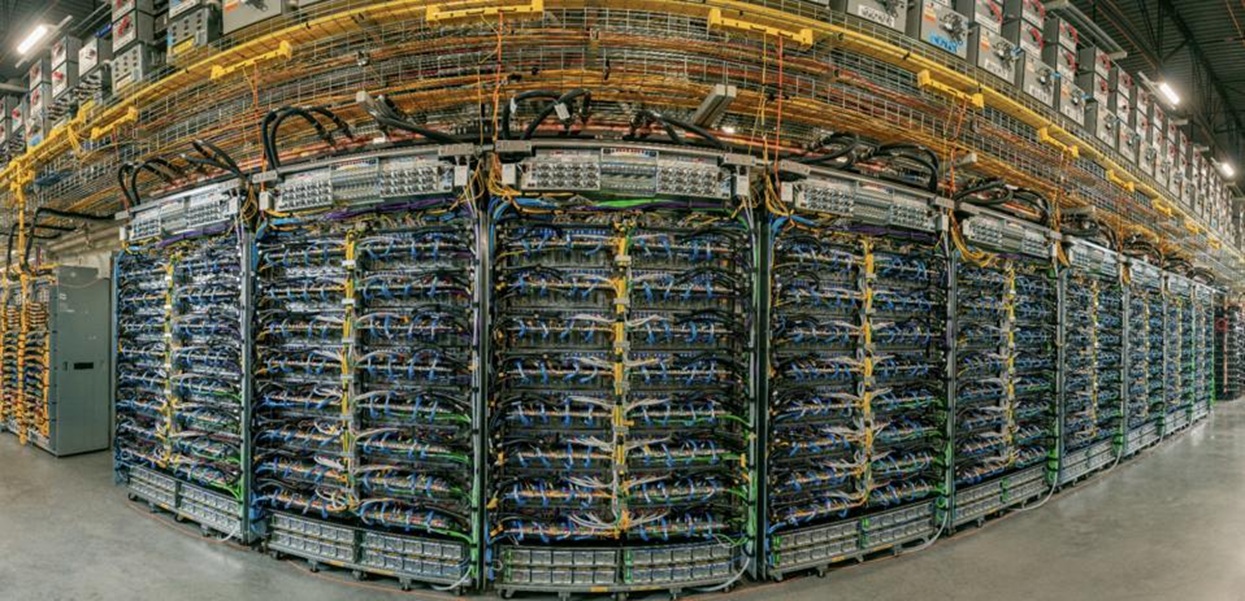
Alphabet says it operates around 10 million kilometers of terrestrial and subsea fiber, more than thirty data centers and more than forty Google Cloud regions. Its infrastructure offers its own TPUs, Axion processors and Nvidia GPUs. (blog.google)
In the second quarter of 2026, Google also highlighted its Virgo network, designed to connect up to one million AI accelerators across multiple sites, along with its eighth-generation TPUs. (blog.google)
Scale changes the nature of the company.
Google no longer merely buys computing capacity to operate its software.
It designs part of the computing stack.
It builds the facilities in which that computing takes place.
It develops the networks connecting those facilities.
It trains the models.
It creates tools for developers.
It operates the cloud through which those tools are sold to enterprises.
Then it distributes the resulting products through services used by billions of people.
It is difficult to imagine a more complete illustration of digital vertical integration.
One Model, Many Revenue Streams
This architecture produces another advantage: a single technological breakthrough can serve several markets.
An improvement in Gemini can make Search more relevant.
It can improve advertising performance by understanding user intent more precisely.
It can improve Gmail or Docs.
It can be monetized through Gemini Advanced or Google One.
It can become an API consumed by developers.
It can strengthen services sold through Google Cloud.
It can reinforce Android.
It can serve YouTube.
It can improve cybersecurity products.
It can even transfer into activities that no longer look much like the Internet, from Waymo to drug discovery.
Research and development is therefore not trapped inside a single product line.
Alphabet can amortize a fundamental technological advance across many surfaces.
This helps explain why Google’s true competitor in artificial intelligence is never simply OpenAI, Anthropic or xAI. Depending on the layer, the competitors become Nvidia, Amazon, Microsoft, Meta, Apple, TikTok, Netflix, Salesforce, Uber or several of them simultaneously.
Alphabet is not fighting one war.
It is fighting several on the same technological terrain.
Google Cloud, the Second Engine
The rise of Google Cloud may be the most important economic change beneath the AI narrative.
For years, Google dominated the consumer Internet while remaining behind Amazon and Microsoft in enterprise cloud computing.
That hierarchy still exists in absolute terms, but the gap is evolving rapidly.
In the second quarter of 2026, AWS generated approximately $42.2 billion in quarterly revenue. Microsoft recently disclosed roughly $29.4 billion for Azure in its latest quarter. Google Cloud generated $24.8 billion. (sec.gov)
The three figures do not cover perfectly identical accounting scopes, but the order of magnitude is revealing.
Google Cloud is no longer a peripheral business.
More importantly, AI gives it a differentiation opportunity that traditional cloud infrastructure offered less clearly.
Google can provide TPUs, Nvidia GPUs, its own Gemini models, Vertex AI, Workspace, data tools, security software and now different agent platforms within a single architecture.
Nearly 90% of Fortune 100 companies were using Gemini Enterprise in the second quarter, according to Alphabet. The company also said that nearly 500 Cloud customers had each consumed more than one trillion tokens over the previous twelve months. (blog.google)
Cloud is therefore becoming the place where Google’s historic investments in artificial intelligence can be sold directly to other companies.
Search monetizes consumer intent.
Cloud monetizes enterprise demand for computing and intelligence.
The combination is formidable.
YouTube: The Other Empire of Attention
Alphabet’s ecosystem is not reducible to Google either.
YouTube alone would probably rank among the world’s major technology companies if it were independent.
In 2025, its combined annual revenue from advertising and subscriptions exceeded $60 billion. (blog.google)
But YouTube’s strategic value extends beyond direct revenue.
The platform gives Alphabet a major position in video, a global creator network, an enormous content library, a recommendation engine, an advertising business complementary to Search, subscription revenues, YouTube Music and a growing presence on television screens.
Search captures what people want to know.
YouTube captures part of what they want to watch.
Maps captures where they want to go.
Android sits inside the mobile interfaces through which many of those intentions are expressed.
Chrome acts as a gateway to the Web.
Gmail and Workspace cover communication and productivity.
The economic value lies not only in the power of each product.
It lies in the way they reinforce one another.
Android: The Power of Distribution
Android may be the clearest example of an asset whose strategic value exceeds its directly visible revenue.
Google does not need to sell Android in the way Apple sells the iPhone.
Android allows the Google ecosystem to exist natively across an enormous share of the global smartphone base.
Search, Chrome, Maps, Gmail, YouTube, Google Play and now Gemini can all be deeply integrated into that environment.
Owning technology is useful.
Owning its distribution is more useful.
This logic helps explain why Microsoft, after missing the mobile revolution, has committed so many resources to ensuring that it does not miss the AI revolution. It also explains why Apple retains tremendous power even when it relies on external partners for certain fundamental technologies: the iPhone gives Apple direct access to the user.
Alphabet owns something in between.
It does not fully control the hardware, but it controls a large part of the software environment inhabiting that hardware.
That distribution is a formidable competitive defense.
It is also one of the reasons antitrust authorities watch the company so closely.
When the Ecosystem Becomes an Antitrust Problem
Integration contains a fundamental ambiguity.
From an industrial perspective, connecting Search, Chrome, Android, Gemini, Cloud and the underlying infrastructure can produce better services, greater efficiency and lower costs.
From a competition perspective, the same integration can make entry extraordinarily difficult for rivals.
The U.S. government has already secured a landmark ruling against Google in search. The final judgment prohibits certain forms of exclusivity involving Search, Chrome, Google Assistant and Gemini and requires Google to provide some competitors with access to certain data derived from its search index and user interaction. (justice.gov)
In digital advertising, Google has also been found liable for anticompetitive conduct, although a federal judge declined on September 2, 2026, to force a divestiture of AdX and instead favored behavioral remedies. (reuters.com)
In Europe, the new AI-driven search interface is already opening another front. The European Commission is examining, among other issues, the consequences of AI Overviews for publishers and the conditions under which they can refuse the use of their content for such features without disappearing from traditional search results. (reuters.com)
The contradiction is almost perfect.
The more effectively Alphabet integrates its technologies, the stronger the economic reasons to use them together.
And the harder they become to separate, the more regulators may conclude that this coherence suppresses competition.
The Web Against Google
Another limit is emerging.
For two decades, Google and the Web maintained a relatively symbiotic relationship.
Publishers produced information.
Google organized it.
Users searched.
Google sent them traffic.
Publishers monetized part of that audience.
Google monetized the searches.
Artificial intelligence changes this balance.
If Google can directly generate a sufficiently satisfactory synthesis inside AI Overviews or AI Mode, the user may no longer need to click through to the website that supplied part of the underlying information.
The best product for Google’s user may therefore reduce the value received by those feeding the informational ecosystem on which Google itself depends.
The company faces a problem familiar to dominant platforms: optimizing the interface can damage the economics of its suppliers.
The difficulty is no longer merely legal.
It is ecological, in the economic sense.
A platform cannot sustainably extract all the value from an ecosystem if that ecosystem can no longer finance the production on which the platform depends.
Digital Heavy Industry
Another transformation is even more dramatic.
For years, large software companies were admired precisely because they were not capital intensive.
Once developed, software could be replicated at very low marginal cost. Margins were enormous. Infrastructure requirements remained limited compared with those of traditional industry.
Artificial intelligence partially reverses that logic.
Alphabet now expects 2026 capital expenditures of between $195 billion and $205 billion, after raising its guidance again in July. (reuters.com)
The scale deserves attention.
A company born from a search algorithm is preparing to invest roughly $200 billion in a single year, primarily in computing infrastructure.
Data centers.
Servers.
Accelerators.
Networks.
Energy.
Land.
Cooling systems.
Electrical equipment.
The digital economy is rediscovering a physical materiality that its vocabulary long obscured.
The cloud consists of buildings.
Artificial intelligence consists of semiconductors.
Models require electricity.
Generated answers require gigantic physical infrastructures.
Alphabet is therefore becoming a form of digital heavy industry.
And the transformation is already affecting its finances. Despite Google Cloud’s spectacular second-quarter growth, Alphabet recorded negative free cash flow of roughly $5.9 billion for the quarter, an exceptional event for a company historically able to generate immense amounts of cash. (reuters.com)
AI may therefore strengthen Alphabet while temporarily weakening one of the characteristics that made its economic model extraordinarily attractive: its ability to produce more cash than it could reasonably invest.
The Advantage of Capital
Yet that constraint is simultaneously a barrier to entry.
Very few companies can spend $200 billion a year on infrastructure while continuing to finance tens of billions in research, repurchase shares, pursue multiple experimental projects and absorb major strategic errors.
AI could therefore produce a competitive paradox.
It makes new software easier to create.
But it makes the infrastructure required to develop the most powerful models and serve them globally extraordinarily expensive.
Technological competition is shifting toward a form of capitalism in which financial power once again becomes decisive.
A laboratory can invent a remarkable model.
Alphabet can simultaneously finance the model, the processor, the data center, the network, the cloud and global distribution.
That is a different category of power.
Waymo and the Move Into the Physical World
 Waymo shows how far this architecture may extend.
For many years, autonomous driving looked like the archetypal project that an extraordinarily profitable company could finance without knowing exactly when it would become economically viable.
That is changing.
In June 2026, Alphabet referred to a valuation of roughly $126 billion for Waymo and expansion into twenty additional cities. (blog.google)
Waymo matters less because it may one day become a major mobility operator than because it represents the convergence of capabilities developed elsewhere inside Alphabet: artificial intelligence, mapping, computing, image processing, cloud infrastructure and the operation of complex systems.
The same logic applies to Isomorphic Labs in drug discovery or Wing in drone delivery.
For years, the “Other Bets” resembled a collection of experiments.
AI may gradually give them a common technological language.
Alphabet would then no longer be attempting only to organize the digital world.
Its systems would begin acting in the physical world.
A Portfolio of Imperfect Monopolies
It would nevertheless be misleading to portray Alphabet as invulnerable.
In almost every market in which it operates, the company faces a powerful rival.
Amazon still leads cloud computing in revenue.
Microsoft possesses an exceptional enterprise relationship, Windows, Microsoft 365, GitHub, Azure and infrastructure capable of competing with Google across almost every layer.
Apple controls the device and retains extraordinary user loyalty.
Meta controls several of the world’s largest social networks and is investing heavily in its own models and infrastructure.
Nvidia occupies the critical gateway of accelerated computing.
OpenAI and Anthropic have shown that much smaller companies can set the technological pace and alter user behavior.
TikTok competes with YouTube for attention.
Amazon and online marketplaces capture a share of commercial searches that once flowed naturally toward Google.
And the rise of agents may shift value toward entirely new interfaces.
Alphabet is enormous because it is everywhere.
It is also exposed because every layer of its system can be attacked.
The Real Risk of Integration
The most subtle risk may nevertheless be neither OpenAI, nor Microsoft, nor the regulator.
It is complexity.
The more businesses a company integrates, the more its interests can collide.
Search must maximize the quality of answers while preserving advertising revenue.
AI Mode must provide enough direct answers while maintaining an economically viable Web.
Android must remain attractive to manufacturers that may fear deeper integration of Google services.
Cloud must be perceived as neutral by companies that compete with Alphabet in other markets.
Gemini must improve rapidly without damaging trust in existing products.
Infrastructure investment must follow explosive demand without transforming a high-margin industry into an increasingly capital-intensive one.
Waymo must cross the extraordinarily difficult boundary between technological achievement and industrial operation.
Alphabet’s coherence is its advantage.
It could also become its constraint.
From Information to Infrastructure
Google’s transformation is ultimately more important than the succession of its products suggests.
The original Google sat above the Web.
It did not necessarily produce the pages, computers or networks. It built the interface through which information could be found.
Alphabet is now moving downward into the lower layers while simultaneously moving upward into the higher ones.
Below, it is building computing capacity, processors, networks and data centers.
Above, it is producing models capable not only of retrieving information but of synthesizing it, reasoning over it and increasingly acting upon it.
Between the two remain the interfaces: Search, Android, Chrome, Gmail, Maps, YouTube, Workspace and Cloud.
This is probably the best way to understand Alphabet’s $4.1 trillion market capitalization.
Markets are no longer valuing only an extraordinarily profitable advertising system.
They are valuing the possibility that one company could control an exceptionally broad share of the value chain being built around artificial intelligence.
That wager is not without risk. It requires enormous investment. It provokes competition authorities. It threatens some of the balances that allowed the Web to prosper. It forces Alphabet to transform its most profitable product before a competitor does so on its behalf. And it assumes that the hundreds of billions committed to computing infrastructure will ultimately generate revenues on a comparable scale.
But the company possesses an advantage that few competitors can reproduce in its entirety.
It can invent a technology inside DeepMind, train it on its TPUs, run it in its data centers, sell it through Google Cloud, integrate it into Workspace, distribute it through Android, incorporate it into Search, apply it to YouTube and then expose it almost instantly to several billion users.
During its first years, Google’s mission was to organize the world’s information.
Alphabet is now pursuing a different ambition, one it does not formulate in these terms but that its architecture increasingly reveals.
It no longer seeks merely to organize information. It is building an expanding share of the infrastructure through which information is computed, interpreted, distributed and monetized.
And when the same company begins to control computing, intelligence and the interface, the question is no longer only how far it can grow.
It is where its limit begins.
Main Sources
Alphabet / Google — second-quarter 2026 financial results and Form 10-Q; June 2026 investor presentation; statements by Sundar Pichai during first- and second-quarter 2026 earnings.
U.S. Securities and Exchange Commission — Alphabet financial filings.
U.S. Department of Justice, Antitrust Division — United States et al. v. Google LLC, judgment and remedies relating to search and search advertising.
Reuters — Alphabet results and investments, cloud market developments, artificial-intelligence infrastructure spending and antitrust decisions in September 2026.
CompaniesMarketCap / Macrotrends — market data relating to Alphabet’s capitalization in early September 2026.
Market-capitalization figures are market data and may change daily. The analysis relating to competitive advantages, vertical integration, Search cannibalization and Alphabet’s transformation into “digital heavy industry” reflects Atlas Limits’ interpretation based on the public data and information cited above.
Atlas Limits Research Desk
Atlas Limits’ editorial and analytical desk.