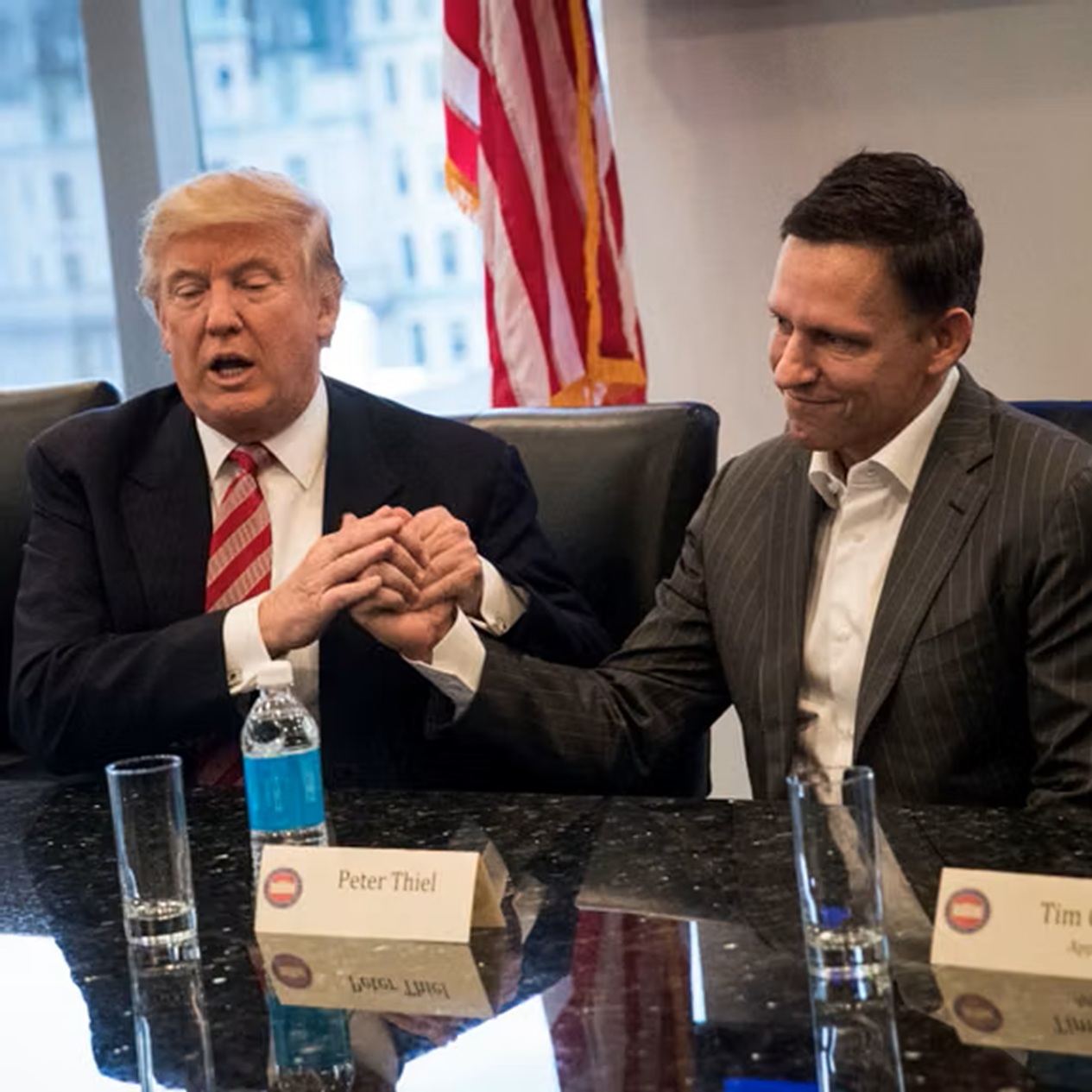
Peter Thiel is difficult to fit into a single category. Entrepreneur, investor, billionaire, libertarian intellectual, political donor, co-founder of PayPal and Palantir, Facebook’s first major outside investor and a central figure at Founders Fund, he simultaneously belongs to the worlds of technology, finance, defense and American politics.
But accumulating these roles is not enough to explain his significance.
What distinguishes Peter Thiel is the consistency with which, for more than two decades, he has connected a particular conception of progress, a critique of Western institutions, an unconventional theory of capitalism and an investment strategy. While many technology billionaires developed political doctrines after building their fortunes, Thiel has increasingly used capital to finance companies that correspond to a worldview that was already largely formed.
That worldview rests on several simple but radical intuitions: competition is often destructive; technological monopolies can be productive; modern democracies struggle to make long-term decisions; institutions become bureaucratic; the West has underestimated the importance of material progress; and technology can create spaces for action that traditional politics no longer provides.
For years, these ideas appeared marginal within a Silicon Valley culture that was broadly libertarian but economically focused on software, the Internet and consumer services. Today, they look different. Artificial intelligence, drones, satellites, energy, cybersecurity, defense, data exploitation and reindustrialization have placed technology back at the center of state power.
Peter Thiel, then, is not simply the story of an exceptionally successful investor.
He is also one of the figures through whom the transformation of part of America’s technological elite can be understood.
From Frankfurt to Stanford
Peter Andreas Thiel was born in Frankfurt, West Germany, in 1967. His family moved to the United States when he was a child. He grew up mainly in California and studied philosophy at Stanford before earning a law degree from the same university.
Stanford played a decisive role in his intellectual formation.
In the late 1980s, Thiel became involved in the cultural controversies sweeping American universities. In 1987, he co-founded The Stanford Review, a conservative student newspaper created to challenge what its founders regarded as the progressive ideological dominance of the campus.
This experience matters for understanding what came later. Long before PayPal, Facebook or Palantir, Thiel was already thinking about institutions, elites, intellectual conformity and the mechanisms through which certain ideas become dominant.
His philosophical education also mattered. René Girard, who taught at Stanford, is frequently cited as a major influence on Thiel’s thinking. Girard’s theory of mimetic desire — the idea that people often desire what others desire, generating rivalry in the process — provides a framework particularly compatible with the suspicion Thiel would later develop toward competition.
The same idea would eventually reappear in economic form.
Individuals imitate their rivals. Companies imitate their competitors. Students compete for the same degrees. Graduates pursue the same prestigious jobs. Investors finance the same trends.
Competition, from this perspective, is not necessarily the rational engine assumed by classical economics. It can become a mechanism of collective imitation.
PayPal: The First Experiment in Technological Power
In the late 1990s, Thiel helped create Confinity, which developed what would become PayPal. The company merged with X.com, founded by Elon Musk, before eventually adopting the PayPal name.
Its early ambitions extended beyond creating a convenient way to pay online. Some of its founders imagined digital payments as a means of reducing dependence on traditional financial infrastructure and national borders.
PayPal ultimately became a far more pragmatic company: an infrastructure for transferring money rapidly over the Internet, particularly well suited to the expansion of e-commerce.
In 2002, eBay acquired PayPal for approximately $1.5 billion in stock.
The transaction enriched several members of the founding team. Yet its most important legacy extended far beyond the deal itself.
Around PayPal emerged what would become known as the “PayPal Mafia”: a network of entrepreneurs and investors whose members later helped create or develop Tesla, LinkedIn, YouTube, Yelp, Palantir and numerous other companies.
The phenomenon illustrates one of Silicon Valley’s fundamental mechanisms: financial capital is only one component of power. Networks of trust, engineers, operational experience and the ability to finance the next generation of entrepreneurs are equally important.
Thiel understood this logic early.
The Facebook Bet
In 2004, Peter Thiel invested $500,000 in a young company created by Mark Zuckerberg: Facebook. The investment gave him roughly 10 percent of the company at the time and made him its first major outside investor.
It would become one of the most famous bets in venture-capital history.
More importantly, however, it illustrates the investment philosophy Thiel would later articulate: search not merely for a company capable of competing within an existing market, but for one capable of establishing a dominant position in a new market.
That distinction became central to Zero to One, published with Blake Masters in 2014.
For Thiel, a genuinely innovative company should not aim merely to become slightly better than its competitors. It should create something that did not previously exist.
Going from 1 to n means replication.
Going from 0 to 1 means invention.
That distinction leads to a provocative conclusion: the objective of a technology company should be to escape competition.
In Praise of Monopoly
In conventional economic theory, competition is generally considered beneficial. It lowers prices, encourages efficiency and prevents companies from extracting excessive rents indefinitely.
Thiel partially reverses this logic.
In his view, a company trapped in permanent competition spends much of its energy simply surviving. Margins decline, decision-making horizons shorten and the capacity to finance long-term projects diminishes.
By contrast, a company possessing technology, networks, branding or economies of scale powerful enough to dominate its market can generate profits that allow it to invest in the future.
Thiel is therefore not necessarily defending regulatory monopolies or rents protected by the state. He values what he describes as creative monopoly: a company that has built something sufficiently different to find itself, at least temporarily, alone in its category.
This doctrine is fundamental to understanding part of the digital economy.
Google in search, Facebook in social networking, Microsoft in parts of the software industry, Nvidia in artificial-intelligence accelerators and several major digital platforms demonstrate how technology can generate increasing returns and network effects that naturally favor concentration.
The paradox is considerable.
A digital revolution historically associated with open markets and decentralization has produced some of the most powerful concentrations of economic power in contemporary history.
Thiel does not necessarily regard this outcome as an anomaly.
It may instead be the natural consequence of technological success.
Palantir: When Silicon Valley Meets the State
The creation of Palantir in 2003 is probably the most important project for understanding the political dimension of Peter Thiel.
The company develops platforms capable of integrating, organizing and analyzing vast quantities of dispersed data. Its technologies have progressively been adopted by government agencies, intelligence services, armed forces and public administrations, as well as private companies.
The CIA, through its venture-capital arm In-Q-Tel, was among Palantir’s early backers.
This relationship with the state apparatus sharply distinguished Palantir from the dominant Silicon Valley culture of the 2000s, which was overwhelmingly focused on consumers, digital advertising and Internet applications.
Two decades later, the landscape has changed profoundly.
According to Palantir’s filings with the U.S. Securities and Exchange Commission, the company generated approximately $4.48 billion in revenue in 2025. Around $2.40 billion came from government customers, including approximately $1.9 billion from the U.S. government.
Palantir therefore occupies the intersection of two systems once regarded as fundamentally different: Silicon Valley’s software ecosystem and the American national-security apparatus.
It is precisely this intersection that makes Thiel particularly significant.
The libertarian suspicious of the state helped build one of the technology companies most closely associated with the sovereign functions of that state.
The contradiction is less obvious if one considers that Thiel has often distinguished administrative bureaucracy from strategic capacity. His criticism does not necessarily target the existence of a powerful state. It is directed more specifically at what he regards as its inefficiency, slowness and inability to master decisive technologies.
From this perspective, the technology company does not necessarily replace the state.
It can become the infrastructure that allows the state to become powerful again.
Founders Fund: Financing the Physical World
With Founders Fund, created in the mid-2000s, this philosophy became a strategy for allocating capital.
The fund’s portfolio is revealing. Founders Fund has invested in companies including SpaceX, Palantir, Anduril, Stripe, Facebook, Airbnb, Neuralink, OpenAI, DeepMind, Figma, Spotify, Nubank and The Boring Company, alongside businesses operating in energy, industry, space, artificial intelligence and defense.
These companies obviously do not all correspond to a single doctrine.
But a pattern emerges.
Thiel and several investors influenced by similar ideas have repeatedly criticized venture capital’s concentration on relatively superficial digital innovations while more difficult sectors — energy, industry, space, biotechnology and defense — required longer investment horizons and considerably more capital.
The famous contrast between the flying cars promised by science fiction and the digital applications that actually emerged captures this frustration.
For several decades, the argument goes, the West experienced extraordinary growth in computing power without comparable progress across many parts of the physical world.
The technological “stagnation” thesis is debatable. Advances in medicine, semiconductors, energy and communications have been enormous.
Yet the idea has profoundly influenced a generation of entrepreneurs.
SpaceX seeks to radically reduce the cost of access to space.
Anduril develops autonomous systems for defense.
Palantir builds software infrastructure for complex organizations.
Neuralink works on brain-computer interfaces.
Other companies financed by the American venture-capital ecosystem are developing new nuclear reactors, automated factories, drone systems and new energy infrastructure.
Silicon Valley is gradually returning to atoms after dominating bits.
The Critique of Institutions
Thiel’s thinking does not stop at economics.
In an essay published by Cato Unbound in 2009, he wrote a sentence that became emblematic of his political outlook: he no longer believed that “freedom and democracy” were compatible.
Removed from its context, the statement can appear to express straightforward hostility toward democracy. His argument was more complex, but also more radical.
Thiel explained that he had lost confidence in the ability of democratic politics to produce the libertarian outcomes he wanted. He regarded the expansion of government, regulation and electoral politics as making it extremely difficult to reduce political power through political means.
His conclusion at the time was therefore less about conquering the state than about finding spaces capable of escaping its reach.
The Internet represented one.
Seasteading — the creation of autonomous communities at sea — represented another.
Space could eventually become a third.
Technology therefore becomes more than an economic instrument. It becomes a means of creating new institutional possibilities.
This helps explain why Thiel has financed or supported projects that can initially appear unrelated.
Cryptocurrencies, new cities, life extension, space exploration, artificial intelligence and experimental communities share a common question: can new systems be built when existing systems appear impossible to reform?
From Exiting Politics to Investing in It
There is, however, a striking contradiction in this trajectory.
After arguing that libertarians should seek ways beyond politics, Thiel gradually became one of Silicon Valley’s most politically involved entrepreneurs.
In 2016, he publicly supported Donald Trump and addressed the Republican National Convention.
At the time, the move was particularly unusual in a Silicon Valley environment where support for Democratic candidates overwhelmingly predominated.
Thiel subsequently financed various Republican candidates and played an important role in the political emergence of figures originating from, or connected to, the technology ecosystem.
J.D. Vance is the most prominent example.
Before entering the Senate and later becoming vice president of the United States, Vance worked in the venture-capital world associated with Thiel. During his 2022 Ohio Senate campaign, Thiel provided major financial support to a political committee backing his candidacy.
This evolution reflects a broader change.
Part of Silicon Valley is no longer merely asking Washington for a favorable regulatory environment.
It is attempting to influence the very conception of American power.
The Rise of a Technological Right
It would be excessive to reduce this entire movement to Peter Thiel. Elon Musk, Marc Andreessen, David Sacks, Palmer Luckey and other entrepreneurs and investors have their own trajectories and political convictions.
But a new ideological space has gradually emerged.
Depending on the individuals involved, it combines criticism of bureaucracy, support for entrepreneurship, hostility toward certain forms of regulation, American reindustrialization, technological acceleration, national defense, artificial intelligence, cryptocurrencies and skepticism toward parts of the university and media establishment.
This constellation is not perfectly coherent.
It combines libertarianism with economic nationalism, deregulation with enormous government contracts, suspicion of the administrative state with a desire for a stronger military state, and the defense of individual freedom with the development of powerful surveillance technologies.
Thiel embodies several of these contradictions.
That is precisely what makes him representative of his era.
The Libertarian Paradox
Palantir is perhaps the clearest manifestation of this contradiction.
How can a libertarian committed to limiting political power help build technologies that allow governments to process enormous quantities of data?
The answer advanced by Thiel and Palantir generally distinguishes technology itself from the purposes for which it is used, while arguing that democratic states must possess technological tools powerful enough to compete with their adversaries.
This logic has become increasingly important with the return of strategic competition between major powers.
The United States cannot maintain military superiority without companies capable of rapidly developing artificial intelligence, satellites, autonomous systems, cybersecurity and data infrastructure.
The traditional boundary between the military-industrial complex and the technology industry is therefore becoming increasingly porous.
Lockheed Martin, RTX and Northrop Grumman are no longer the only possible models for strategic defense suppliers.
Palantir, SpaceX, Anduril and a new generation of venture-backed companies are seeking to become central components of American power.
Thiel contributed to this convergence unusually early.
The Power of the Network
His influence, however, cannot be measured solely through financial holdings.
It operates through networks.
Former PayPal executives, entrepreneurs financed by Founders Fund, former Palantir employees, investors, intellectuals, political officials and engineers form an ecosystem whose members circulate between companies, investment funds and public institutions.
This is a particular form of power.
It is neither strictly economic, institutional nor political.
It rests on the ability to identify people, finance projects, assemble teams and create organizations capable of subsequently exercising influence of their own.
Venture capital consequently becomes a mechanism for selecting future centers of power.
Investing in a startup is no longer simply a bet on financial returns.
When artificial intelligence, defense, money, data or space are involved, deciding which companies receive enough capital to scale also means indirectly participating in the selection of the infrastructure of the future.
The Thiel Fellowship: Against Elite Reproduction
This critique of institutions also appears in the Thiel Fellowship.
Created in 2011, the program offers young entrepreneurs $100,000 over two years to develop their projects rather than immediately pursuing a conventional university education.
The program is deliberately provocative.
In the United States, elite universities constitute one of the principal mechanisms through which economic, administrative and technological elites reproduce themselves. Stanford, Harvard, MIT and Yale provide not only education, but networks, social legitimacy and privileged access to prestigious organizations.
Thiel, himself a graduate of Stanford and Stanford Law School, attacks precisely this system.
In his view, competition for prestigious degrees can encourage highly talented people to follow already established paths rather than take genuine risks.
Again, the Girardian logic appears.
Everyone wants admission to the same universities because everyone wants admission to the same universities.
Everyone pursues the same jobs because people considered brilliant pursue those jobs.
Prestige becomes mimetic.
The entrepreneur must break the cycle.
A Fortune Turned Into an Instrument
The success of these investments has made Thiel one of the world’s wealthiest individuals. Forbes estimated his fortune at approximately $27.9 billion in late July 2026, a figure that naturally fluctuates with markets and the value of his holdings.
But in Thiel’s case, wealth matters less as a measure of consumption than as a capacity for intervention.
Capital makes it possible to finance companies before they become consensual.
It can support political candidates.
It can fund intellectual institutions.
It makes it possible to wait years for a technology to mature.
Above all, it allows investors to make bets that organizations constrained by immediate profitability may be unable or unwilling to make.
This is one of the major transformations created by the accumulation of wealth within the American technology economy.
Certain individuals now control resources comparable to the budgets of many public institutions and can deploy them with extraordinary discretion.
The question extends far beyond Peter Thiel.
It concerns Elon Musk, Jeff Bezos, Mark Zuckerberg, Larry Ellison and dozens of other billionaires capable of financing infrastructure, scientific research, media, political campaigns, artificial intelligence or space programs.
The concentration of capital therefore produces a concentration of the capacity to experiment.
The Return of the State
Thiel’s story ultimately contains a major irony.
Much of the technological libertarianism of the 1990s imagined the Internet as a space through which states could gradually be circumvented.
Three decades later, the most strategically important technology companies are instead moving closer to governments.
Artificial intelligence depends on semiconductors subject to export controls.
Satellite constellations have become military infrastructure.
Drone manufacturers work with defense ministries.
Data centers depend on energy and industrial policy.
Governments subsidize semiconductor production.
Digital platforms are integrated into geopolitical rivalry.
Technology did not abolish geopolitics.
It became one of its principal arenas.
This evolution paradoxically brings Silicon Valley closer to the world Thiel appeared to want to escape when he wrote about moving beyond politics.
But it can also be interpreted differently: if the political system cannot be escaped, then the institutions capable of exercising power within it must be transformed.
A Vision That Has Met Its Moment
It would be tempting to present Peter Thiel as a prophet who anticipated the evolution of the technological world.
That would go too far.
Some of his predictions have proved wrong. Several projects he supported failed to produce the breakthroughs expected of them. His conception of progress is debatable, his political positions remain deeply controversial, and some of the contradictions in his worldview are difficult to reconcile.
Yet several contemporary transformations have undeniably made the questions he has asked for years more consequential.
Does the West need to recover the ability to build large-scale infrastructure?
Can democracies sustain technological strategies over several decades?
Should strategic companies seek competition or dominance?
Do universities actually identify the most innovative people, or do they reproduce conformist behavior?
Should governments develop critical technologies themselves or rely on private companies?
And what happens when a small number of entrepreneurs acquire increasing influence over the infrastructure on which national sovereignty depends?
These are no longer marginal questions.
They now shape part of the debate over the future of the United States.
Beyond Peter Thiel
The real subject, then, may not be Peter Thiel himself.
It is the transformation of the relationship between capital, technology and power.
For much of the twentieth century, states concentrated most of the resources required to develop strategic technologies: nuclear power, spaceflight, aviation, telecommunications and military computing.
Over recent decades, a growing share of innovation has been produced by private companies possessing enormous financial resources, highly specialized talent and technological capabilities.
Artificial intelligence is accelerating this transformation.
The most advanced models, data centers, semiconductors, satellite networks and digital platforms are largely controlled by companies.
The state remains sovereign in law.
But part of its operational capacity increasingly depends on infrastructure it does not entirely own.
Peter Thiel has built his career precisely along this frontier.
He began in a technological world that dreamed of reducing the importance of the state. He then helped create a company operating at the heart of its strategic functions. He financed entrepreneurs building the infrastructure of the future. Eventually, he moved directly into the political arena.
That trajectory tells us something larger than the story of a billionaire.
It tells the story of the gradual disappearance of the boundary between Silicon Valley and Washington.
And perhaps of the emergence of a new kind of elite: neither simply industrial, nor simply financial, nor simply political, but capable of operating simultaneously through capital, technology, infrastructure and institutions.
In such a world, power no longer consists only in governing.
It also consists in deciding which technologies will be built.
Main sources
— Peter Thiel, The Education of a Libertarian, Cato Unbound, 2009. — Peter Thiel and Blake Masters, Zero to One: Notes on Startups, or How to Build the Future, 2014. — Palantir Technologies, Form 10-K / 2025 Annual Report, U.S. Securities and Exchange Commission. — Founders Fund, institutional materials and investment portfolio. — Forbes, Peter Thiel profile and wealth estimate, July 2026. — Wharton School, interviews and discussions with Peter Thiel on competition, innovation and monopoly. — Public corporate and historical records concerning PayPal, Facebook, Palantir and Peter Thiel’s investment activities.
Atlas Limits Research Desk
Atlas Limits’ editorial and analytical desk.