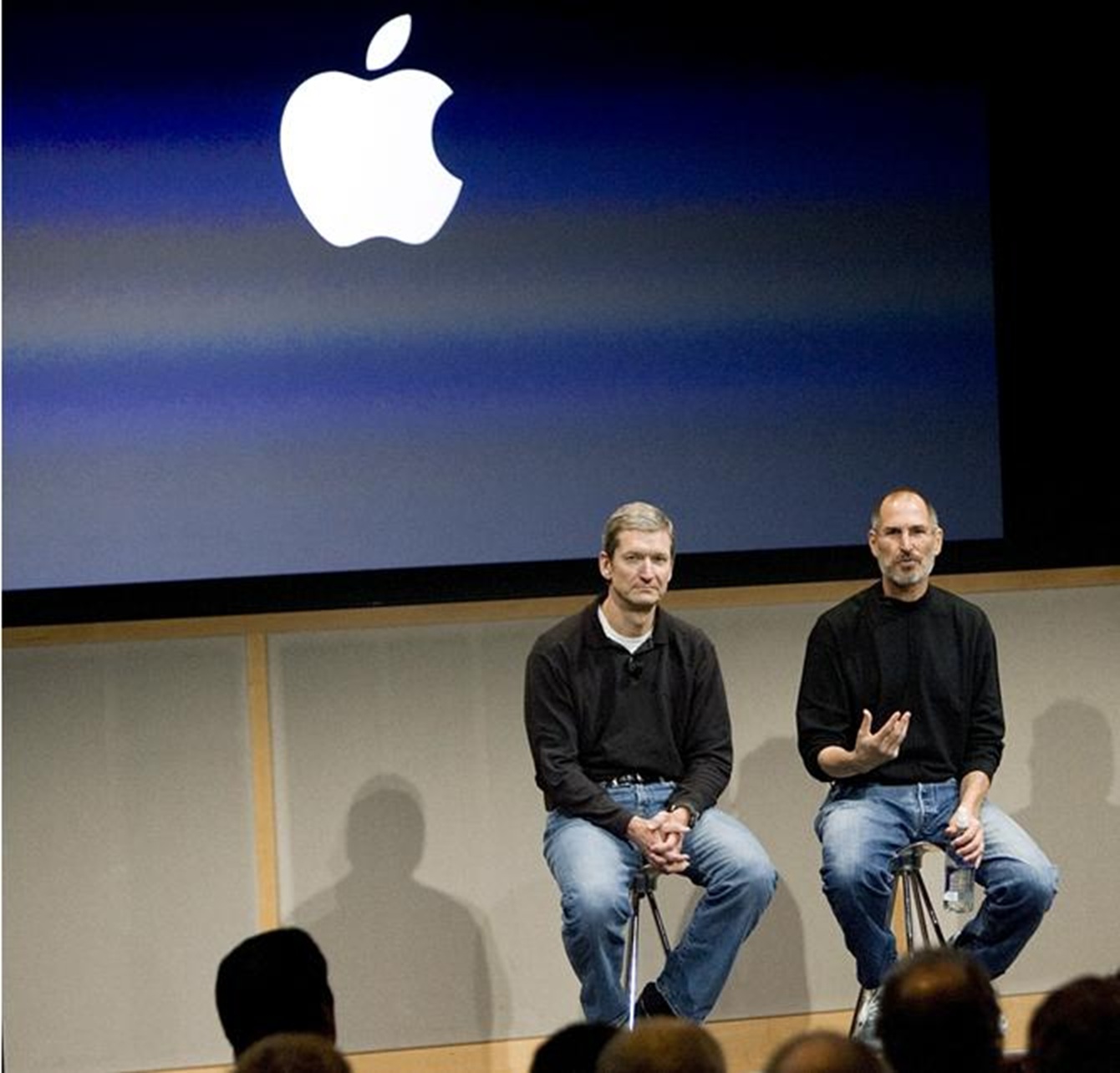
On August 31, 2026, Tim Cook posted a few lines to bid farewell to the Apple community one last time as chief executive. “My title changes tomorrow,” he wrote. A simple sentence to close fifteen years at the helm of one of the world’s most powerful companies. On September 1, John Ternus succeeds him as CEO, while Cook remains Executive Chairman.
The transition, however, goes far beyond the individuals involved. It closes a cycle that began long before Cook became chief executive. Since Steve Jobs returned in 1997, Apple has undergone two successive transformations: first, the reconstruction of a company around the product and technological integration; then, the conversion of that architecture into an industrial, commercial and financial system operating on a global scale.
Jobs largely built modern Apple. Cook gave it its contemporary scale.
With Ternus, a third era now begins, perhaps a more uncertain one. Apple no longer needs to be rescued, as it did in 1997. Nor does it need to prove that it can become enormous, as it did in 2011. It must determine whether the ecosystem that created its power can remain central as artificial intelligence, new forms of computing and geopolitical fragmentation begin to shift the boundaries of the technology industry.
THE RETURN OF JOBS: REBUILDING APPLE
When Steve Jobs returned to Apple in 1997, the company was not yet the symbol of power it would become. Its product range was confused, its finances were fragile, and its position in personal computing had been largely marginalized by the Windows ecosystem.
The recovery that followed is often told as a succession of iconic products. The iMac in 1998. The iPod in 2001. The iPhone in 2007. The iPad in 2010. But that chronology alone does not explain what actually happened.
Jobs gradually imposed a doctrine.
Apple should not try to manufacture every possible product. It should concentrate its resources on a small number of devices, control the essential components of their operation, and turn technology into a coherent experience. Hardware, software, interface and, increasingly, services had to be designed together.
The iMac offered the first visible expression of this strategy. The iPod then expanded the company’s territory beyond the personal computer. iTunes added an essential layer: Apple was no longer merely controlling the device, but beginning to organize the distribution of the content that gave it value.
On January 9, 2007, this logic reached its turning point. On the Macworld stage, Jobs introduced the iPhone as the combination of a phone, an iPod and an Internet communications device. Behind the demonstration lay a much deeper transformation: the personal computer was beginning to migrate into the pocket.
The iPhone quickly became Apple’s center of gravity. But the decisive innovation was not simply the device itself.
With the App Store, launched in 2008, Apple turned the phone into a platform. Outside developers could build their own products on infrastructure controlled by Apple. Every new application increased the usefulness of the iPhone; every new user increased the platform’s economic value to developers.
A cycle of expansion took shape.
Apple gradually stopped selling only objects. It built an environment in which devices, operating systems, applications, content and services reinforced one another.
When Jobs died in 2011, he therefore left Tim Cook more than an extraordinarily profitable company.
He left him an architecture.
TIM COOK: CHANGING SCALE
Tim Cook was not Steve Jobs, and his historical significance lies precisely in the fact that he never truly attempted to become him.
His public image was long constructed in opposition to that of his predecessor. Jobs represented the product, intuition, design and presentation. Cook appeared to be the man of operations, suppliers, inventory and logistics.
There is some truth to that distinction. But it profoundly understates the nature of his tenure.
Cook understood that the challenge was no longer simply to invent the Apple ecosystem. The company now had to operate it on a global scale.
The supply chain became a strategic instrument. Volumes increased dramatically. Distribution expanded. The supplier network deepened. Apple perfected an industrial machine capable of producing and distributing tens of millions of highly sophisticated devices within extremely short timeframes.
This capability was less spectacular than an iPhone launch. Yet it became one of the foundations of Apple’s power.
Designing an exceptional product is difficult. Manufacturing tens of millions of units, using components sourced across multiple countries while maintaining high quality standards, tight deadlines and considerable margins, is another form of mastery entirely.
Under Cook, Apple gradually became as much an industrial achievement as a technology company.
FROM THE IPHONE TO THE APPLE ECONOMY
Cook did not merely increase volumes.
He gradually changed the economic nature of the company.
The iPhone remained the group’s center of gravity, but Apple built an increasingly dense constellation around it: Apple Watch, AirPods, iCloud, Apple Music, Apple TV+, Apple Pay, AppleCare and numerous services integrated into its devices.
The logic was fundamental.
A user could enter the ecosystem through an iPhone, then buy AirPods, add an Apple Watch, use a Mac or an iPad, store data in iCloud, make payments through Apple Pay and subscribe to several services. Each component increased the usefulness of the others.
The product became an ecosystem. The ecosystem became an economy.
This transformation also allowed Apple to partially reduce its dependence on hardware replacement cycles. Services introduced a greater proportion of recurring revenue and deepened the economic relationship with each user.
The iPhone was no longer merely a phone purchased every few years. It became the main gateway into an Apple economy.
This architecture explains part of the company’s extraordinary financial expansion during the Cook era. When he became CEO in 2011, Apple generated just over $100 billion in annual revenue and its market capitalization was still measured in hundreds of billions. By the end of his tenure, annual revenue exceeded $400 billion and the company’s valuation was measured in trillions.
Cook did not merely administer Jobs’ legacy.
He multiplied its economic scale.
POWER AND ITS DOWNSIDE
The success of this strategy nevertheless created its own contradiction.
The more coherent the Apple ecosystem became, the harder it became to leave.
Changing phones could now mean reconfiguring a watch, headphones, services, data, software habits, subscriptions or payment systems. What represented extraordinary customer retention for Apple could also be interpreted by competition authorities as a form of lock-in.
The App Store concentrated this tension in particular.
Apple’s control over application distribution, commissions, payment methods and certain rules imposed on developers triggered confrontations with private companies and regulators across several jurisdictions.
The issue extended beyond commissions charged on applications.
It concerned the very nature of digital platforms. How far can a company that designs a device and its operating system control the economy that develops inside that environment?
Apple’s historical strength — integration — therefore became one of its principal regulatory vulnerabilities at the same time.
APPLE SILICON: TAKING BACK THE CORE OF THE MACHINE
The Cook era cannot, however, be reduced to the commercial exploitation of innovations conceived under Jobs.
One of the period’s most consequential technological decisions concerned semiconductors.
Apple was already developing its own processors for the iPhone. With Apple Silicon and the Mac’s transition to the M-series chips beginning in 2020, the company extended that strategy to personal computing and reduced a fundamental technological dependence on Intel.
The processor became another layer of vertical integration.
Apple could now coordinate the design of its chips, devices and operating systems more closely. Performance, battery life, thermal efficiency and software could be optimized as components of the same system.
The company’s historical philosophy approached its fullest expression: Apple designed the device, an increasing share of its strategic components, the operating system, the principal software interfaces, the services and the distribution environment.
Apple Silicon perfectly illustrates the continuity between the two eras. Its logic is deeply consistent with the integrated philosophy developed under Jobs; its industrial execution belongs unmistakably to Cook’s Apple.
WHEN A COMPANY BECOMES A GEOPOLITICAL ACTOR
But as Apple changed scale, it also changed in nature.
A company selling hundreds of millions of devices, controlling a global software platform and organizing a supply chain spanning several continents can no longer treat geopolitics as an external environment.
China provides the clearest example.
For years, it offered Apple a combination that was extremely difficult to reproduce elsewhere: enormous industrial capacity, a dense concentration of suppliers, specialized labor, logistical infrastructure and a vast domestic market.
This concentration contributed to the extraordinary efficiency of Apple’s model. It also exposed its vulnerability as relations between Washington and Beijing deteriorated.
The company gradually sought to diversify part of its production, notably toward India and Vietnam. But moving a supply chain built over several decades is not equivalent to transferring a few production lines. Suppliers, expertise, equipment, infrastructure and scale constitute an industrial ecosystem of their own.
Apple therefore finds itself at the intersection of several transformations: Sino-American rivalry, industrial policy, technology controls, supply-chain security and growing demands for digital sovereignty.
At this scale, managing Apple no longer means merely managing a corporation.
It also means navigating between states.
THE TIM COOK PARADOX
Cook’s record nevertheless contains a paradox that is difficult to ignore.
He leaves behind an Apple considerably larger, richer and more integrated than the company he inherited. Yet the product that continues to structure its economy was born before he became CEO.
Apple Watch became an important platform. AirPods created an enormously profitable category. Services fundamentally changed the group’s economics. Apple Silicon was a major technological achievement.
But none of these innovations produced a rupture comparable to the iPhone.
Vision Pro was intended to open a new territory around spatial computing. The device demonstrated Apple’s technological capabilities, but it has not, so far, triggered a mass migration in user behavior comparable to the one created by the smartphone.
The comparison must be handled carefully. The iPhone was an exceptional event in industrial history. Expecting a company to reproduce a disruption of that magnitude regularly would mean turning the exception into the standard.
But the issue becomes strategic when the technological paradigm itself begins to change.
ARTIFICIAL INTELLIGENCE AND THE NEXT PARADIGM
For nearly two decades, the smartphone has been the dominant interface of personal computing.
Apple was one of its principal architects and probably its greatest economic beneficiary.
Generative artificial intelligence is now putting that architecture back into motion.
Competition is no longer limited to building the best device or the best operating system. It increasingly concerns artificial intelligence models, autonomous agents, computing infrastructure, data and the ability of software to understand an intention and then act directly on behalf of the user.
In this new environment, the interface may gradually become less important than the intelligence flowing through it.
Apple possesses considerable advantages: an immense installed base of active devices, internally designed processors, deep control over hardware and software, a global brand, exceptional distribution and, above all, direct access to hundreds of millions of users.
But the company now faces competitors for whom artificial intelligence is the strategic core rather than an additional layer of an existing ecosystem.
The danger is not necessarily that the iPhone disappears.
It is that the decisive layer of the digital experience moves above it.
If the intelligent agent gradually becomes the primary interface between users and the digital world, whoever controls the device may no longer necessarily control the relationship.
This may be the most important strategic question Tim Cook leaves to his successor.
JOHN TERNUS: INHERITING A COMPLETED EMPIRE
John Ternus does not arrive in the situation Steve Jobs faced in 1997.
He does not have to save Apple.
Nor does he arrive in Tim Cook’s position in 2011.
He does not have to prove that a brilliant technological architecture can become a global industrial machine.
Ternus inherits an extraordinarily integrated, profitable, globalized and technologically sophisticated company. An engineer by training, at Apple since 2001 and long responsible for hardware engineering, he belongs to the company’s historical continuity. He experienced the Apple of Jobs, helped build the Apple of Cook and now assumes responsibility for defining what comes next.
The difficulty of his mandate lies precisely in the quality of that inheritance.
The better a system works, the harder it becomes to transform it without destroying the advantages that made it successful.
Apple must continue to exploit the iPhone economy while preparing for a world in which the iPhone may lose some of its centrality. It must defend the benefits of vertical integration while responding to regulatory pressure. It must diversify its industrial base without losing the efficiency built over several decades. And it must find its place in artificial intelligence without becoming merely the hardware distributor for innovations conceived elsewhere.
Ternus therefore faces neither Jobs’ problem nor Cook’s.
He must determine when a company at the summit should begin questioning the very system that brought it there.
THREE AGES OF APPLE
The modern history of Apple can ultimately be understood as the succession of three problems.
Steve Jobs had to answer an existential question: what should Apple be?
His answer was integration. The product had to become a system.
Tim Cook inherited another question: how far could that system be expanded?
His answer was scale — industrial, commercial, financial and geographical. The system became an empire.
John Ternus now inherits a more difficult question: what becomes of that empire when the center of the technological world begins to shift?
The succession of September 1, 2026 is therefore more than a change of chief executive.
It closes a historical period.
Jobs understood that Apple would not win by simply making more computers than its competitors, but by redefining the relationship between humans and machines. Cook understood that this relationship could become the architecture of a global economic system.
Between them, Apple went from a threatened computer company to one of the most influential private infrastructures of the digital economy.
The company no longer faces the risk of disappearing. It faces a subtler difficulty — the one that confronts every power that reaches maturity.
Whether to continue perfecting the world it dominates, or recognize early enough that the next one is already being built.
MAIN SOURCES
Apple — “Tim Cook to Become Apple Executive Chairman; John Ternus to Become Apple CEO,” April 20, 2026.
Apple — “Apple Reinvents the Phone with iPhone,” January 9, 2007.
Apple — “iPhone at Ten: The Revolution Continues,” January 2017.
Apple — Annual reports and financial results, fiscal years 2011–2025.
Apple — “2025 marked a record-breaking year for Apple Services,” January 2026.
Apple — Corporate communications on Apple Silicon and the Mac transition to Apple processors.
Apple — Corporate communications on John Ternus and the leadership of Hardware Engineering.
U.S. Securities and Exchange Commission — Apple Inc., Form 10-K and regulatory filings.
European Commission — Proceedings and decisions concerning the App Store, the Digital Markets Act and Apple’s business practices.
Reuters — Coverage of Tim Cook’s succession, Apple’s industrial strategy, geographical diversification and positioning in artificial intelligence.
Atlas Limits Research Desk
Atlas Limits’ editorial and analytical desk.