For decades, the global geography of technology appeared relatively simple. The United States designed digital architectures, Europe and Japan retained control of certain critical industrial capabilities, while China manufactured, assembled and exported. That division was never entirely accurate. Today, it has become profoundly inadequate.
China remains central to global manufacturing, but it is no longer merely a production base. It develops its own artificial intelligence models, builds telecommunications infrastructure, manufactures semiconductors, controls a considerable share of the battery and solar supply chains, exports electric vehicles, deploys industrial robots and seeks to create software ecosystems capable of reducing its dependence on Western technology.
This transformation does not mean that China has achieved technological autonomy. Significant dependencies remain in advanced lithography, chipmaking equipment, certain industrial software systems, high-bandwidth memory, scientific instruments and several foundational components. Yet the relevant question is no longer whether China can “catch up” with the established technology powers. It is where China already dominates, where it is approaching the global frontier and where the remaining bottlenecks could still slow its rise.
China’s singularity lies less in any individual company than in the relationships connecting them. The state, provincial governments, universities, public laboratories, banks, industrial funds, component manufacturers, digital platforms and consumer markets form a system whose depth would be difficult to reproduce elsewhere. China is no longer simply producing technologies. It is gradually building the conditions under which they can be designed, financed, industrialised, deployed and replaced within the same economic space.
Beyond the catch-up model
China’s technological industrialisation did not happen in a single stage. Beginning in the 1980s, the country’s opening to foreign investment allowed it to enter global production networks. Joint ventures, transfers of expertise, imported equipment, engineering education and the arrival of multinational companies formed the first layers of the system.
China initially learned to manufacture according to standards established elsewhere. It then developed domestic suppliers, improved the quality of its components, consolidated its logistics capabilities and began designing its own products. Imitation, reverse engineering and technology transfers played a role in this trajectory, as they have in the industrial history of many emerging powers. They are no longer sufficient, however, to explain the current performance of companies capable of investing tens of billions of dollars in research, filing international patents and operating at the technological frontier in several industries.
In 2025, China’s research and development expenditure reached RMB 3.926 trillion, an increase of 8.1% over the previous year, according to the National Bureau of Statistics. Companies accounted for most of this expenditure, ahead of public research institutes and universities. In the same year, China entered the top ten of the World Intellectual Property Organization’s Global Innovation Index for the first time.
Scale does not tell the entire story. Patent volumes reveal neither their quality nor their industrial value, and higher research expenditure does not automatically produce fundamental breakthroughs. Yet the continuity of the effort, its geographical distribution and its connection with manufacturing capabilities demonstrate that Chinese innovation can no longer be reduced to a handful of isolated champions.
China hosts 24 of the world’s 100 leading innovation clusters identified by WIPO. The Shenzhen–Hong Kong–Guangzhou cluster ranks first globally, ahead of Tokyo–Yokohama and San José–San Francisco, while Beijing ranks fourth. Chinese technological power therefore rests on a constellation of specialised territories rather than on a single centre.
A directed economy under intense competition
China’s model is often portrayed as a top-down planning system in which the state selects technologies, appoints corporate winners and finances their expansion. This description contains an element of truth, but it overlooks the intensity of competition within the domestic market.
The central government identifies priority sectors, mobilises finance, organises public procurement and attempts to secure strategic infrastructure. Provinces and municipalities build industrial zones, support laboratories and invest in local companies. State-owned banks, venture capital funds, industrial investment vehicles and regional financing structures complete this architecture.
Companies then compete, often brutally. In electric vehicles, digital platforms, delivery services, financial technology and artificial intelligence, dozens of players target the same users, reduce prices and accelerate product cycles. This pressure eliminates weaker businesses, but it also creates overcapacity, erodes margins and sometimes produces an inefficient allocation of capital.
Chinese industrial policy does not therefore eliminate the market. It directs, finances and, in some sectors, intensifies it. The result is neither a conventional command economy nor fully liberal capitalism. It is a hybrid system in which the state sets the broad direction while competition determines which technologies, products and companies survive.
This relationship remains unstable. The regulatory crackdown imposed on large platforms from 2020 onward demonstrated that their power remained subordinate to political priorities. Ant Group had to suspend its initial public offering, e-commerce companies faced new regulations and the private tutoring industry was fundamentally restructured. The state can support an industry and later constrain it if its expansion is perceived as a threat to financial, social or political stability.
The 15th Five-Year Plan for 2026–2030 confirms this approach. Integrated circuits, artificial intelligence, connected vehicles, robotics, advanced materials, biomedicine, aerospace and the low-altitude economy are intended to become structural industries. Quantum technologies, 6G, brain-computer interfaces and biomanufacturing represent the next frontiers. Through its “AI Plus” initiative, Beijing is not merely seeking to develop large models. It wants artificial intelligence to penetrate manufacturing, services, logistics, energy and government.
The geography of innovation
Each of China’s major clusters performs a particular function within this architecture.
Beijing concentrates the country’s leading universities, national laboratories, decision-making institutions, military research centres and a significant share of the artificial intelligence industry. Baidu, ByteDance, Xiaomi, JD.com, Meituan, Zhipu AI and numerous start-ups have established research facilities or headquarters in the capital.
Shenzhen represents an opposite but complementary model. Its strength comes less from academic institutions than from the density of its supply chains. Huawei, Tencent, BYD, DJI, ZTE and thousands of component manufacturers operate in an environment where an electronic prototype can be designed, modified and manufactured within weeks. The proximity between engineers, factories, subcontractors and markets turns manufacturing itself into an instrument of innovation.
Shanghai combines finance, semiconductors, electric vehicles, software and biotechnology. Hangzhou developed around Alibaba, e-commerce, cloud computing and artificial intelligence. Jiangsu hosts manufacturers of components, solar panels and industrial equipment. Hefei has established itself in electric vehicles, displays, quantum technology and semiconductors through an especially active public investment strategy. Wuhan possesses an ecosystem specialising in optics and telecommunications, while Chengdu and Chongqing are playing a growing role in electronics, automotive manufacturing and aerospace.
Even Ningde, once a peripheral city in Fujian Province, has become a global industrial node through CATL. Its rise illustrates how a dominant company can restructure an entire territory around its suppliers, research centres and logistics infrastructure.
Hong Kong retains a distinctive function. Its technology industry is smaller than Shenzhen’s, but its financial markets, commercial law and international openness make it an interface for capital raising, public listings and the overseas expansion of Chinese groups.
Platforms as a laboratory
Before becoming an artificial intelligence power, China built one of the world’s most integrated digital ecosystems. Alibaba constructed an architecture linking e-commerce, cloud computing, logistics and payments. Tencent transformed WeChat into social, commercial and financial infrastructure. JD.com invested in automated warehouses and delivery networks. Meituan connected restaurants, local commerce, mobility and urban services. Pinduoduo reshaped low-cost retail before launching Temu internationally. ByteDance demonstrated through TikTok that a Chinese platform could acquire worldwide cultural influence.
The power of these companies comes from the scale of the domestic market, but also from the integration of everyday uses. In China, the smartphone became a payment instrument, a commercial identity, an administrative channel, a work platform and a gateway to daily services faster than in most other markets. Super-apps shortened the distance between attention, transaction and delivery.
This evolution generated enormous volumes of data and created an environment conducive to experimentation. Companies can test new features among hundreds of millions of users and connect digital services to physical infrastructure. Algorithms do not simply recommend videos or products. They coordinate delivery workers, optimise warehouses, organise transport networks and adjust prices in real time.
The system has its own limitations. China’s digital space is protected by regulatory barriers that have long restricted foreign competition, while the collection and use of data are subject to increasingly stringent political and security requirements. The concentration of services also expands the power of platforms over merchants, workers and users. The government has therefore sought to regain control over companies that have become essential to the daily functioning of the economy.
Artificial intelligence under constraint
Chinese artificial intelligence is not synonymous with DeepSeek. Baidu has developed the Ernie family, Alibaba the Qwen models, Tencent Hunyuan and ByteDance Doubao, while Moonshot AI, MiniMax, Zhipu AI and other companies have built their own architectures. This diversity reflects the intensity of competition among platforms, laboratories and new entrants.
DeepSeek nevertheless acquired particular symbolic importance. Its models demonstrated that a Chinese company could approach the global frontier by focusing on training efficiency, inference optimisation and the distribution of open-weight models. DeepSeek-V3 used a mixture-of-experts architecture in which only a fraction of the model’s parameters is activated for each token. DeepSeek-R1 subsequently strengthened reasoning capabilities through reinforcement learning.
DeepSeek’s success was sometimes interpreted as proof that US restrictions on advanced chips had failed. The reality is more complex. Hardware constraints encouraged Chinese laboratories to pursue greater efficiency, but the most advanced models still require substantial computing capacity, fast interconnects and high-performance memory. Software optimisation can reduce a hardware disadvantage; it cannot make that disadvantage disappear.
Alibaba occupies another structural position. The Qwen family has become one of the principal sets of Chinese models available with open weights, while also supporting Alibaba Cloud services. In August 2026, the group introduced Qwen3.8-Max, a mixture-of-experts model announced at 2.4 trillion parameters and intended for coding, research and long-horizon tasks. Beyond the figures publicised by the company, the strategic significance lies in the integration of models, cloud infrastructure, e-commerce, enterprise software and computing capacity.
China is therefore developing an artificial intelligence strategy that differs from that of the leading American companies. US groups tend to concentrate their most powerful models within proprietary services. Chinese developers more frequently combine commercial offerings with openly or partially openly distributed models to accelerate adoption among developers and industrial companies. This approach follows a technological logic, but also a geopolitical one: a widely accessible model can become infrastructure used far beyond China.
Competition is not determined solely by performance rankings. It also concerns operating costs, local deployment, cloud control, adaptation to non-Western languages, device integration and the ability to embed models in vehicles, robots and industrial equipment.
Chinese models nevertheless remain subject to specific requirements concerning content, security and political compliance. These constraints shape training data, filtering mechanisms and generated responses. They may limit certain international uses and fuel concerns over privacy, data governance and research freedom.
Semiconductors at the centre of the confrontation
Semiconductors represent the principal vulnerability of the Chinese system, but they are also the field in which substitution efforts are most intense.
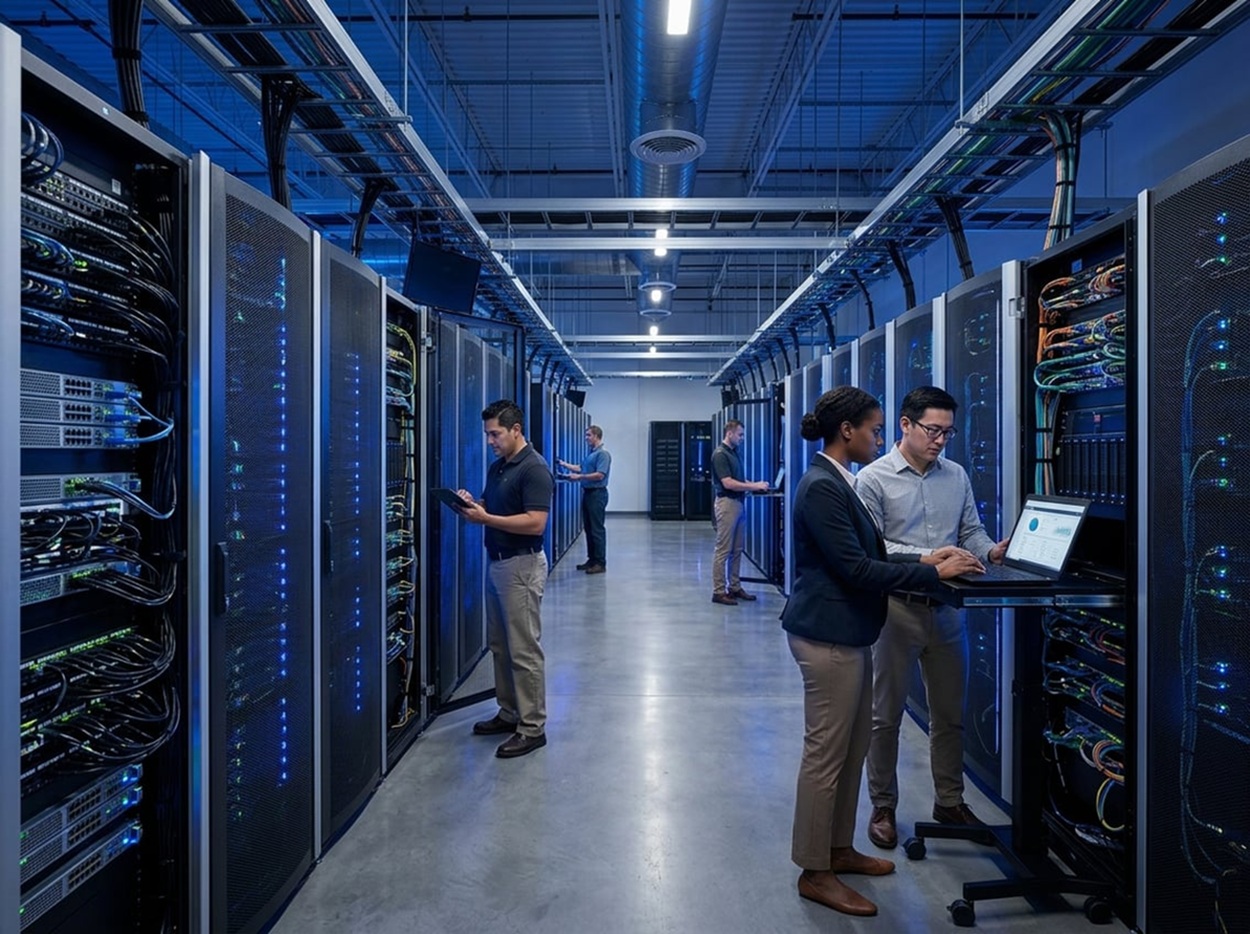
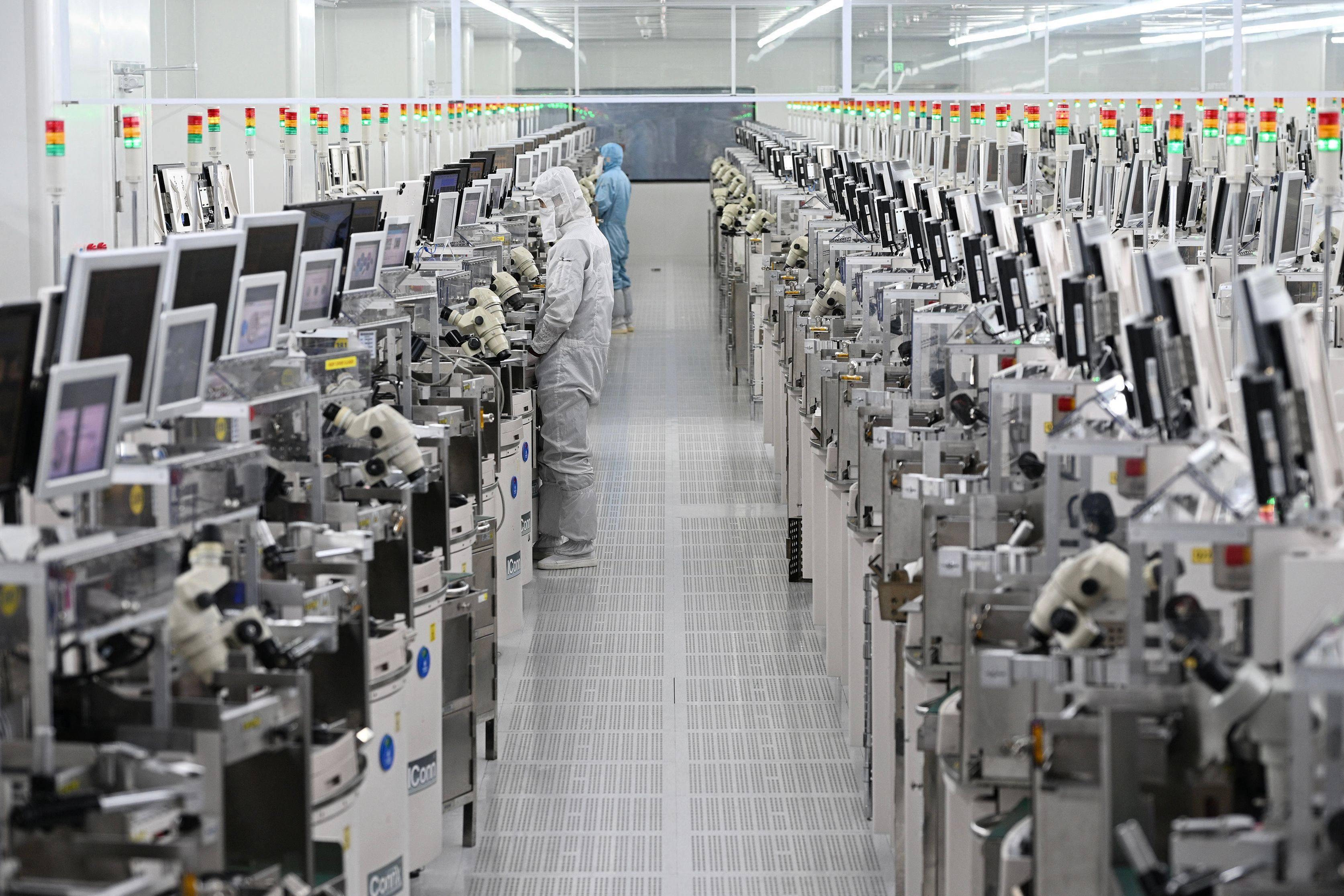
China already possesses an extensive industrial chain. HiSilicon designs processors for Huawei. SMIC and Hua Hong provide manufacturing capacity. YMTC develops NAND flash memory, while CXMT is progressing in dynamic random-access memory. Naura Technology and AMEC manufacture certain types of chipmaking equipment. Cambricon, Biren Technology, Moore Threads, Enflame and Huawei’s Ascend ecosystem are developing accelerators for artificial intelligence. Alibaba also owns T-Head, which specialises in processors and RISC-V architectures.
This accumulation does not yet constitute a fully autonomous supply chain. The most advanced chips depend on electronic design automation software, deposition and etching equipment, metrology systems, specialised materials and, above all, lithography platforms whose production is concentrated among a small number of Western and Japanese companies. Extreme ultraviolet lithography machines are produced exclusively by ASML and are not exported to China. Restrictions have also expanded to cover certain deep ultraviolet systems, high-bandwidth memory, software and artificial intelligence accelerators.
SMIC has demonstrated that relatively advanced circuits can be manufactured with older equipment, notably by multiplying lithography steps. This approach, however, increases complexity, costs and the risk of lower yields. Producing a functioning chip is not the same as manufacturing it at scale, at a competitive price and with energy efficiency comparable to the best products made by TSMC or Samsung.
Huawei embodies this search for resilience. After losing access to several Western suppliers, the company rebuilt part of its supply chains, revived its high-end smartphone business and accelerated the development of its Ascend processors for artificial intelligence. In 2025, Huawei spent RMB 192.3 billion on research and development, equivalent to 21.8% of its revenue. More than half of its employees worked in R&D.
China’s objective is probably not to achieve immediate and complete independence across every component. It is first to prevent an external restriction from bringing an entire strategic industry to a halt. This distinction is fundamental: technological sovereignty does not necessarily require manufacturing the world’s best component. It requires maintaining a sufficiently capable alternative to preserve the system’s essential functions.
Huawei and the reconstruction of a technology stack
Huawei now extends far beyond telecommunications equipment. The company produces smartphones, network infrastructure, servers, cloud services, energy systems, automotive software and artificial intelligence accelerators.
HarmonyOS occupies a central position in this architecture. Initially presented as a distributed operating system for different categories of devices, it gradually became a means of reducing dependence on Android and the American software ecosystem. Huawei is attempting to connect smartphones, cars, connected devices, televisions, industrial equipment and cloud services within a common environment.
The challenge is not merely technical. An operating system exists as a viable platform only if it possesses applications, developers and users. Building the ecosystem therefore requires persuading thousands of companies to adapt their services. China’s domestic market gives Huawei the scale necessary to undertake this transition, but international expansion remains more difficult in the face of Android and iOS dominance.
Huawei operates alongside Xiaomi, Oppo, Vivo, Honor, Lenovo and Transsion. Xiaomi is attempting to connect consumer electronics, connected devices and electric vehicles. Oppo and Vivo remain important smartphone manufacturers. Lenovo maintains a global presence in personal computers and infrastructure. Transsion, the owner of brands including Tecno and Infinix, has grown by adapting its devices to the requirements of African, South Asian and Middle Eastern markets.
These companies illustrate a characteristic of the Chinese model: hardware is rarely treated as an isolated business. The device becomes the entry point to an ecosystem combining software, data, cloud services, finance, mobility and artificial intelligence.
Telecommunications, networks and standards
Through Huawei and ZTE, China possesses two of the world’s leading telecommunications equipment manufacturers. This position gives it influence over a foundational layer of the digital economy: the networks through which data flows.
China has built an exceptionally dense 5G infrastructure and is attempting to extend its uses beyond smartphones. Private industrial networks, automated ports, mines, factories, power grids and connected vehicles have become testing grounds. In this model, 5G is productive infrastructure rather than simply an improvement in mobile connectivity.
The competition also concerns technical standards. A company that helps define a standard can influence future architectures, monetise its patents and create lasting dependencies. Chinese research into 6G, satellite communications and the convergence of terrestrial and orbital networks follows this logic.
Chinese equipment nevertheless faces restrictions in several countries. Governments that exclude it cite security risks, the relationship between Chinese companies and the state, and the dangers of relying on a foreign supplier for critical infrastructure. Beijing and the affected companies reject these allegations and point to the absence of publicly disclosed evidence of embedded espionage mechanisms.
The dispute demonstrates that technological competition is no longer solely about performance or price. Political trust, data governance and strategic alignment have become as important as technical specifications.
The electric vehicle as a technology product
The automotive industry is probably where China’s transformation is most visible. Chinese manufacturers long depended on joint ventures with foreign companies for internal combustion engine expertise. The transition to electric mobility allowed them to alter the industrial hierarchy.
BYD, Geely, SAIC, Chery, Great Wall, Nio, XPeng, Li Auto and, more recently, Xiaomi have developed vehicles combining batteries, power electronics, software, sensors and driver-assistance systems. Electric vehicles reduce the importance of certain legacy capabilities associated with combustion engines while increasing the value of fields in which China has built considerable advantages.
According to the International Energy Agency, China produced approximately 16 million electric cars in 2025. Exports exceeded 2.5 million units, twice the previous year’s level. This growth rests on competitive pricing, an extensive product range and an especially dense supplier base.
BYD represents the most advanced example of vertical integration. The company manufactures its own batteries, electronic systems, power semiconductors and vehicles. This structure reduces reliance on outside suppliers, accelerates model development and gives the company greater control over costs. Other manufacturers differentiate themselves through software, embedded systems, battery swapping, fast charging or the digital experience inside the vehicle.
The speed of this transition should not obscure its weaknesses. Price competition is reducing margins, weakening smaller manufacturers and creating the prospect of abrupt consolidation. Production capacity sometimes exceeds domestic demand, pushing companies towards exports. That international expansion, in turn, fuels accusations of overcapacity and subsidised competition.
The European Union imposed countervailing duties ranging from 7.8% to 35.3% on battery electric vehicles manufactured in China after concluding that their value chain benefited from subsidies that threatened injury to European producers. Chinese authorities reject this assessment. Automotive groups are gradually responding by localising production in Europe, Asia, Latin America and the Middle East.
The next phase will therefore no longer be defined by exports alone. Chinese companies will need to manufacture abroad, manage international supplier networks, comply with different regulatory systems and build brands capable of inspiring confidence beyond their domestic market.
Batteries and clean technologies
China’s electric vehicle position would be impossible without its battery industry. CATL reported that it retained first place in the global electric vehicle battery market in 2025, with a share of 39.2%. Its lithium-ion battery sales reached 661 GWh. BYD, CALB, Gotion and EVE Energy complete an ecosystem covering cells, cathodes, anodes, separators, refining and recycling.
Chinese companies played a major role in the revival of lithium iron phosphate batteries. Although less energy-dense than some nickel-rich chemistries, they are generally cheaper, more stable and less dependent on cobalt. Innovation has involved not only chemistry, but also cell arrangement, vehicle integration, thermal management and charging speed.
China is also investing in sodium-ion, semi-solid and future all-solid-state batteries. It remains difficult, however, to distinguish industrial announcements from advances that can genuinely be manufactured at scale. In this industry, the decisive technology is not one that works only in a laboratory, but one that can be produced millions of times with stable yields and acceptable costs.
The same logic applies to solar power. LONGi, JinkoSolar, Trina Solar, JA Solar and Tongwei occupy different layers of a chain extending from polysilicon to finished modules. Huawei and Sungrow possess a global presence in power inverters, while Goldwind and Envision Energy have become major wind power companies.
This concentration has helped reduce the global cost of low-carbon technologies, but it has also created dependence on Chinese capacity. The United States, European Union, India and other economies are now seeking to rebuild alternative supply chains, even when those alternatives are more expensive.
China’s clean technology advantage also contains a contradiction. Manufacturing batteries, solar panels and electronic components consumes large quantities of energy and raw materials. Part of that production still relies on electricity generated from coal. The global transition towards low-carbon technologies therefore depends heavily on an industrial system whose environmental footprint remains substantial.
Drones, robotics and the low-altitude economy
DJI has dominated the global civilian drone market for several years. Its advantage rests on the integration of motors, sensors, cameras, stabilisation software and manufacturing capacity. Chinese drones are used in filmmaking, agriculture, mapping, infrastructure inspection and emergency services.
The dual-use nature of these technologies nevertheless contributes to geopolitical tension. The same aircraft can monitor crops, inspect a power grid or gather information over sensitive terrain. Restrictions targeting Chinese drone manufacturers illustrate how difficult it has become to separate civilian technology from national security.
Beijing now wants to develop a “low-altitude economy” encompassing logistics drones, air taxis, electric vertical take-off and landing aircraft and traffic management systems. EHang, AutoFlight and other companies are testing vehicles intended to carry passengers or goods. Their widespread adoption will depend on safety, certification, operating costs and acceptance by urban populations.
Robotics is following a similar trajectory. According to the International Federation of Robotics, more than two million industrial robots were operating in Chinese factories in 2024. The country installed approximately 295,000 new units that year, accounting for 54% of global installations. For the first time, Chinese manufacturers supplied the majority of robots sold in their own market.
This industrial base supports the development of mobile robots, collaborative machines and humanoid systems. Unitree, UBTech, Fourier Intelligence, AgiBot and several automotive manufacturers are investing in the field. Humanoid demonstrations attract considerable attention, but their economic importance remains uncertain. In the near term, China’s advantage lies less in a general-purpose robot capable of imitating a human than in the progressive automation of warehouses, assembly lines, ports and logistics facilities.
Cloud computing and the industrial internet
Alibaba Cloud, Huawei Cloud, Tencent Cloud and Baidu AI Cloud provide China’s principal digital infrastructure. Their markets remain less globalised than those of Amazon Web Services, Microsoft Azure or Google Cloud, but they benefit from vast domestic demand and close relationships with industry.
The significance of Chinese cloud computing extends beyond hosting. It concerns the ability to connect computing power, data, artificial intelligence models and physical infrastructure. Chinese groups are developing platforms for local governments, manufacturers, banks, hospitals and energy operators. The country is attempting to move its digital economy from a predominantly consumer-oriented model towards one capable of improving industrial productivity.
This transition is essential. Commerce, entertainment and payment platforms created large corporate groups, but they are not sufficient to address slowing productivity or demographic ageing. Artificial intelligence, robotics, digital twins and automation must now transform factories, transport systems and public services.
China’s enormous manufacturing base offers a particular advantage. Artificial intelligence models can be tested on production lines, computer vision systems can be integrated into quality control and private 5G networks can coordinate machinery. The boundary between software and industry is becoming less distinct, favouring companies capable of operating in both worlds.
Space, navigation and quantum technologies
China’s technological capabilities also extend to orbital infrastructure. The BeiDou navigation system provides an alternative to the American GPS. The Tiangong space station maintains a permanent Chinese presence in low Earth orbit. The Chang’e missions have strengthened the country’s lunar exploration capabilities, while the Tianwen programme pursues planetary objectives.
Alongside public institutions, a commercial space industry is beginning to develop. LandSpace, Galactic Energy, Space Pioneer and other companies are working on reusable launch vehicles, satellite constellations and orbital services. They remain far from SpaceX’s scale, but they benefit from a domestic market, strategic demand and growing access to public infrastructure.
The University of Science and Technology of China in Hefei plays a central role in quantum research. The Micius satellite enabled experiments in long-distance quantum communication, while several laboratories are developing photonic and superconducting quantum computers. As elsewhere, announcements require caution: an experiment demonstrating an advantage on a specific task does not yet constitute a commercially useful, universal quantum computer.
China’s interest in quantum technology, 6G, brain-computer interfaces and biomanufacturing nevertheless reveals an important shift. Its technology policy is no longer concerned only with overcoming visible areas of weakness. It is attempting to identify fields in which the global hierarchy has not yet been established.
Biotechnology and the life sciences
Chinese technology is not confined to the digital and electronic domains. BGI has built a global presence in genetic sequencing. WuXi AppTec and WuXi Biologics have integrated themselves into international pharmaceutical research and manufacturing chains. BeiGene, now BeOne Medicines, illustrates the ambition to develop innovative medicines capable of reaching global markets.
China possesses several advantages: a large population, extensive hospital capacity, an industrial base in chemicals and pharmaceuticals, and a growing number of researchers. It has also reformed regulatory procedures to accelerate access to clinical trials and new treatments.
The life sciences raise different issues from electronics, however. Medical data protection, research ethics, genomic security and possible links between civilian companies and public institutions carry particular importance. In the United States, several Chinese groups have faced proposed restrictions on national security grounds. As in telecommunications, institutional trust has become a component of competitiveness.
A technological power moving at different speeds
Describing China as technologically dominant would be as misleading as continuing to portray it as a simple imitator. Its system operates at several different speeds.
In one group of industries, China possesses a dominant or near-dominant industrial position. These include solar panels, batteries, civilian drones, several segments of electronics, electric vehicle manufacturing and parts of the telecommunications infrastructure market. Its strength in these areas rests on scale, supplier networks, cost, speed of industrialisation and vertical integration.
In a second group, China operates at or sufficiently close to the global frontier to influence its direction. Artificial intelligence, smartphones, digital platforms, robotics, autonomous vehicles, quantum technology and certain biotechnologies belong to this category. Positions can change rapidly depending on the products, applications and criteria being examined.
The third group contains persistent dependencies: advanced lithography, certain semiconductor design tools, high-bandwidth memory, scientific instruments, metrology equipment, aircraft engines and several extremely high-precision components. These weaknesses are strategic because they sit upstream and can affect numerous industries.
China’s response is to multiply substitution efforts. This strategy sometimes produces duplication, unproductive investment and companies kept alive artificially. It can also generate rapid progress when a sufficiently large domestic market allows national suppliers to improve their products generation after generation.
The model’s domestic limits
The Chinese system must now confront the consequences of its own expansion. Slower economic growth, the property crisis, debt accumulated by some local governments and weak domestic demand are reducing the resources available. Technology investment is expected to create new engines of growth, but it can also deepen overcapacity if consumption and foreign demand do not rise at the same pace.
Intense competition is simultaneously a strength and a weakness. It accelerates innovation but destroys the margins needed to finance long-term research. In automotive manufacturing, solar power and digital platforms, price wars can weaken an entire industry before a small number of companies eventually prevail.
Demography represents another constraint. The working-age population is declining, while the economy must absorb large numbers of graduates at a time when skilled employment is not always expanding quickly enough. Automation partly responds to future labour shortages, but it may reinforce social pressures in the short term.
Political control over information and research also produces contradictory effects. It enables the state to mobilise resources rapidly and protect strategic projects. It can also restrict the circulation of ideas, encourage self-censorship and reduce the country’s attractiveness to some international researchers. An economy capable of efficiently improving known technologies does not automatically possess the conditions necessary to generate unpredictable scientific breakthroughs.
Finally, international expansion faces a trust deficit. Chinese companies must demonstrate that they can protect data, comply with local regulations and operate independently from Beijing’s political priorities. This is not merely a communication problem. It reflects the structure of a system in which the separation between companies, the state and national security is less transparent than in many Western economies.
Globalisation is changing form
Chinese technologies do not spread in the same way everywhere. In advanced economies, they face controls, subsidy investigations and security debates. In many emerging markets, their pricing, availability and financing conditions make them particularly attractive.
Huawei and ZTE have built telecommunications networks across Africa, Asia and Latin America. Transsion adapted its smartphones to African markets. Chinese manufacturers of solar panels, batteries and electric vehicles are advancing in countries where Western alternatives remain expensive. TikTok has become a global cultural platform, even as its future remains subject to political decisions in several states.
This expansion is now entering a new phase. Exporting from China will no longer be enough. Chinese groups must build factories in Hungary, Türkiye, Brazil, Thailand, Morocco and elsewhere, employ local workers and integrate regional suppliers. Chinese technology is gradually becoming multinational.
Localisation may reduce trade tensions, but it also creates new ones. Host governments will seek technology transfers and attempt to prevent these factories from remaining simple assembly operations dependent on Chinese components. Beijing therefore faces a question once directed at Western companies operating in China: how much technology should be shared in exchange for market access?
Building a parallel system
China is not withdrawing from the global technology economy. Its companies continue to use international architectures, software, equipment and standards. Production chains remain interdependent, and complete separation would impose considerable costs on every participant.
Yet a parallel system is taking shape. It includes Ascend processors, HarmonyOS operating systems, Qwen and DeepSeek models, Chinese cloud platforms, the BeiDou network, telecommunications standards, payment services and an industrial chain covering much of the required hardware.
This system does not need to replace the Western ecosystem entirely to alter the global balance. It merely needs to become sufficiently complete to reduce the effectiveness of sanctions, provide an alternative for third countries and allow Chinese companies to continue operating when access to certain foreign technologies is restricted.
American controls have slowed China’s access to the most advanced chips and manufacturing equipment. They have also increased the strategic value of every domestic supplier capable of replacing a foreign product. In the short term, the restrictions create a genuine disadvantage. Over the longer term, they accelerate China’s substitution effort. The outcome will depend on the relative speed of these two processes.
A new technological balance
China’s technological power can be understood neither as a perfectly planned miracle nor as the simple product of subsidies and foreign technology transfers. It is the result of several decades of industrial learning, public investment, private competition, international openness and infrastructure construction.
Its principal advantage is not always possession of the most advanced technology when considered in isolation. It lies in the ability to connect research, production, suppliers, finance and real-world deployment on an exceptional scale. An innovation may be less spectacular in a Chinese laboratory yet reach factories, vehicles, networks or the devices of hundreds of millions of users more quickly.
Its vulnerabilities are equally structural. Dependence on certain foundational technologies, overcapacity, weak profitability among many companies, demographic ageing and international distrust could slow its expansion. Political centralisation facilitates mobilisation, but it may also limit the intellectual diversity on which scientific breakthroughs depend.
The question is therefore no longer whether China has become a technology power. It already has. The real question concerns the nature of the system it is building and its ability to endure.
If China manages to reduce its critical dependencies without suffocating the competition that drives its innovation, it will possess the first nearly complete technological architecture constructed outside the American ecosystem. If it fails, it may still retain lasting dominance in industries where industrialisation and scale matter more than absolute control of the scientific frontier.
Either way, the old division of labour has ended. China is no longer merely the world’s factory. It has become one of the places where the world’s future infrastructure, standards and technologies are being designed.
Main sources
- State Council of the People’s Republic of China — 2026 Government Work Report
- State Council — Emerging industries and the 15th Five-Year Plan, 2026–2030
- National Bureau of Statistics of China — 2025 National Statistical Communiqué
- World Intellectual Property Organization — Global Innovation Index 2025
- WIPO — Global Innovation Cluster Ranking 2025
- International Energy Agency — Global EV Outlook 2026: Manufacturing and Trade
- CATL — 2025 Annual Report highlights
- BYD — Financial reports and 2025 Annual Report
- Huawei — 2025 Annual Report
- DeepSeek — DeepSeek-V3 Technical Report
- DeepSeek — DeepSeek-R1 Technical Report
- Alibaba Cloud — Qwen3.8-Max announcement
- Baidu — Fourth Quarter and Fiscal Year 2025 Results
- International Federation of Robotics — World Robotics 2025
- US Bureau of Industry and Security — Controls on advanced semiconductor manufacturing equipment
- US Bureau of Industry and Security — Licensing policy for semiconductors exported to China, January 2026
- ASML — 2025 Annual Report
- ASML — Updated export restrictions on advanced lithography technologies
- European Commission — Countervailing duties on battery electric vehicles from China
- OECD — MAGIC Database of Industrial Subsidies
Atlas Limits Research Desk
Atlas Limits’ editorial and analytical desk.