Some countries derive their importance from wealth, others from military power, technology, or their ability to project influence beyond their borders. Egypt belongs to a different category. Its importance begins with geography.
At the northeastern edge of Africa, facing the Levant, open to both the Mediterranean and the Red Sea, crossed by the Nile and guarding the Suez Canal, Egypt occupies one of the world’s great geopolitical compression points. Trade routes, Arab power balances, African rivalries, energy security, migration and the conflicts of the Middle East almost inevitably encounter Egyptian territory in one form or another.
Geography is compounded by scale. With more than 110 million inhabitants, one of the region’s largest military establishments, a deeply rooted state apparatus, a relatively diversified industrial base, a cultural influence that long extended across the Arab world and a history of statehood with few equivalents, Egypt possesses nearly all the attributes that should make it an indispensable power.
It still is. But rarely have those attributes been accompanied by so many constraints.
Contemporary Egypt carries the simultaneous weight of its history, its population, its territory, its debt, its infrastructure ambitions and the crises surrounding its borders. It must feed and employ an immense population concentrated on a tiny fraction of its territory, preserve access to water whose sources lie beyond its borders, secure a maritime artery whose revenues depend on conflicts it does not control, maintain its influence in an Arab world whose economic centre of gravity has shifted towards the Gulf, and preserve strategic autonomy while remaining dependent on external capital, partners and institutions.
Egypt’s weight has therefore become twofold. It is the weight Egypt exerts on its environment — and the weight its environment exerts upon Egypt.
A State Before a Power
To understand Egypt, one must begin with what distinguishes it from many modern states: it was not recently constructed around a territory. The territory constructed the state.
For millennia, the Nile concentrated population, agriculture, taxation, administration and political authority along an extraordinarily narrow axis. Egypt is vast on a map, but its inhabited space is much smaller. Desert covers most of the country, while the Nile Valley and Delta accommodate the overwhelming majority of its population.
This geography encouraged centralisation very early. Governing Egypt has always meant organising a densely populated society dependent upon a shared vital infrastructure. Water, agriculture, transport and security have never been entirely separable from the state.
Regimes changed. Pharaohs, foreign empires, Islamic dynasties, the Ottoman Empire, British influence, monarchy and finally the republic succeeded one another. Yet the centrality of the state apparatus survived almost every rupture.
The Free Officers Revolution of 1952 and the rise of Gamal Abdel Nasser gave this continuity a modern form. The Egyptian republic was built around a developmental state, a politically central military, an extensive public sector and an ambition extending far beyond national borders.
Under Nasser, Cairo did not merely seek to govern Egypt. It aspired to shape part of the future of the Arab world.
Nasserism, pan-Arabism, the nationalisation of the Suez Canal in 1956, confrontation with the former colonial powers and Israel, and the construction of the Aswan High Dam placed Egypt at the centre of Middle Eastern and post-colonial politics.
That era left behind an enduring conception of Egyptian power: a country capable of pulling the region behind it.
But it also revealed its limits. The defeat of 1967 against Israel profoundly weakened the pan-Arab project. Under Anwar Sadat, Egypt gradually changed course: the 1973 war, rapprochement with Washington, economic opening, then the Camp David Accords and the 1979 peace treaty with Israel.
Egypt did not cease to be central. The nature of its centrality changed. From then on, it became less the ideological engine of the Arab world than one of its principal balancing states.
The Country of Scale
That role rests first on a demographic reality. With a population now exceeding 110 million, Egypt is by far the largest demographic centre of the Mediterranean Arab world.
This scale gives it a considerable domestic market, an abundant labour force, military depth and a cultural weight that few regional states can reproduce. It also explains why Egypt remains indispensable to almost every major regional equation. Yet demography is also one of its fundamental constraints.
Each new generation requires housing, schools, hospitals, transport, electricity, food and, above all, employment. Egypt’s challenge is therefore not simply one of economic growth. It concerns the speed at which growth must be generated to absorb continually expanding needs.
Several additional points of GDP growth do not necessarily translate rapidly into higher living standards when wealth must be distributed across such a vast population.
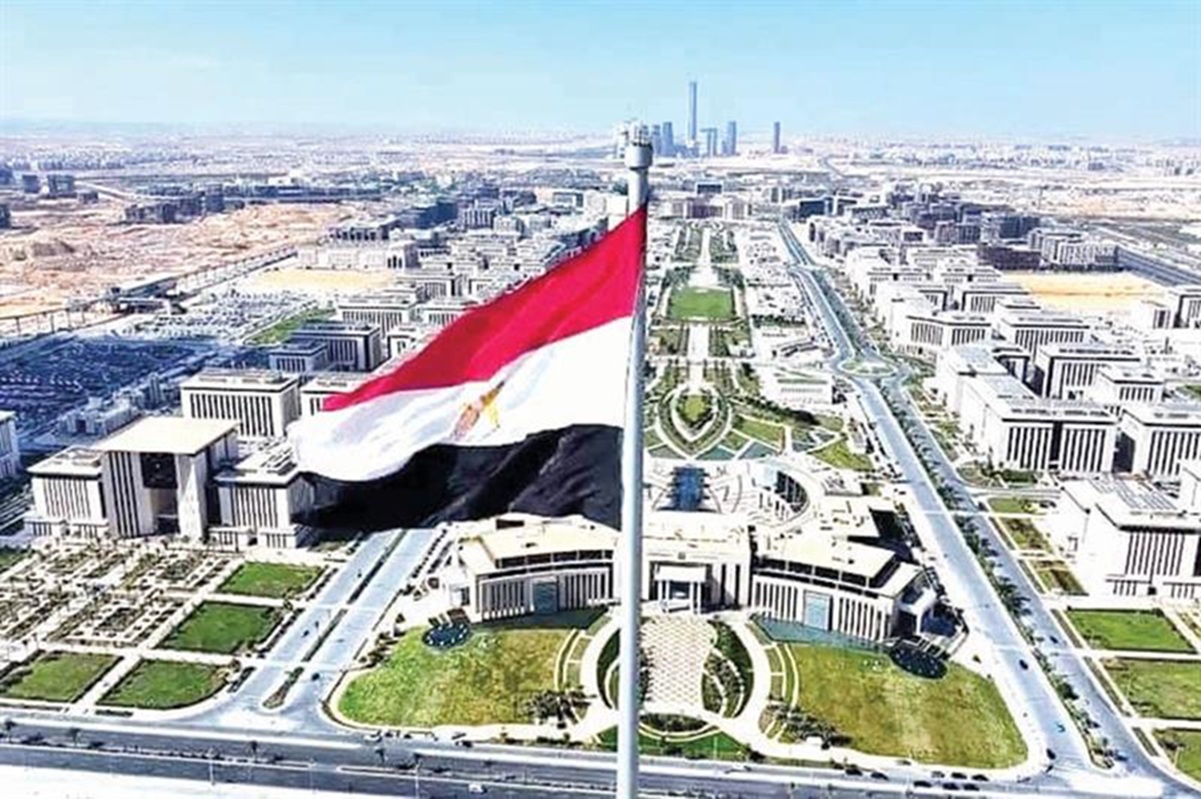
This pressure helps explain the scale of investment undertaken over the past decade: new roads, bridges, rail networks, energy infrastructure, urban extensions, development of new territories and the construction of a new administrative capital east of Cairo.
These projects cannot be reduced to prestige. Greater Cairo cannot indefinitely absorb the country’s demographic and administrative expansion. Egypt is therefore attempting to alter its own geography. But altering geography is expensive.
Build Today, Pay Tomorrow
Here lies one of the central contradictions of the Egyptian model. The country must invest heavily because it is enormous and continues to grow. Yet the very scale of those investments increases its financing requirements.
Over recent years, the Egyptian economy has endured a succession of shocks: the pandemic, higher food and energy prices, the consequences of the war in Ukraine, foreign-currency shortages, repeated depreciation of the Egyptian pound, high inflation and, eventually, the disruption of Red Sea shipping.
By 2026, however, the picture had become more nuanced than one of permanent crisis. The International Monetary Fund estimated real growth at around 4.6% for fiscal year 2025/26, after growth of 5.2% during its first nine months. Inflation, which had severely eroded purchasing power, had moderated but remained high, reaching 14.3% in June 2026. International reserves had strengthened, while remittances from Egyptians abroad and tourism continued to provide essential foreign currency. Stabilisation, however, does not mean that structural vulnerabilities have disappeared.
Egypt continues to face substantial external financing requirements, debt-service pressures and a more fundamental question concerning the allocation of resources between the state, public enterprises, state-affiliated structures and the private sector.
The IMF has repeatedly emphasised this issue: despite macroeconomic progress, the reduction of the state’s economic footprint and the divestment programme have advanced more slowly than expected.
Behind the fiscal debate therefore lies a debate about the development model itself.
The Egyptian state can build quickly. It can mobilise land, public companies, financing and considerable administrative capacity. This ability is one of its principal advantages.
But a sustainably productive economy also requires private investment to develop within a sufficiently predictable and competitive environment.
The challenge of the coming years will be less about choosing abstractly between state and market than determining where one should stop so that the other can expand.
The Gulf and the New Economy of Influence
This question has become more important as Egypt’s relationship with the Gulf monarchies has fundamentally evolved. For much of the twentieth century, Cairo possessed an enormous political and cultural advantage over the Arabian Peninsula. Egypt produced the films, songs, intellectuals, teachers, military officers and much of the political vocabulary of the Arab world. The economic balance is now different.
Saudi Arabia, the United Arab Emirates and Qatar possess vastly greater financial resources and are developing their own economic, media, academic, technological and diplomatic centres.
Part of the Arab world’s centre of gravity has moved from the Nile to the Gulf. For Egypt, this does not mean the disappearance of influence but a transformation of the relationship. Gulf capital can stabilise the external balance, finance projects and acquire assets. The enormous Ras El-Hekma agreement announced with the United Arab Emirates in 2024 illustrated this evolution: Egypt’s financing requirements now intersect directly with the investment and diversification strategies of the Gulf monarchies.
The interdependence is real. But it introduces a new question: how does a major political power preserve its autonomy when the financial centres around it command resources far greater than its own?
Egypt has not become a satellite of the Gulf. Its scale, military, geography and diplomatic apparatus make such an interpretation far too simplistic. But it now operates within a multipolar Arab world in which Cairo no longer possesses a monopoly on centrality.
Suez: A Few Kilometres That Belong to the World
No asset better illustrates Egypt’s relationship with the international system than the Suez Canal. It is Egyptian by sovereignty but global by function.
Connecting the Mediterranean to the Red Sea, it allows a substantial share of trade between Europe and Asia to avoid circumnavigating Africa via the Cape of Good Hope. Since opening in 1869, the canal has therefore become far more than a national infrastructure asset: it is part of the physical architecture of globalisation.
Nasser’s nationalisation of the canal in 1956 demonstrated precisely how infrastructure could simultaneously become an economic asset, a symbol of sovereignty and an instrument of international power.
Seventy years later, another lesson has emerged. Owning strategic infrastructure does not mean controlling everything that determines its value.
Attacks on shipping in the Red Sea from late 2023 led numerous carriers to reroute vessels around Africa. Egypt was not a party to the operations causing this reorganisation of global trade, yet it suffered the consequences directly.
Suez therefore embodies a strategic paradox: it gives Egypt an extraordinary geographical rent while exposing part of its revenues to security conditions around Bab el-Mandeb, more than 2,000 kilometres from Port Said.
Conditions have since partially improved. In early 2026, the Suez Canal Authority reported that during the first half of fiscal year 2025/26, vessel numbers had increased by 5.8%, net tonnage by 16% and revenues by 18.5% compared with the same period a year earlier. The return of large container vessels also pointed towards a gradual normalisation of traffic. But the episode will remain a demonstration of vulnerability.
A crisis in Yemen can affect Cairo’s finances. A decision made by a shipping company in Copenhagen, Marseille or Shanghai can alter Egypt’s foreign-currency inflows. This, too, is the weight of the world.
The Nile: Vulnerability Upstream
If Suez connects Egypt to global commerce, the Nile connects it to Africa. And this relationship is more existential still.
Egypt has historically depended on the river for agriculture, drinking water and the organisation of its territory. But the Nile does not originate in Egypt. Much of its water arrives from the Ethiopian highlands through the Blue Nile.
Ethiopia’s construction of the Grand Ethiopian Renaissance Dam, or GERD, therefore introduced a fundamental question into Egyptian strategy: how can a country guarantee a vital resource when the infrastructure capable of altering its management lies within another sovereign state?
For Addis Ababa, the dam represents development infrastructure, electricity generation and a symbol of national sovereignty. For Cairo, the issue touches directly upon water security. The dispute reveals a broader transformation.
Egypt has historically looked primarily north and east: towards the Mediterranean, the Levant and the Arabian Peninsula. Geography increasingly requires it to look south.
East Africa, Sudan, Ethiopia and the Horn of Africa are no longer diplomatic peripheries. They belong to the first circle of Egyptian national security.
The Nile therefore recalls an elementary truth: even a power of more than one hundred million people can depend on decisions made upstream.
Borders Turned into Crisis Lines
Few major countries today are surrounded by such an unstable environment. To the west, Libya remains politically fragmented.
To the south, the war in Sudan has shattered an already fragile regional equilibrium and generated major population movements. To the northeast lie Israel and Gaza. Further away, the Red Sea opens towards Sudan, Eritrea, Djibouti, Yemen and Bab el-Mandeb.
Egypt therefore sits at the intersection of several crisis systems that were once analysed separately but are becoming increasingly interconnected.
The war in Gaza provides the most sensitive example. The Rafah crossing gives Egypt a particular role. Cairo is simultaneously a territorial neighbour, an interlocutor of Israel, a partner of the United States, a mediator alongside Qatar and other regional actors, and a state deeply opposed to any large-scale and permanent displacement of Palestinians into Sinai.
This position explains why Egyptian diplomacy remains indispensable even as its relative economic influence declines. In August 2026, Egypt was still participating alongside Qatar and Türkiye in mediation efforts concerning Gaza. Here lies a fundamental distinction between wealth and power.
A country can become richer than Egypt. It cannot relocate Rafah, Sinai, Suez or the Nile Delta. Geography therefore continues to guarantee Cairo a seat at the table.
The Military as the Backbone
At the centre of the system stands the military institution. Since 1952, every Egyptian president except Mohamed Morsi has emerged from the military establishment. Under Abdel Fattah el-Sisi, the former defence minister who came to power following Morsi’s removal in 2013 and was subsequently elected president in 2014, that continuity has been reaffirmed. But the military’s role extends far beyond defence.
It is a political, economic and administrative institution with interests across numerous sectors and direct involvement in several major national projects. For its defenders, this architecture provides the state with execution capacity and stability that are particularly valuable in a region where several states have collapsed or fragmented since 2011.
For its critics, it restricts political space, complicates economic competition and concentrates an excessive share of institutional power.
Both dimensions must be considered simultaneously to understand the Egyptian system. The military is not simply another actor within the state. It belongs to the state’s historical architecture.
The question is therefore less whether it will disappear from the system than how its role will evolve as the economy seeks greater private investment, higher productivity and fewer structural distortions.
A Power That Cannot Choose One Camp
This domestic architecture extends into foreign policy. Egypt remains one of the United States’ principal military partners in the Middle East. The peace treaty with Israel has, since 1979, constituted one of the pillars of the regional order supported by Washington.
But Cairo simultaneously maintains relations with Russia, expands trade with China, belongs to BRICS, works closely with the Gulf monarchies, remains deeply engaged in Africa and preserves essential economic ties with Europe.
This positioning is not necessarily hesitation. It reflects the logic of a very large middle power seeking to avoid exclusive strategic dependence.
China can provide trade, investment and infrastructure. Russia remains a military, energy and nuclear partner, notably through the El Dabaa nuclear power project. The United States remains an essential security partner. The European Union is a major market, source of capital and interlocutor on Mediterranean and migration issues. The Gulf provides investment and financing that would be difficult to replace.
Egypt cannot realistically abandon any of these relationships. Its diplomacy therefore consists less in choosing a bloc than in preserving enough relations with each to maintain its own room for manoeuvre.
The Centre Moves
One question remains more difficult to quantify: influence. For decades, Cairo was one of the undisputed cultural capitals of the Arab world. Egyptian cinema, music, literature, universities, newspapers and television structured a cultural space extending from the Maghreb to the Gulf.
That influence has not disappeared. Egyptian Arabic remains widely understood throughout the region, and the country’s cultural production remains considerable. But the ecosystem has changed.
Dubai, Riyadh, Doha and Abu Dhabi now concentrate capital, corporate headquarters, media organisations, international events, technological investment and rapidly expanding cultural industries. Regional power has become much more distributed.
Egypt must therefore accomplish something particularly difficult: retain the advantages of a historic power while learning to operate as one pole within a system that no longer has a single centre. Its size prevents marginality. Its constraints prevent hegemony. Between the two probably lies its true place in the twenty-first century.
The Weight of the World
Egypt is neither the sick man sometimes portrayed by exclusively economic readings nor the uncontested regional power that a simple reading of its demographics and history might suggest. It is more complex.
It possesses one of the most strategic geographies on the planet, yet depends on the stability of regions it does not control. It has an immense population that is simultaneously its market, its strength and its principal social challenge. It has a powerful state but must broaden the economic space available to private enterprise. It controls Suez but not Bab el-Mandeb. It lives by the Nile but does not control its sources. It remains indispensable to the Middle East even as the Arab world’s economic centre of gravity has shifted towards the Gulf. This accumulation of contradictions could be interpreted as weakness.
It may instead be the normal condition of a power situated precisely where several worlds meet.
Egypt no longer possesses the ability to define the regional order alone, as it once aspired to do under Nasser. Nor does it possess the financial resources of the Gulf monarchies, Israel’s technological power or the strategic freedom of a state isolated from the world’s major conflict zones.
But none of those actors possesses what Egypt possesses simultaneously: Africa and the Middle East, the Mediterranean and the Red Sea, the Nile and Suez, demographic mass and historical depth. That is why Egyptian crises invariably generate concern far beyond Egypt itself.
The country is too large for its difficulties to remain national, too central for its weakening to be without consequences and too exposed to escape the transformations of the international system.
For millennia, Egypt has organised its survival around a river crossing the desert. In the twenty-first century, the principle remains strangely similar. It must continue to concentrate limited resources, absorb immense pressures and maintain the cohesion of a vast human space amid an unstable environment.
Egypt still carries part of the world. But now, it feels all of its weight.
Main Sources
International Monetary Fund (IMF) — macroeconomic data, growth outlook, inflation, external financing and Egypt’s economic programme, including the seventh review under the Extended Fund Facility published in July 2026.
Suez Canal Authority — canal traffic, tonnage and revenue data, including statistics concerning the gradual recovery of shipping during 2025–2026.
World Bank — structural data on Egypt’s economy, population, development trajectory and macroeconomic constraints.
CAPMAS — Central Agency for Public Mobilization and Statistics — national demographic and socioeconomic statistics.
Egyptian institutional sources and international documentation — infrastructure, economic policy, energy, regional relations and major development projects.
Reuters — recent regional developments concerning Gaza, Egyptian diplomacy, energy and international economic relations.
Atlas Limits Research Desk
Atlas Limits’ editorial and analytical desk.