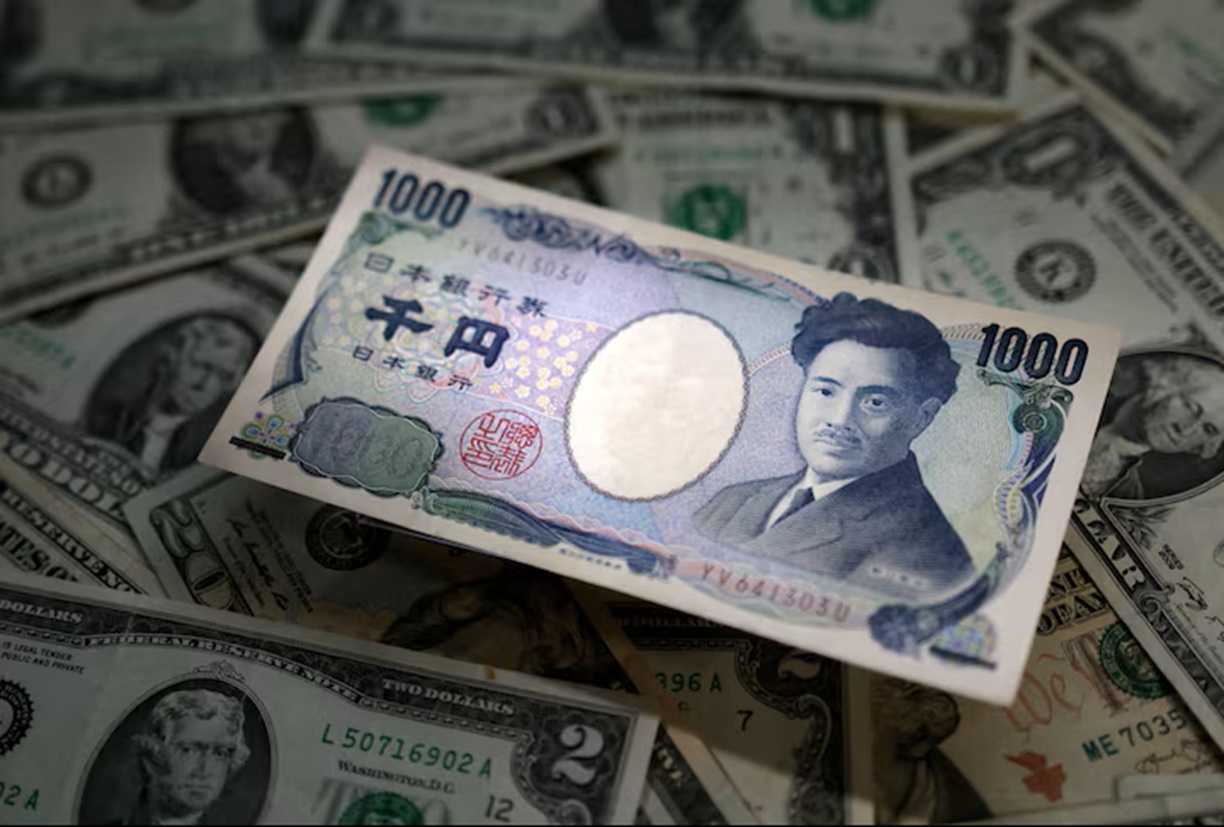
For a long time, Japanese interventions in the foreign-exchange market followed a relatively familiar script. The yen weakened too quickly, the Ministry of Finance issued increasingly explicit warnings, and Tokyo eventually bought its own currency to remind markets that some trajectories were not entirely unconstrained. The effect might last for days or weeks before interest-rate differentials and capital flows resumed their work.
The summer of 2026 changed the scale of the problem.
Japan’s official reserves fell to $1.2075 trillion at the end of August, from $1.2871 trillion a month earlier. The $79.6 billion decline, or 6.18%, was the largest monthly drop on record. At the same time, the value of securities held within the reserves fell from $927.3 billion to $839.6 billion.
These figures cannot be mechanically equated with the cost of intervention. Japan’s reserves are valued at market prices, bonds and gold fluctuate in value, and assets denominated in other currencies are converted into dollars at prevailing exchange rates. But the order of magnitude is consistent with another figure published by the Ministry of Finance: between July 30 and August 26, Japan spent ¥15.399 trillion on foreign-exchange operations, close to $100 billion at exchange rates prevailing during the period. It was Tokyo’s largest monthly intervention on record.
The yen had previously fallen toward 164 per dollar, its weakest level in four decades. Intervention pushed it back toward 155 in early August. But the relief was not permanent: the currency subsequently weakened toward 160 before returning to the 155–156 range in early September.
It is precisely this difficulty in stabilizing the currency durably that gives the episode its significance.
From National Intervention to Monetary Coordination
On July 31, Japan did not intervene alone.
The Japanese Ministry of Finance later confirmed that it had purchased yen in coordination with the U.S. Treasury Department. It was the first joint intervention by the two countries since 2011. Tokyo said the operation was intended to address what both governments regarded as excessive and disorderly currency movements, adding that it would not hesitate to act jointly again.
The distinction may appear technical. It is not.
A coordinated intervention means that defending the yen is no longer solely a matter between Japan’s Ministry of Finance and the foreign-exchange market. Washington is now willing to participate directly in stabilizing the currency of its principal Asian ally.
The July 31 operation can still be regarded as exceptional. The mechanism announced around it is potentially more consequential.
In the same statement, Japanese Finance Minister Satsuki Katayama said Japan planned to use the Federal Reserve’s Foreign and International Monetary Authorities Repo Facility, or FIMA, in the future.
Created in 2020 and made permanent in 2021, the facility allows approved foreign central banks and monetary authorities to obtain dollars temporarily from the Federal Reserve against U.S. Treasury securities held at the Federal Reserve Bank of New York. The securities can then be repurchased when the repo matures.
In other words, a country needing dollars does not necessarily have to sell its Treasuries immediately into the market.
The mechanism was originally designed to prevent large foreign demand for dollars from triggering forced sales of U.S. government bonds and destabilizing the Treasury market. In 2026, it could acquire another application: indirectly supporting an ally’s capacity to intervene in its own currency.
The shift deserves attention.
Three Markets Begin to Converge
Japan still holds more than $1.2 trillion in reserves. It is therefore not experiencing a conventional balance-of-payments crisis, nor does it face an immediate shortage of foreign currency.
But the composition of those reserves makes intervention on this scale systemically relevant.
At the end of July, Tokyo held $927 billion in securities within its official reserves. One month later, that component had fallen to roughly $840 billion. A substantial share of these assets consists of U.S. government debt.
When Japan sells dollar assets to buy yen, it is therefore not merely altering the USD/JPY exchange rate. It can also affect demand for U.S. Treasuries.
And when it chooses instead to mobilize those securities through FIMA, a third institution enters the equation: the Federal Reserve.
The yen, Japan’s reserves and the U.S. government bond market are thus beginning to be connected through the same liquidity infrastructure.
This is probably the most important aspect of the episode.
Foreign-exchange reserves are often portrayed as a kind of national vault: a stockpile of assets accumulated so that a country can defend its currency when circumstances require it. In practice, they belong to a much more circular financial system. Japan holds large quantities of U.S. debt to invest its reserves. When its currency needs defending, those assets can be mobilized. If selling them becomes problematic for the American market, the U.S. central bank can provide a mechanism through which they can generate liquidity without being liquidated.
The vault, it turns out, has a connecting door.
Washington Is Also Protecting Its Own Market
The American interest is not merely geopolitical.
Japan is one of the largest foreign holders of U.S. government debt. A succession of Japanese interventions financed through large-scale Treasury sales could place additional pressure on a market that already sits at the center of the global financial system.
FIMA is designed precisely to reduce that risk.
The Federal Reserve itself describes the facility as providing foreign monetary authorities with an alternative source of dollars so that they are less likely to be forced to sell Treasuries in the open market. One of its explicit purposes is to support the smooth functioning of U.S. financial markets.
Potential Japanese use of FIMA would therefore produce an unusually clear alignment of interests.
Japan could continue obtaining the dollar liquidity needed for its operations while reducing the amount of U.S. government debt it needs to sell. The United States, meanwhile, would limit the risk that one of its largest allies inadvertently becomes a source of pressure on its own bond market.
Monetary cooperation between Tokyo and Washington is therefore not simply an expression of solidarity between allies. It is also a form of mutual balance-sheet protection.
Reserves Can Buy Time
This architecture does not, however, resolve the fundamental cause of yen weakness.
A central bank or government can move the price of a currency by buying it on a massive scale. It is considerably more difficult to change permanently the reasons investors want to sell it.
For years, the yen has suffered in part from the interest-rate differential between Japan and other developed economies. When yields available in the United States are substantially higher than those available in Japan, capital has a natural incentive to leave the yen in search of higher returns elsewhere.
Intervention can resist that movement. It cannot indefinitely replace the forces behind it.
The market reaction following the July intervention illustrated the problem. A sharp appreciation of the yen was followed by renewed weakness. Only weeks after the record operation, Tokyo and Washington were already discussing the need to maintain coordination.
The problem is therefore beginning to migrate.
If the authorities want a durable appreciation of the currency, the question will no longer simply be how many dollars the Ministry of Finance can mobilize. It will increasingly be whether Japanese monetary policy can narrow the yield differential that structurally contributes to yen weakness.
By early September, markets were almost fully pricing another 25-basis-point increase by the Bank of Japan at its September 17–18 meeting. Even advisers traditionally associated with highly accommodative monetary policy were discussing the need for further tightening.
This is where defending the yen encounters a deeper constraint.
The Domestic Price of a Stronger Yen
Higher interest rates can support the currency. But Japan is not an economy in which rates can be raised without consequences.
Its public debt is enormous, its economy has adapted over decades to exceptionally low financing costs, and its government bond market has been profoundly shaped by past Bank of Japan intervention.
A more restrictive monetary policy can therefore strengthen the yen while gradually increasing the financing cost of the state and the broader economy.
Tokyo faces a trade-off that reserves can postpone but cannot eliminate.
Keeping rates too low preserves the differential with the United States and weakens the currency. A weak currency raises import costs and feeds inflation. Massive intervention can slow depreciation, but it consumes or mobilizes reserves. Raising rates more aggressively reduces pressure on the currency, but increases domestic financing costs.
Each solution therefore transfers part of the problem to another component of the system.
A New Function for the Dollar Architecture
The Japanese episode also says something about the international monetary system.
Large foreign-exchange reserves accumulated by states are sometimes interpreted as a means of reducing their vulnerability to the dollar. Yet when those reserves are themselves invested primarily in dollar-denominated assets, using them can reinforce links with the American financial infrastructure rather than weaken them.
Japan provides an almost perfect illustration.
Tokyo possesses one of the world’s largest stocks of foreign reserves. It can therefore intervene with financial power available to very few countries. But a large part of that power is stored in assets embedded within the American financial market.
When defending the yen becomes large enough to risk disturbing that market, the Federal Reserve in turn possesses a mechanism capable of transforming those assets into liquidity.
The network closes back on itself.
This does not mean that the Federal Reserve is now directly defending the yen. FIMA is not a financing line dedicated to the Japanese currency, and its use remains governed by the Federal Reserve’s own framework. Its institutional purpose remains the temporary provision of dollar liquidity and the stability of the Treasury market.
But if Tokyo actually uses it to support the operations required to stabilize its currency, the boundary between the dollar liquidity infrastructure and the exchange-rate policy of an allied country will become thinner than it has been until now.
The Record Is Probably Not the Story
Japan still possesses an immense stock of reserves. A decline of almost $80 billion in a single month does not immediately threaten its ability to intervene.
The real signal lies elsewhere.
Within a matter of weeks, Tokyo conducted the largest foreign-exchange intervention in its history, secured coordinated action from the United States, recorded a sharp decline in the value of the securities component of its reserves, and announced its intention to mobilize a permanent Federal Reserve facility to access dollars without having to liquidate as many Treasuries.
Taken separately, each of these developments can be described as a technical stabilization instrument.
Taken together, they indicate that defending the yen has moved to a different scale.
And that may be the central paradox. Japan has enough reserves to fight the market for a long time. But the larger that fight becomes, the more clearly it reveals that reserves are not an independent form of financial power. They belong to a system of interest rates, debt and liquidity in which Washington still controls a crucial part of the infrastructure.
Japan can defend the yen with its reserves.
What it is discovering is that, at this scale, it no longer defends it alone.
Main Sources
Japan Ministry of Finance — International Reserves/Foreign Currency Liquidity, end-July and end-August 2026.
Japan Ministry of Finance — Foreign Exchange Intervention Operations, July 30–August 26, 2026.
Japan Ministry of Finance — Statement by Finance Minister Satsuki Katayama, August 3, 2026, concerning coordinated intervention with the United States and planned future use of FIMA.
Federal Reserve Board — Foreign and International Monetary Authorities Repo Facility and institutional FAQ.
Reuters — reporting on Japanese intervention, yen movements and U.S.–Japan monetary coordination, August–September 2026.
Atlas Limits Research Desk
Atlas Limits’ editorial and analytical desk.