There are international relationships that can be broken. The one between Morocco and Spain is probably not among them.
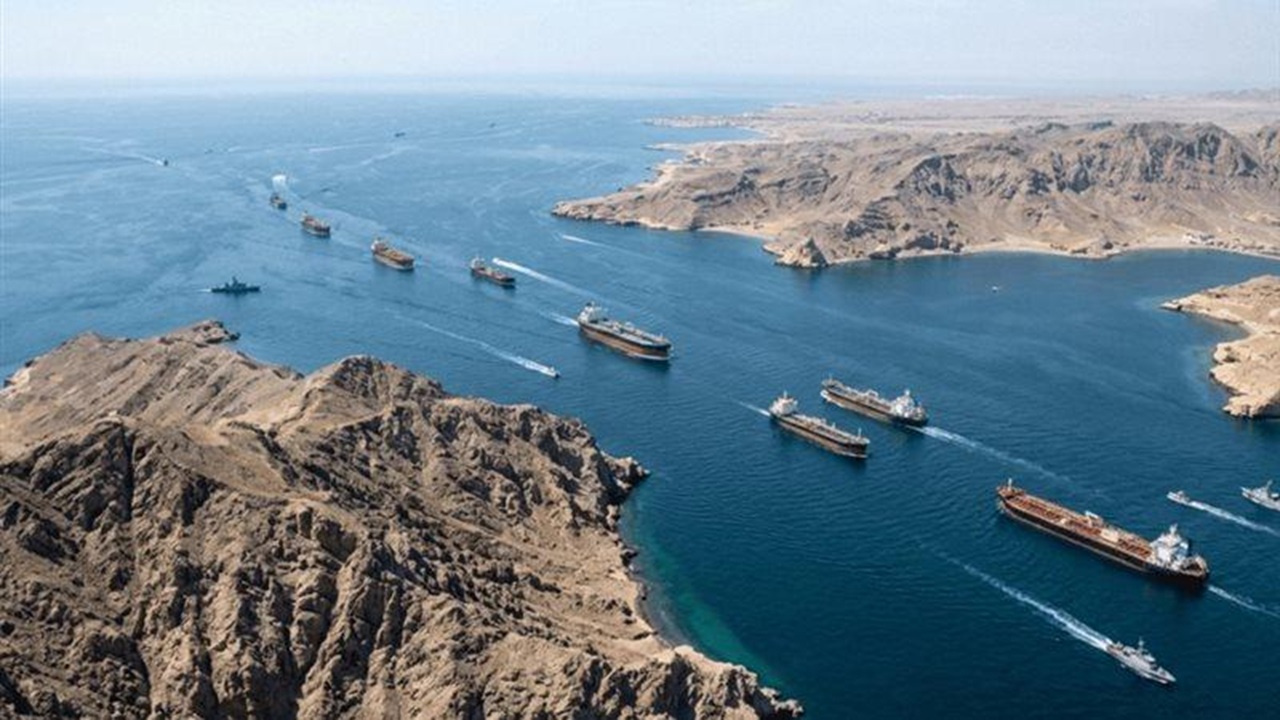
Fourteen kilometres separate the two shores of the Strait of Gibraltar. Yet this narrow distance concentrates an exceptional density of strategic interests. Goods, capital, tourists, workers, energy flows and industrial supply chains cross it every day. Morocco has become Spain’s leading trading partner in Africa; Spain has been Morocco’s leading trading partner since 2012. The two countries cooperate on migration, counterterrorism, drug trafficking, energy, infrastructure and, increasingly, the organisation of the 2030 FIFA World Cup.
This interdependence is well established. What is changing in 2026 is something else: the political architecture designed to prevent historical disputes from contaminating that interdependence is beginning to show its limits.
The paradox is striking. As recently as December 2025, Madrid and Rabat were describing their bilateral relationship as being at its strongest point in modern times. Only months later, Algeria is again occupying a central place in Spanish diplomacy, the Western Sahara issue is advancing in the Spanish parliament, Ceuta has experienced a major migration crisis, Morocco has publicly reiterated its claims over Ceuta and Melilla, while Spain is preparing a visit by Felipe VI to both cities.
None of this amounts to a rupture. Taken together, however, these developments suggest that the broad normalisation launched in 2022 may have reached its political frontier.
A Relationship Built to Survive Its Own Contradictions
The contemporary history of Spanish-Moroccan relations is less a story of reconciliation than one of the gradual institutionalisation of disagreement.
Morocco gained independence in 1956. Spain retained Ceuta and Melilla, which Madrid considers integral parts of its national territory and which Rabat claims. In 1975, Spain withdrew from Western Sahara, its former colony, whose status has since remained at the heart of the confrontation between Morocco and the Polisario Front, backed by Algeria.
Over time, this conflict-laden geography was accompanied by an economic, human and security interdependence that became increasingly difficult to unwind.
In 1991, the two kingdoms attempted to give this contradiction an institutional structure. The Treaty of Friendship, Good-Neighbourliness and Cooperation signed in Rabat provided for regular high-level meetings, affirmed respect for territorial integrity and organised cooperation in economic, military, cultural, legal and security affairs. The treaty even envisaged cooperation on a future fixed link across the Strait of Gibraltar.
The ambition was clear: to transform a historically conflictual proximity into an organised bilateral system.
It did not eliminate crises.
In July 2002, Moroccan troops occupied Perejil Island, an uninhabited islet located only a few hundred metres from the Moroccan coast. Spain deployed forces and retook the island. The episode was brief and geographically almost trivial, yet politically substantial: two states bound for eleven years by a treaty of good neighbourliness had found themselves in a military confrontation over a few hectares of rock.
Another red line emerged in November 2007, when King Juan Carlos and Queen Sofía visited Ceuta and Melilla. Rabat recalled its ambassador for consultations. Nearly two decades later, that precedent has again become directly relevant.
The lesson from these recurring crises is straightforward: cooperation has never eliminated sovereignty disputes. It has merely increased the cost of activating them.
2021: The Demonstration
The crisis of May 2021 provided the clearest demonstration of this vulnerability.
Spain quietly admitted Brahim Ghali, leader of the Polisario Front, for treatment after he contracted Covid-19. Rabat viewed the decision as a direct challenge to what it considers one of its core national interests in Western Sahara.
A few weeks later, around 8,000 people entered Ceuta over two days as Moroccan border controls loosened. Madrid implicitly accused Rabat of using migratory pressure. Morocco replied that the real issue was political: Spain could not, in Rabat’s view, cooperate closely with Morocco while taking decisions touching on what the kingdom regards as its territorial integrity.
The crisis exposed a central feature of the relationship: the dossiers are formally separate, but they can become connected very quickly.
Western Sahara, migration, borders, security cooperation and diplomacy do not necessarily form a permanent system of bargaining. They do, however, form a system in which a breakdown of trust in one area can alter the balance in others.
Pedro Sánchez then chose a response that would transform the relationship.
2022: Spain’s Strategic Shift
On 18 March 2022, Morocco’s royal palace made public a letter from Pedro Sánchez in which Spain described Morocco’s 2007 autonomy proposal for Western Sahara as “the most serious, realistic and credible basis” for resolving the dispute.
For Madrid, the change was substantial.
Spain did not formally recognise Moroccan sovereignty over Western Sahara and continued to frame any settlement within the United Nations process. But it abandoned the more balanced position that had traditionally defined its policy and moved significantly closer to Rabat.
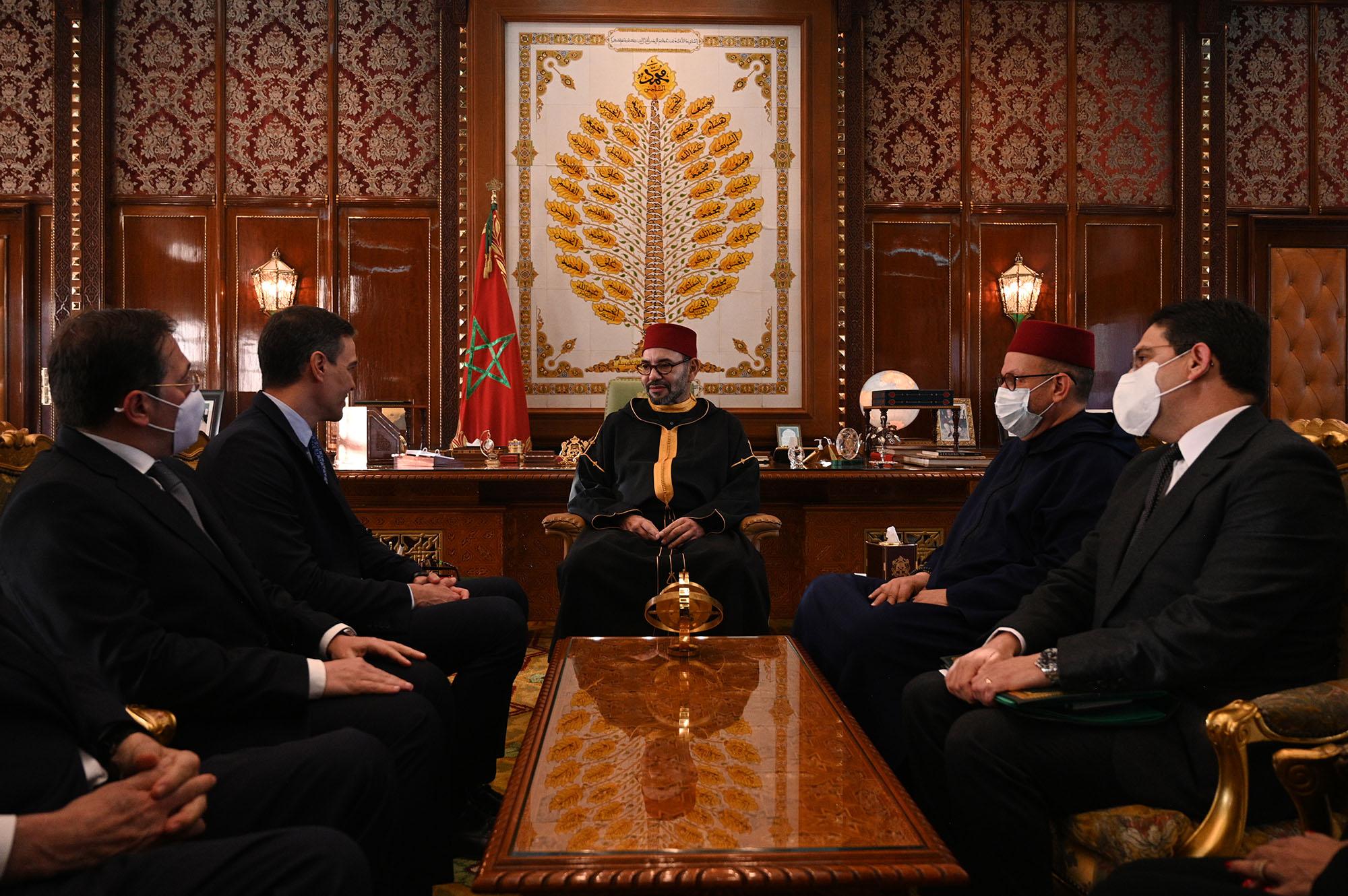
On 7 April, Sánchez met Mohammed VI in Rabat. A new bilateral roadmap was adopted. It rested on trust, permanent consultation and a commitment to avoid unilateral acts and faits accomplis. Maritime links were restored, migration-management mechanisms were reactivated, talks on maritime boundaries resumed, and the normalisation of cross-border trade at Ceuta and Melilla was placed on the agenda.
The geopolitical cost was immediate.
Algeria, the principal supporter of the Polisario Front and a major energy supplier to Spain, recalled its ambassador and in June 2022 suspended its friendship treaty with Madrid. In practice, Spain had resolved one Maghreb crisis by opening another.
The choice could nevertheless be defended through its short-term results. Cooperation with Rabat resumed. Trade accelerated. Migration pressure could again be managed jointly. Political relations gradually reached a level rarely seen before.
The mechanism appeared to be working.
The High Point
The 4 December 2025 summit probably marked the high point of that sequence.
Pedro Sánchez and Aziz Akhannouch chaired the 13th High-Level Meeting between the two countries in Madrid. Fourteen cooperation agreements were signed. Both governments described the relationship in explicitly historic terms and reaffirmed the 2022 roadmap.
The economic figures gave substance to the diplomatic rhetoric.
In 2024, bilateral merchandise trade reached approximately €22.7 billion, a record and an increase of more than 7 percent. Spanish exports to Morocco stood at €12.859 billion, while imports reached €9.834 billion. More than 6,000 Spanish companies exported regularly to the Moroccan market, while more than 900 had subsidiaries or significant equity interests there.
Human interdependence was deepening in parallel. By late 2025, the Spanish government noted that Moroccans formed the largest foreign national community in the country and that roughly 335,000 Moroccan nationals were contributing to Spain’s social security system.
A common strategic horizon was also taking shape: Spain, Morocco and Portugal will jointly host the 2030 FIFA World Cup. Madrid has simultaneously encouraged Spanish companies to participate in Morocco’s large infrastructure projects; Spain had already approved more than €750 million in financing for a Moroccan rail project.
Even an issue carrying heavy symbolic weight had begun to move: in January 2025, commercial goods traffic resumed at Melilla after years of disruption.
By the end of 2025, the logic of the relationship seemed to have changed in nature. It was no longer merely about managing a difficult neighbour. The two economies were increasingly functioning as components of the same productive space linking Europe and Africa.
And yet, beneath this growing integration, the old disputes had not disappeared.
Western Sahara Never Left the Room
The first reminder came less from Madrid or Rabat than from European law.
On 4 October 2024, the Court of Justice of the European Union upheld the annulment of trade agreements between the European Union and Morocco insofar as they applied to Western Sahara without the consent of the people of the territory.
The judgment illustrated a contradiction that bilateral diplomacy could not resolve on its own. Madrid could move politically closer to Morocco’s position, but it remained a member of a European Union whose legal order continued to distinguish Morocco from Western Sahara.
Within Spain itself, the colonial legacy produced another contradiction.
A legislative proposal in the Spanish Congress seeks to facilitate access to Spanish nationality for Sahrawis born when the territory was administered by Spain. The proposal did not emerge from the crisis of 2026; its parliamentary origins predate it. That is precisely what makes it significant.
On 23 July 2026, the Justice Committee approved the proposal. In August, Congress published the text as it moved further along the parliamentary process.
Spain therefore found itself in an unusual position: its government regarded Morocco’s autonomy plan as the most credible basis for a settlement, while its parliament was examining the legal consequences of Spain’s historical responsibility toward the population of its former colony.
The two positions are not legally incompatible. Politically, their coexistence is far less comfortable.
The Return of Algiers
Another development may be even more important.
After the rupture triggered by Spain’s 2022 shift, Madrid gradually began rebuilding its relationship with Algeria.
The process accelerated in 2026.
On 26 March, Foreign Minister José Manuel Albares travelled to Algiers. Algeria had been Spain’s leading supplier of natural gas for the third consecutive year. Political dialogue resumed and the friendship treaty suspended during the crisis was reactivated.
Then, on 20 July 2026, Pedro Sánchez travelled to Algiers himself and met Abdelmadjid Tebboune. He described Algeria as a strategic partner and a friendly country. The two governments announced a new high-level meeting for the autumn and pledged to deepen cooperation on energy, security, counterterrorism and migration.
By then, Algeria was again Spain’s leading supplier of natural gas in 2026.
It would be excessive to interpret this rapprochement as a Spanish turn against Morocco. Madrid has not withdrawn its support for Morocco’s autonomy plan. It is doing something more conventional: rebuilding a two-legged Maghreb policy.
For Spain, that is rational. For Rabat, it cannot be irrelevant. Morocco’s principal European partner is again normalising relations with Morocco’s principal regional rival.
And the chronology became increasingly striking.
Sánchez was in Algiers on 20 July. Three days later, the Sahrawi nationality proposal crossed an important parliamentary threshold.
A week later, Ceuta erupted.
Ceuta, Again
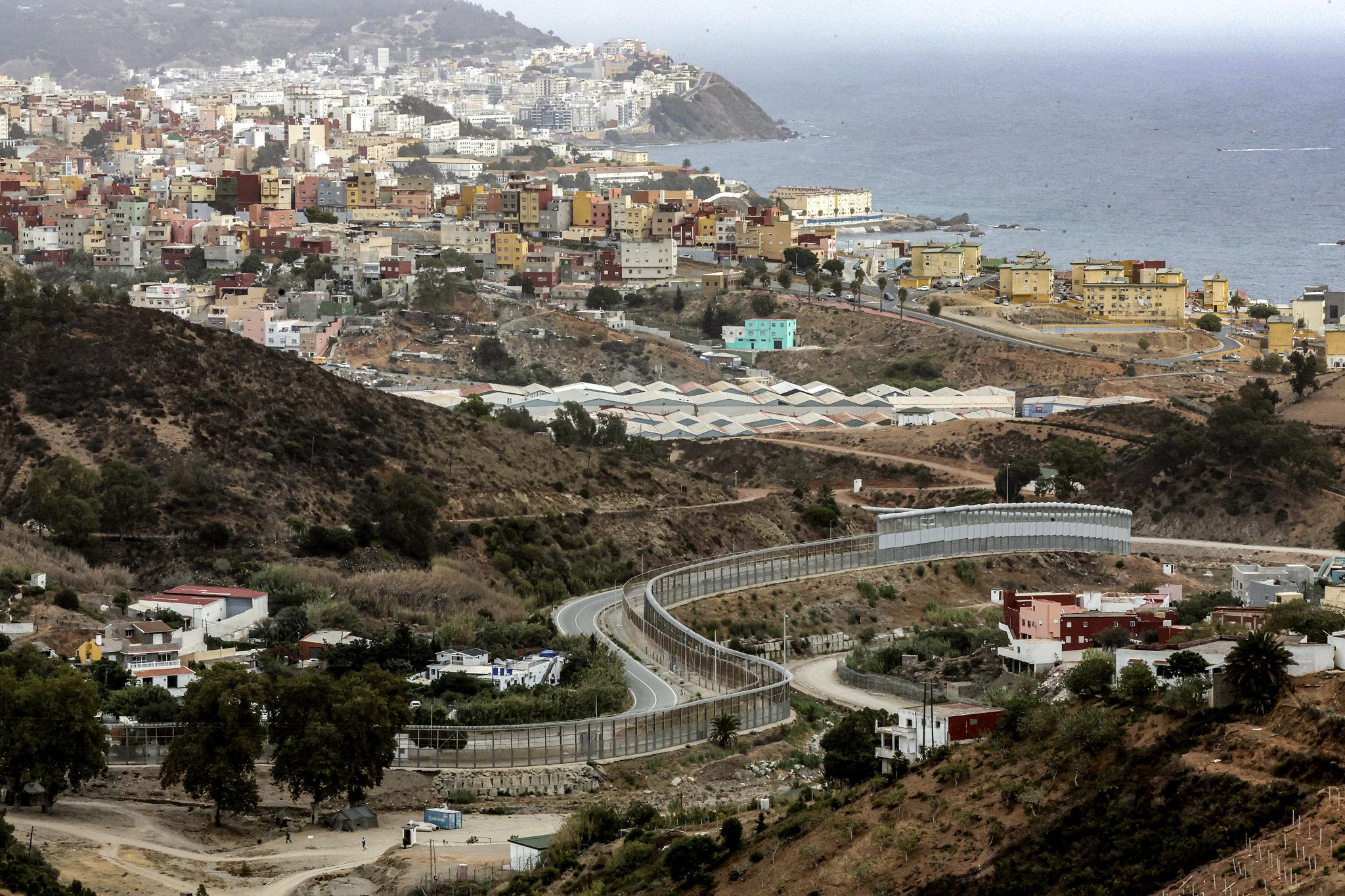 On 30 and 31 July 2026, more than 70,000 people crossed into Ceuta from Morocco in a movement of exceptional scale.
The episode triggered a humanitarian disaster and a major political crisis in Spain.
The most sensitive question remains unresolved: what exactly happened on the Moroccan side of the border?
Pedro Sánchez has said that there is no evidence proving that the Moroccan government designed or ordered the operation. He has nevertheless acknowledged that Moroccan forces allowed crossings to take place during a critical period of roughly ten hours. Rabat denies having orchestrated the movement and has pointed instead to smuggling networks, social media and false information.
Evidence gathered by Spanish police and transmitted to judicial authorities has nevertheless described unusually permissive behaviour by Moroccan forces and raised questions about what occurred at the border.
At this stage, attributing political responsibility to Rabat would go beyond the available evidence.
But uncertainty itself is now producing strategic effects.
Trust, which was precisely the central political asset of the 2022 roadmap, has been weakened.
Spanish society, meanwhile, has already reached its own conclusions. In a 40dB poll published on 7 September, nearly nine in ten respondents attributed some responsibility for the Ceuta crisis to Morocco. A majority also judged Pedro Sánchez’s handling of the episode negatively.
The government’s Morocco policy, long treated largely as a matter of diplomacy, has therefore become a domestic political issue.
That is a major shift.
Ceuta and Melilla Return to the Foreground
The crisis then produced precisely what the 2022 normalisation had sought to avoid: the explicit return of sovereignty disputes.
In August, Moroccan Justice Minister Abdellatif Ouahbi publicly reiterated Morocco’s claim to Ceuta and Melilla and referred to a future settlement through dialogue.
Madrid responded immediately. Defence Minister Margarita Robles stressed the Spanish character of both cities, while the Foreign Ministry reaffirmed that Spain’s territorial integrity was not negotiable.
The significance does not lie in the fact that Morocco’s claim is new. It is not. The change lies in its public re-emergence within a relationship that both governments had carefully organised in order not to confront it directly.
Madrid then raised the symbolic stakes further.
The government and the royal household are preparing a visit by Felipe VI to Ceuta and Melilla. It would be the king’s first visit since ascending to the throne in 2014.
The precedent is politically heavy: when Juan Carlos visited both cities in 2007, Morocco recalled its ambassador.
No one yet knows how Rabat would respond this time. But the very prospect of the visit shows how much the political centre of gravity in Spain has shifted since July.
A government that invested substantial diplomatic capital in protecting its relationship with Morocco must now demonstrate to its own public that it will not compromise on Spanish sovereignty.
The Sánchez Problem
This may be the most important way in which the current crisis differs from previous ones.
In 2022, Pedro Sánchez could absorb a high domestic political cost in order to restore relations with Rabat. His shift on Western Sahara provoked opposition from parts of his coalition, from parliament and from sections of public opinion, but the government could point to tangible results: border stability, migration cooperation, stronger trade and diplomatic normalisation.
In 2026, that equation has become far harder.
If Sánchez protects Rabat too aggressively after Ceuta, the opposition can accuse him of having exchanged a historic concession on Western Sahara for border stability that Morocco ultimately proved unable — or, according to his critics, not always willing — to guarantee.
If he hardens his position against Rabat, he risks weakening precisely the migration and security cooperation he sought to restore.
And if he simultaneously deepens ties with Algiers, supports a royal visit to Ceuta and Melilla, and allows the Sahrawi nationality proposal to continue through parliament, Rabat may conclude that the political spirit of 2022 is gradually being diluted even if its formal terms remain intact.
Madrid therefore faces a familiar dilemma: how to maintain a privileged relationship with Morocco without allowing that relationship to become a form of political dependence.
Rabat faces the inverse problem: how to convert its strategic importance to Spain into durable influence without provoking the very Spanish reactions that reduce that influence.
Interdependence as a Brake
It would nevertheless be premature to announce the end of the rapprochement.
The structural forces point in the opposite direction.
More than €22 billion in annual merchandise trade does not disappear because of a diplomatic crisis. Thousands of companies on both sides of the Strait require stability. Spain remains a crucial gateway between Morocco and the European market. Morocco remains essential to Spain’s migration and security policy on its southern frontier.
Infrastructure deepens that interdependence further. The ports of Algeciras and Tanger Med operate simultaneously as competitors and as nodes within the same Strait economy. Automotive, textile, agri-food and logistics supply chains cross the maritime border in both directions. Electricity interconnections already link the two countries.
And then there is 2030.
In four years, Morocco, Spain and Portugal are due to host the World Cup together. For Rabat and Madrid, the event extends far beyond football: infrastructure, transport, tourism, investment and international image make it a shared geoeconomic project.
A genuine diplomatic rupture would therefore impose costs that neither side has an interest in paying.
That is precisely what makes the relationship more complex than a conventional crisis.
The Limits of Rapprochement
Spain and Morocco are not returning to 2021.
Their economic relationship is denser. Their cooperation mechanisms are more numerous. Their governments have stronger communication channels. The 2030 World Cup creates a common horizon. And Madrid has not reversed its strategic shift on Western Sahara.
But something has nevertheless moved.
The normalisation of 2022 rested on the belief that a sufficiently dense and predictable relationship could contain the most dangerous historical disputes. Four years later, those very disputes are resurfacing: Western Sahara, Algeria, Ceuta, Melilla, migration, sovereignty and colonial memory.
They are not returning separately. They are interacting.
That is probably where the true limit of the Spanish-Moroccan rapprochement lies. Economics can reduce the cost of conflict. Cooperation can make crises less frequent. Diplomacy can organise silence around certain disagreements. But none of these things can erase geography or history.
Since 1991, Madrid and Rabat have learned to manage that reality more effectively than before. Since 2022, they had even begun to believe they might move beyond it.
The year 2026 is a reminder of a more uncomfortable distinction: a relationship can become indispensable without becoming settled.
And that, perhaps more than the Ceuta crisis itself, is what Madrid and Rabat must now learn to manage.
Main Sources
Government of Spain — Treaty of Friendship, Good-Neighbourliness and Cooperation between Spain and Morocco, 4 July 1991; official documentation on bilateral relations; 13th Spain–Morocco High-Level Meeting, 4 December 2025; Pedro Sánchez’s visit to Algeria, 20 July 2026.
Moroccan Ministry of Foreign Affairs — Spain–Morocco Joint Declaration and bilateral roadmap of 7 April 2022.
Spanish Ministry of Foreign Affairs — bilateral relations with Morocco; economic and security cooperation; José Manuel Albares’s visit to Algeria, March 2026.
Spanish Ministry of Economy, Trade and Business — data on Spain–Morocco trade and bilateral economic cooperation.
Congress of Deputies — legislative proposal concerning Spanish nationality for Sahrawis born under Spanish administration; Justice Committee proceedings, July–August 2026.
Court of Justice of the European Union — judgments of 4 October 2024 concerning EU–Morocco agreements and Western Sahara.
Reuters, EFE, Associated Press — July 2026 Ceuta crisis, Spanish and Moroccan political reactions, developments in Spanish public opinion and preparations for a visit by Felipe VI to Ceuta and Melilla.
Atlas Limits Research Desk
Atlas Limits’ editorial and analytical desk.