Long regarded as a peculiar sector — essential to sovereignty but peripheral to the ordinary economy — the defense industry is returning to the center of industrial policy. European rearmament, the war in Ukraine, tensions in Asia and the modernization of military arsenals are turning defense procurement into investment programs stretching over decades. But one question remains: is the arms industry really an economic engine, or does it primarily transform part of a country's existing wealth into military power?
In 2025, global military expenditure reached $2.887 trillion, according to the Stockholm International Peace Research Institute (SIPRI). It increased by 2.9% in real terms in a single year and by 41% since 2016. The world now devotes roughly 2.5% of its gross domestic product to military expenditure.
Behind this enormous sum lies an industry whose geography largely mirrors that of global economic and technological power. The United States, Western Europe, China, Russia, Japan, South Korea, Israel and, increasingly, several emerging powers maintain industrial systems capable of producing combat aircraft, missiles, submarines, satellites, radars, armored vehicles, electronic systems, drones and military software.
Yet defense is not an industry like any other.
Its primary customer is the state. Its markets respond less to conventional consumer cycles than to perceptions of threats, alliances, military doctrines and shifts in the balance of power.
Understanding its economic significance therefore requires moving beyond a simple assumption: more military spending does not automatically mean greater prosperity.
From the War Economy to the Military-Industrial Complex
The world wars demonstrated how extensively a modern country could mobilize its industrial base. Steelmaking, automobiles, chemicals, shipbuilding, aviation and electronics could all be redirected toward military production on a colossal scale.
The fundamental break, however, came after 1945.
The Cold War transformed what had previously been an exceptional mobilization into a permanent structure. Both the United States and the Soviet Union maintained enormous armed forces during peacetime, continuously financed new weapons systems and built industrial, scientific and academic networks around national defense.
On January 17, 1961, at the end of his presidency, Dwight D. Eisenhower gave this new reality a name that would become famous: the “military-industrial complex.”
The former Supreme Allied Commander in Europe did not dispute the necessity of strong national defense. He warned, however, that the permanent combination of an immense military establishment and a large arms industry had created a new center of power in American history.
More than six decades later, that architecture has not disappeared.
It has become international.
An Industry Worth Hundreds of Billions of Dollars
The numbers provide an initial measure of the phenomenon.
According to SIPRI, arms revenues generated by the world's 100 largest arms-producing and military-services companies reached a record $679 billion in 2024. They had increased by 5.9% in a single year and by 26% since 2015.
The United States occupies the dominant position. Thirty-nine American companies were represented among those 100 groups, generating $334 billion in arms revenues.
Around companies such as Lockheed Martin, RTX, Northrop Grumman, General Dynamics and Boeing exists an immense network of subcontractors, engineering firms, laboratories, component manufacturers, electronics companies and service providers.
Europe simultaneously maintains major industrial centers around groups such as BAE Systems, Airbus, Leonardo, Rheinmetall, Thales, Dassault Aviation, Safran and Saab.
And the current trajectory is clearly expansionary.
In 2025, European military expenditure increased by 14% in real terms to approximately $864 billion, according to SIPRI's regional definition. Germany spent around $114 billion, the United Kingdom $89 billion and France $68 billion.
Defense has therefore once again become a growth industry.
But that still does not necessarily make it an engine of national economic growth.
The Immediate Economic Effect: Orders, Factories and Jobs
A military procurement contract is, first and foremost, public expenditure.
When a government orders aircraft, frigates or air-defense systems manufactured domestically, the money finances companies that pay employees, purchase components, build facilities and compensate suppliers.
Part of that expenditure subsequently flows back through the economy in the form of wages, investment, taxes and subcontracting orders.
In some regions, the impact can be considerable.
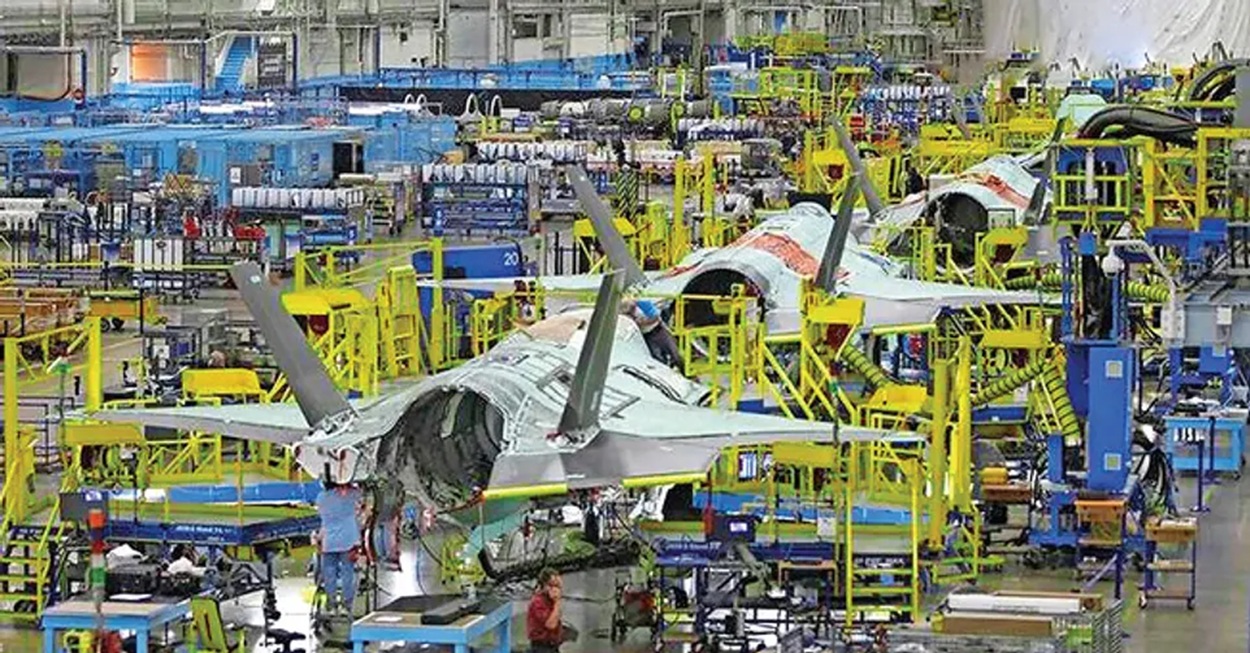
A factory producing combat aircraft, missiles or armored vehicles can structure an entire industrial ecosystem for decades. Military programs are generally long, technologically complex and accompanied by maintenance contracts that may extend over several decades.
They therefore offer something increasingly rare in modern industry: long-term visibility over demand.
A government can order a weapons system today whose deliveries will continue into the 2030s and whose maintenance may last until the 2050s.
For the companies involved, that visibility makes it possible to invest, train engineers and develop highly specialized supply chains.
It also explains why governments increasingly regard defense as an instrument of industrial policy.
The Return of the Strategic State
The war in Ukraine has dramatically accelerated this development in Europe.
For several decades, much of the continent reduced inventories, consolidated its defense industries and prioritized smaller armed forces. The return of high-intensity warfare revealed another reality: possessing advanced military technology is insufficient if a country lacks the industrial capacity to rapidly produce ammunition, missiles, drones and equipment in large quantities.
Military power has therefore once again become a question of factories.
The European Union has gradually incorporated this dimension into its economic strategy. ReArm Europe / Readiness 2030 includes mechanisms intended to enable up to €800 billion in additional defense expenditure and financing capacity, including the €150 billion SAFE instrument for defense investment.
The doctrinal change is considerable.
Military expenditure is no longer presented exclusively as the fiscal cost of security. It is increasingly seen as an instrument for rebuilding European industrial capabilities.
Specialty steels, explosives, electronics, optics, space systems, cybersecurity, artificial intelligence, propulsion, batteries, components and semiconductors are progressively becoming part of the same equation.
Defense and industrial policy are beginning to converge again.
Defense as a Technological Accelerator
This is probably where the strongest economic argument for military expenditure can be found.
Industrial history shows that defense investment can generate technologies whose applications extend far beyond the battlefield.
The phenomenon is particularly visible in the United States.
Programs financed by the Department of Defense and DARPA played important roles in the development of fundamental technologies related to computer networking, satellite navigation, semiconductors, advanced materials and electronics.
The TCP/IP protocols that remain fundamental to the architecture of the Internet emerged from research associated with ARPANET under DARPA's leadership.
Satellite navigation provides another example. American military programs such as Transit and later NAVSTAR contributed to the emergence of GPS, whose civilian applications are now ubiquitous in transportation, telecommunications, agriculture, logistics and smartphones.
Defense can therefore function as a form of extremely patient public venture capital.
Governments can finance expensive, uncertain technologies without an immediate commercial market because their strategic importance justifies the investment.
When those technologies eventually become usable by civilian industries, their economic externalities can be enormous.
But the Direction of Innovation Is Reversing
The relationship is no longer as one-directional as it was during the twentieth century.
For decades, some technologies originated in military laboratories before migrating into civilian markets.
Today, armed forces increasingly purchase technologies originally developed for commercial applications.
Artificial intelligence, cloud computing, drones, software, satellite communications, large-scale data processing, cybersecurity, robotics and commercial space technologies often follow this reverse trajectory.
Some strategic innovation now originates in technology companies whose cultures, development cycles and business models differ radically from those of traditional defense contractors.
The boundary between the military and technology industries is therefore becoming increasingly porous.
The military-industrial complex of the future may be as digital as it is industrial.
Arms Exports: Turning Defense into a National Industry
The economic equation also changes when a country exports weapons on a large scale.
A weapon purchased by the producing country's own government is essentially an internal transfer: taxpayers finance a domestic company to provide equipment to their armed forces.
An exported weapon creates a different dynamic.
It generates external revenues, supports domestic production capacity, spreads development costs across a larger number of units and can contribute positively to the trade balance.
This is why major arms-producing countries almost invariably seek foreign customers.
For the United States, France, Germany, Italy, the United Kingdom, Israel or South Korea, military exports are not merely commercial instruments. They also strengthen diplomatic relationships and create long-term technical dependencies.
Purchasing a combat aircraft frequently means purchasing its spare parts, weapons, upgrades, training and maintenance infrastructure for decades.
The industrial contract therefore becomes a geopolitical relationship.
South Korea provides a particularly revealing example. Seoul increasingly uses its military-industrial base not merely to meet its own security requirements but to compete internationally with armored vehicles, artillery systems, aircraft and other equipment.
Defense becomes simultaneously an instrument of security, an export industry and a tool of influence.
The Paradox of the Military Multiplier
The central question remains: does military expenditure create more wealth than alternative forms of public expenditure?
There is no automatic economic answer.
Any public expenditure injected into an economy can support short-term demand. But its effect depends on numerous variables: the business cycle, unused productive capacity, whether expenditure is financed through taxation or debt, import content, industrial structure and monetary policy.
Defense has certain advantages.
It often supports highly skilled industrial employment, finances advanced research and can preserve strategic capabilities that might otherwise disappear.
But it also possesses a fundamental characteristic: much of its output does not directly increase civilian productive capacity.
A railway network facilitates economic activity for decades. A power station generates electricity. A university develops human capital. Digital infrastructure can raise the productivity of thousands of businesses.
A missile stored in a warehouse fulfills an essential security and deterrence function, but it does not directly produce additional civilian goods or services.
This is the core of the military opportunity cost.
What Is Not Being Funded
Every billion devoted to defense must ultimately be financed.
It can come from higher taxes, reductions in other public expenditure or additional borrowing.
In countries with substantial fiscal capacity, this trade-off may remain relatively manageable. In countries already facing high deficits, demographic aging and enormous investment requirements in infrastructure, energy, healthcare or education, the equation becomes considerably more difficult.
This is why the idea that rearmament automatically constitutes an economic stimulus program should be treated cautiously.
SIPRI itself has emphasized that rising military expenditure can divert resources from other economic and social priorities and, depending on circumstances, weigh on long-term development.
An economy does not therefore necessarily become richer because it produces more weapons.
It may, however, become safer — and that has considerable indirect economic value.
Security Is Itself an Economic Infrastructure
This point is frequently missing from purely accounting-based arguments.
An advanced economy does not operate in a vacuum.
Maritime commerce, energy infrastructure, digital networks, supply chains, satellites, submarine cables, ports and trade routes all depend upon a sufficiently stable international environment.
Military power contributes to maintaining that environment.
A credible deterrent can prevent a war whose economic cost would be infinitely greater than the expenditure required to deter it.
From this perspective, a weapons system is not simply an economically unproductive industrial product.
It can be understood as a form of sovereign insurance.
Like any insurance policy, its maximum value may be realized precisely when it is never used.
The economic challenge is therefore less about determining whether defense “pays for itself” than about identifying the level of resources required to provide sufficient security without excessively weakening the other foundations of national power.
The United States: The Maximum Model
No developed economy illustrates this ambiguity better than the United States.
The country simultaneously possesses the world's largest military budget, its largest arms industry and one of its most advanced technological ecosystems.
According to SIPRI, US military expenditure amounted to approximately $954 billion in 2025, although this represented a decline from 2024 mainly associated with changes in military aid.
These enormous sums flow through an industrial architecture distributed across the American territory.
Yet even in the United States, the defense economy is not the principal engine of national prosperity. Services, consumption, civilian technology, finance, real estate, healthcare and numerous other sectors represent far larger components of economic activity.
Defense instead performs a specific function: it concentrates substantial financial resources on particular technologies, regions and strategic industries.
It is a multiplier of power more than a general engine of growth.
Europe: Rearmament as Industrial Policy?
Europe faces a different question.
The continent possesses a sophisticated but fragmented defense industry divided among multiple states, industrial groups, procurement doctrines and weapons systems.
The current increase in military budgets could therefore produce two very different outcomes.
If additional expenditure is largely devoted to imported equipment, a significant portion of the industrial benefit will accrue to foreign producer economies.
If, by contrast, it enables Europe to expand domestic production chains, harmonize procurement and invest in common capabilities, rearmament could contribute to a broader industrial revival.
The debate over European strategic autonomy therefore becomes an economic debate as well.
The question is no longer simply: how much should Europe spend?
It is also: where will that money be spent, what will it enable Europe to produce, and what industrial capabilities will remain once the current rearmament cycle has passed?
An Industry That Prospers When the World Deteriorates
The arms industry has one final, uncomfortable moral and economic characteristic.
Its commercial prospects generally improve when the geopolitical environment deteriorates.
Wars, international tensions, arms races and perceptions of threat generate higher orders.
This does not mean that defense companies mechanically cause conflicts. The determinants of war are vastly more complex.
But it does create a particular incentive structure.
Defense companies' order books can expand precisely when other industries are suffering from uncertainty, higher energy prices, disrupted trade or geopolitical fragmentation.
This is one of the sector's fundamental paradoxes: what constitutes bad news for the global economy can become good news for the defense industry.
An Economic Engine? Not Exactly
The arms industry can create highly skilled employment, support industrial regions, stimulate particular technologies, generate exports and preserve sovereign capabilities.
It can also produce innovations whose civilian consequences vastly exceed their original military purpose.
In certain regions and during particular historical periods, it can unquestionably become a powerful industrial engine.
But extrapolating those effects to an entire economy would be misleading.
Wealth finances military power far more often than military power creates wealth.
The major American, French, British, German, Japanese or South Korean defense industries exist because these countries already possess states capable of raising taxes, borrowing capital, financing research, educating engineers and sustaining sophisticated industrial ecosystems.
Defense is therefore less the cause of their development than one manifestation of their level of development.
The relationship nevertheless becomes circular.
A powerful economy makes it possible to finance an advanced military industry. That industry protects the country's strategic interests, preserves certain critical technologies and can help maintain the international environment upon which the economy depends.
Economic power produces military power; military power subsequently contributes to protecting economic power.
The New Economics of Rearmament
The real transformation of the 2020s may lie elsewhere.
For three decades, across much of the developed world, defense was regarded as a necessary expenditure that should often be contained.
It is gradually becoming a strategic investment again.
The war in Ukraine, Sino-American tensions, the militarization of space, technological competition, drones, artificial intelligence and the vulnerability of global supply chains have placed industrial capacity back at the center of national security.
The developed world is rediscovering an old reality: an army does not depend solely on soldiers and weapons. It depends on an economy capable of producing, replacing and improving them.
But the reverse is not necessarily true.
An economy does not become powerful because it manufactures weapons.
It can sustainably manufacture the world's most complex weapons because it already possesses the capital, infrastructure, research capabilities, engineers, institutions and productive base required to sustain that effort.
The arms industry is therefore not the hidden engine of developed economies.
It is something more specific: the point at which their economic, technological and fiscal power is converted into strategic power.
And as the world rearms, that intersection is acquiring an importance that developed economies believed, only a few years ago, they could afford to leave in the background.
Main Sources
- Stockholm International Peace Research Institute (SIPRI), Trends in World Military Expenditure, 2025, 2026.
- SIPRI, The SIPRI Top 100 Arms-producing and Military Services Companies, 2024, 2025.
- SIPRI, SIPRI Yearbook 2026, data on military expenditure and the international arms industry.
- European Commission, Future of European Defence — ReArm Europe / Readiness 2030.
- National Archives and Records Administration, President Dwight D. Eisenhower's Farewell Address, January 17, 1961.
- Defense Advanced Research Projects Agency (DARPA), historical material on ARPANET/TCP-IP, satellite navigation, semiconductors and defense-related technological innovation.
Atlas Limits Research Desk
Atlas Limits’ editorial and analytical desk.