There are judges capable of ruling against states, prosecutors who can seek the arrest of heads of government, tribunals that can settle maritime boundaries or order reparations after a conflict. There are even legal rules defining the gravest crimes humanity can commit. Yet there is no global police force, no world ministry of justice, and no sovereign authority standing above states.
The entire ambiguity of international justice lies in this paradox.
Over the course of the twentieth century, states constructed a considerable legal architecture designed to regulate their relations, protect fundamental rights and address the most serious violations of international law. The International Court of Justice settles disputes between states. The International Criminal Court prosecutes individuals. Regional courts protect human rights. Specialized mechanisms operate in trade, maritime law and investment. Temporary tribunals have been established in response to particular wars and atrocities.
Together, these institutions form something that can reasonably be described as an international justice system. But it bears little resemblance to the judicial system of a state. It is fragmented, largely consent-based and dependent for much of its effectiveness on the very actors it is supposed to constrain: sovereign states themselves.
The question, therefore, is not simply who judges the world.
It is who agrees to be judged.
From Absolute Sovereignty to the Idea of a Higher Law
For centuries, international relations rested on a principle that was difficult to reconcile with the existence of global justice: sovereignty.
A sovereign state theoretically recognizes no superior political authority. Classical international law therefore primarily organized relations among independent sovereign powers. Treaties bound those that had accepted them; disputes were settled through diplomacy, arbitration, balances of power or, ultimately, war.
International rules already existed, but there was nothing resembling the judicial architecture that exists today.
The trauma of the two world wars profoundly altered this conception.
After 1945, the creation of the United Nations, the Nuremberg and Tokyo trials, the 1948 Convention on the Prevention and Punishment of the Crime of Genocide and the 1949 Geneva Conventions progressively established a new idea: certain acts are prohibited not simply because individual states reject them, but because the international community considers them intolerable.
Nuremberg introduced an especially important rupture. Behind the state stand individuals. And under certain circumstances, those individuals can be held personally responsible for international crimes.
The state was no longer an absolute legal shield.
But what followed did not produce a genuine global judiciary. Instead, it created an expanding collection of courts and tribunals with very different jurisdictions, legal foundations and coercive capacities.
The International Court of Justice: When States Appear Before a Judge
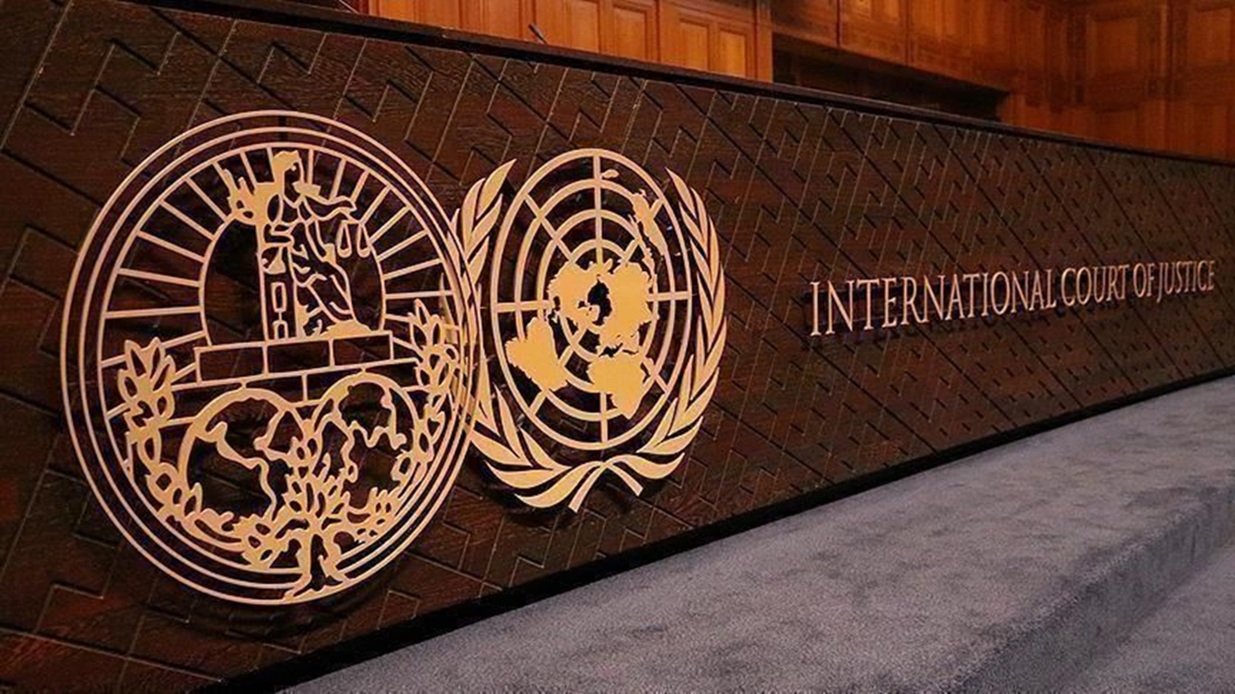
At the symbolic center of this architecture stands the International Court of Justice.
Established by the Charter of the United Nations and seated in The Hague, the ICJ is the principal judicial organ of the UN. All United Nations members are parties to the Statute of the Court, but this does not mean that the ICJ can automatically adjudicate every dispute between them.
This is one of the system's defining characteristics.
The Court's contentious jurisdiction rests on state consent. That consent may arise from a treaty, from declarations recognizing the Court's compulsory jurisdiction under certain conditions, or from a specific agreement to submit a particular dispute.
Once jurisdiction has been established, the Court can rule on some of the most sensitive questions in international relations: territorial sovereignty, maritime delimitation, treaty interpretation, state responsibility, diplomatic relations, the use of force and the application of international conventions.
Its judgments are binding on the parties to the case concerned.
The ICJ also exercises an advisory function. Certain United Nations organs and agencies can request advisory opinions on questions of international law. These opinions generally do not carry the same binding force as judgments in contentious cases, but their legal and political significance can be considerable.
The Court therefore embodies a profound transformation of international relations: two states can agree to have a dispute settled not by their respective power, but through law.
It also immediately exposes the limitations of that model.
The ICJ has no international bailiffs, no police force and no army capable of physically enforcing its decisions.
The Central Problem: Judging Is Not the Same as Enforcing
Within a state, judicial authority operates as part of an institutional apparatus capable of enforcing its decisions. A convicted person can be arrested. Assets can be seized. A company can be sanctioned. A judgment can ultimately be backed by public power.
At the international level, this coercive chain is considerably weaker.
Article 94 of the UN Charter provides that if one party fails to perform its obligations under an ICJ judgment, the other party may bring the matter before the Security Council. The Council may then make recommendations or decide upon measures to give effect to the judgment.
But at this point, law encounters geopolitics.
The five permanent members of the Security Council — China, France, Russia, the United Kingdom and the United States — possess veto power. When the interests of a major power or one of its close partners are directly involved, the institutional capacity to enforce a judicial outcome can therefore collide with the political structure of the international system itself.
This is not a peripheral malfunction.
It is one of the system's constitutive features.
International justice operates in a world where the legal equality of states coexists with profound inequalities of power.
The International Criminal Court: When the Individual Becomes Accountable
The International Criminal Court takes the logic that emerged after the Second World War considerably further.
The ICJ judges states. The ICC judges individuals.
Created by the Rome Statute, adopted in 1998 and entering into force in 2002, the ICC is an independent international organization, institutionally separate from the United Nations even though the two maintain close relations.
Its jurisdiction covers four categories of crimes: genocide, crimes against humanity, war crimes and the crime of aggression.
The historical rupture is considerable.
A head of state, minister, military commander or other individual falling within the Court's jurisdiction can, in principle, be held personally responsible. Official capacity does not automatically erase criminal responsibility before the Court.
But the ICC is not a universal criminal court.
Its jurisdiction depends on specific territorial, personal and temporal conditions. It may notably exercise jurisdiction when relevant crimes are committed on the territory of a state party to the Rome Statute or by one of its nationals. A non-party state may also accept the Court's jurisdiction over a particular situation. The UN Security Council can additionally refer certain situations to the Court.
The result is an uneven judicial geography.
Some states have fully joined the Rome system. Others have not. The United States, Russia, China and India — four major actors in international affairs — are not parties to the Rome Statute.
The universal ambition of international criminal justice therefore coexists with a jurisdiction whose actual reach remains legally fragmented.
A Court Without a Police Force
The contradiction becomes even clearer when an arrest warrant is issued.
The ICC has no international police force of its own capable of locating and arresting suspects. It depends overwhelmingly on cooperation from states.
An arrest warrant can therefore remain outstanding for years if the person concerned stays within territory where the authorities refuse, or are unable, to execute it.
This dependence fundamentally distinguishes international criminal justice from domestic criminal justice.
It also means that the political, diplomatic and military power of a state can indirectly affect the ability of the international judicial system to act against its leaders or nationals.
Law defines responsibility.
Politics often determines the material conditions under which that responsibility can be enforced.
Before the ICC: Tribunals Born from War and Atrocity
The ICC did not emerge from an institutional vacuum.
The International Military Tribunals at Nuremberg and Tokyo established early foundations for individual criminal responsibility under international law after the Second World War. Decades later, the wars in the former Yugoslavia and the genocide against the Tutsi in Rwanda led the UN Security Council to establish two ad hoc criminal tribunals: the International Criminal Tribunal for the former Yugoslavia and the International Criminal Tribunal for Rwanda.
Other institutional models followed.
So-called hybrid courts combined domestic and international law, as well as national and international judges. The Special Court for Sierra Leone, the Extraordinary Chambers in the Courts of Cambodia and the Kosovo Specialist Chambers illustrate attempts to develop judicial mechanisms tailored to particular historical and political circumstances.
The history of international criminal justice is therefore less the story of the linear construction of a single world court than a succession of institutional experiments.
The ICC represents the most ambitious attempt to make this form of justice permanent.
It has not, however, eliminated the need for other models.
International Justice Extends Far Beyond War
Reducing international justice to the ICJ and ICC would provide a deeply incomplete picture.
A considerable proportion of international disputes concern less dramatic but equally important questions affecting the functioning of the global economy and relations among states.
The law of the sea offers a major example.
The United Nations Convention on the Law of the Sea established a legal architecture governing territorial seas, exclusive economic zones, continental shelves and the exploitation of certain marine resources. The International Tribunal for the Law of the Sea, based in Hamburg, is one of the institutions responsible for resolving disputes in this field.
In a world where offshore resources, shipping routes and maritime boundaries have acquired growing strategic importance, determining where one maritime jurisdiction ends and another begins can carry enormous economic and geopolitical consequences.
International trade has also developed its own dispute-settlement mechanisms, particularly within the World Trade Organization. States can challenge trade measures adopted by other governments when they consider them inconsistent with multilateral agreements.
International investment has created yet another legal universe: investor-state arbitration. Thousands of bilateral and multilateral investment treaties contain mechanisms allowing companies or investors, under certain conditions, to challenge state measures before arbitral tribunals.
The International Centre for Settlement of Investment Disputes, an institution of the World Bank Group, occupies an important position within this architecture.
International justice is therefore not concerned solely with war and mass atrocities.
It also helps organize the movement of capital, maritime boundaries, investment and a significant part of global trade.
Regional Systems: When States Accept Greater Constraints
Some of the most advanced forms of supranational justice are found not at the global level, but at the regional one.
The European Court of Human Rights allows individuals, after exhausting domestic remedies and subject to the conditions established by the European Convention on Human Rights, to bring cases against their own states before an international court.
The Inter-American Court of Human Rights and the African Court on Human and Peoples' Rights participate, through different institutional arrangements, in a comparable regional logic of rights protection.
Europe has gone further still through the Court of Justice of the European Union.
The CJEU is not merely a conventional international tribunal. It belongs to a supranational legal order in which European Union law produces extensive effects within national legal systems and, within its field of application, operates under a principle of primacy.
This experience demonstrates that international justice becomes considerably more powerful when states agree to transfer substantial competences to common institutions.
But that degree of integration remains exceptional at the global level.
A Justice System Accused of Choosing Its Defendants
International justice also faces a recurring political criticism: selectivity.
Not every war leads to international prosecution. Not every crime produces the same degree of institutional mobilization. Not every government is exposed to identical judicial mechanisms.
Some of these differences arise from the law itself: different jurisdictions, membership or non-membership in treaties, dates of entry into force, jurisdictional requirements and the principle of complementarity with domestic courts.
But law alone cannot explain every asymmetry.
A state's ability to resist international judicial pressure also depends on its military, economic and diplomatic power, its alliances and its position within international institutions.
This tension is particularly visible in the Security Council. Three of its five permanent members — the United States, Russia and China — are not parties to the Rome Statute, even though the Council can, under certain circumstances, refer situations to the ICC.
The global architecture can therefore appear to embody a justice system aspiring to universality while remaining embedded in a distribution of power inherited from 1945.
This contradiction repeatedly fuels accusations of double standards.
It does not mean that international law is nonexistent. It means that international law operates within a political environment from which it cannot entirely escape.
Why, Then, Do States Agree to Be Judged?
The question may seem obvious: if international justice restricts sovereignty, why did states create these institutions in the first place?
Because law also produces power, predictability and security.
A small state will rarely possess the military capacity to impose its preferred maritime boundary on a much larger power. Judicial proceedings can provide an arena in which legal argument carries greater weight than raw coercive capacity.
Major powers themselves benefit from having parts of international relations governed by predictable rules. Trade, investment, borders, maritime transportation and diplomatic relations would become considerably more costly if every disagreement had to be settled exclusively through coercion.
International law therefore reduces a measure of uncertainty.
It also allows governments to transform some political conflicts into legal disputes, strengthen the legitimacy of their positions, stabilize compromises and sometimes exit confrontations without appearing to have directly capitulated to an adversary.
International justice is consequently not merely a constraint imposed upon states.
It is also an instrument they use.
Law Does Not Abolish Power
It is tempting to oppose two visions of international affairs.
In the first, international law has gradually replaced power politics. In the second, law is little more than an institutional façade behind which states continue pursuing their interests.
Reality is more complicated.
International law genuinely changes state behavior. Borders have been determined by judicial decisions. Governments have paid reparations. Political and military leaders have been arrested, transferred, tried and convicted by international tribunals. Domestic legislation has been amended following decisions by regional courts. Investors have won or lost billions through international arbitration.
These institutions therefore produce real consequences.
But they operate in an environment where no global authority possesses a monopoly on legitimate coercion.
That is probably the fundamental distinction between domestic and international law.
Within a state, public power theoretically stands behind the judge.
In the international system, the judge must often coexist with power.
A Legal Order Without a Sovereign
International justice therefore constitutes one of the most unusual political experiments of the modern era.
States have constructed institutions capable of imposing certain legal obligations upon them without creating a world state. They have recognized that some crimes can engage the personal responsibility of their leaders without accepting a universal criminal jurisdiction. They have developed sophisticated mechanisms for settling disputes while preserving the principle of sovereignty that simultaneously limits those mechanisms.
The result is neither a fully integrated world judiciary nor a mere diplomatic fiction.
It is a legal order without a sovereign.
Its strength comes from the accumulation of treaties, precedents, institutions, interstate cooperation and the legitimacy that governments continue to accord to law.
Its weakness becomes visible when that cooperation disappears.
As the international system becomes more contested, this contradiction grows increasingly apparent. The same states that invoke international law in one dispute may contest its interpretation in another. Judicial institutions must defend their independence while operating amid geopolitical rivalries they cannot control.
The real question, therefore, may no longer be whether international justice exists.
It does.
The question is how universal justice can become in a world that remains politically anything but universal.
Main Sources
United Nations — Charter of the United Nations; Statute of the International Court of Justice; documentation concerning the peaceful settlement of disputes and the UN Security Council.
International Court of Justice (ICJ) — Statute, contentious and advisory jurisdiction, case law and institutional documentation.
International Criminal Court (ICC) — Rome Statute, core legal texts, jurisdiction, complementarity and documentation concerning state cooperation.
United Nations — International Law — Convention on the Prevention and Punishment of the Crime of Genocide; Geneva Conventions and the development of international humanitarian law.
International Tribunal for the Law of the Sea (ITLOS) — United Nations Convention on the Law of the Sea and institutional documentation concerning maritime dispute settlement.
World Trade Organization (WTO) — WTO agreements and dispute-settlement framework.
International Centre for Settlement of Investment Disputes (ICSID) — ICSID Convention, procedural rules and institutional data on investor-state arbitration.
European Court of Human Rights (ECtHR) — European Convention on Human Rights, jurisdiction and mechanisms for the execution of judgments.
Inter-American Court of Human Rights — American Convention on Human Rights and institutional documentation.
African Court on Human and Peoples' Rights — Protocol establishing the Court and institutional documentation.
Court of Justice of the European Union (CJEU) — European Union treaties and case law concerning the direct effect and primacy of EU law.
International Residual Mechanism for Criminal Tribunals — archives and institutional legacy of the international criminal tribunals for the former Yugoslavia and Rwanda.
Atlas Limits Research Desk
Atlas Limits’ editorial and analytical desk.